 English
 français
 Deutsch
 español
 italiano
 português














29/04/2023
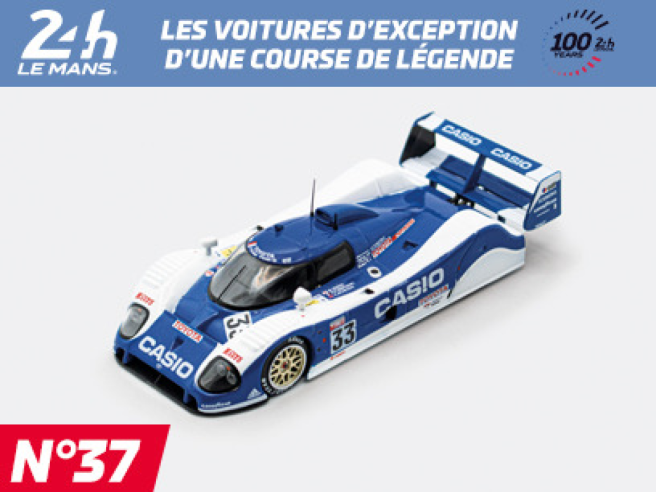
Toyota TS 10 - 1992
Les mythes du Mans Toyota TS 10
Author : Cette collection est une adaptation de 24H Le Mans ® Le auto delle corsa più leggendaria al mondo Éditeur : Centauria Editore s.r.l.
Read moreAfter many years of disappointing results in Group C, Toyota capitalised on the 1991 rule changes to relaunch itself with the TS 10, which was designed according to the new parameters and fitted with a brand new 3.5-litre naturally aspirated V10 engine. This new model came close to success at Le Mans, finishing second behind the unbeatable Peugeot 905.
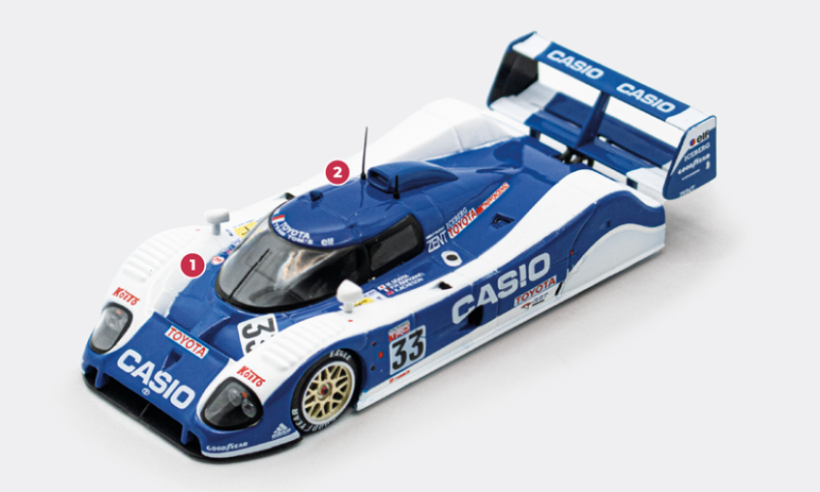
1. The water and oil radiators are installed in the front end to balance the weight distribution. The flanks therefore do not feature large air intakes.
2. The engine is fed air through the dynamic air intake positioned above the passenger compartment.
© IXO Collections SAS - Tous droits réservés.
The new FIA rules to limit the performance of C1 prototypes affected both the general characteristics of the car and those of the engines. By introducing a naturally aspirated engine limited to 3.5 litres with no other means of limiting fuel consumption and a minimum weight of 750 kg, they favoured the C2 category, as demonstrated at Le Mans in 1991 with the victory of the Mazda 787B and the subsequent finish of ten other C2 cars. That result partially facilitated the development of the TS 10, yet in order to play it safe, the Toyota team enlisted the help of a European designer, Tony Southgate from the UK, who had designed the Jaguar-TWR cars that won the 24 Hours of Le Mans in 1988 and 1990. Unlike its competitors, the Japanese brand decided against supercharged engines and opted for a V10 that it had to develop entirely from scratch, while competitors such as Ferrari and Ford already had this type of engine, the type used in Formula 1. Taking inspiration from Maranello, the Japanese engineers designed an engine with five valves per cylinder.
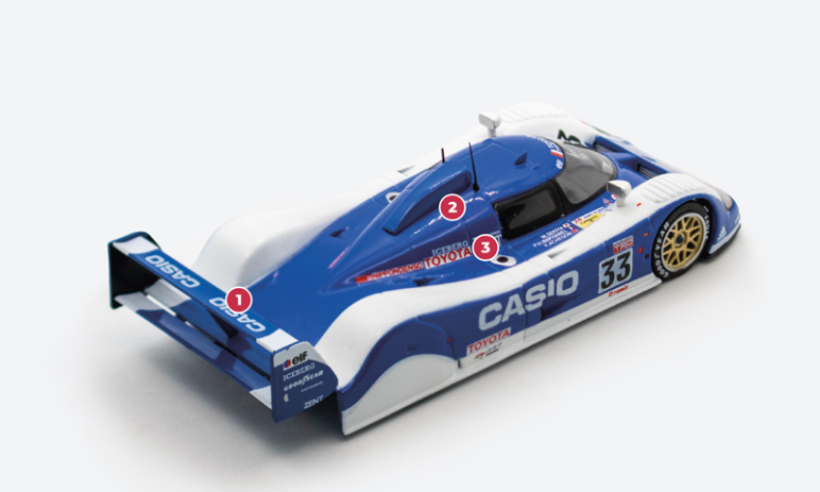
1. The bi-plane rear wing is designed to increase the efficiency of the rear extractor.
2. The 10-cylinder 3.5-litre engine developed by Toyota for the TS 10 has two cylinder banks in a 72° V configuration. Capable of delivering 700 hp, it is limited to 600 hp for endurance races.
3. The carbon fibre body carries the engine and transmission assembly directly.
© IXO Collections SAS - Tous droits réservés.
In its planned debut at the Japanese Autopolis circuit, where the final stage of the 1991 World Sportscar Championship was held, the TS 10 finished sixth, demonstrating its overall quality, something Toyota would build on the following winter in preparation for the 1992 season. The season began with the 500 km of Monza, where the major manufacturers such as Peugeot, Lola and Mazda, who were still active after the withdrawal of Mercedes and Jaguar, fielded their new Sport-Proto cars, but achieved disappointing results, as few cars made it to the finish line due to various technical problems. With two cars in the race, Toyota managed to win, mainly thanks to the performance of drivers Geoff Lees and Hitoshi Ogawa. The Peugeot 905, which was considered the fastest car, had to retire, but made up for it in the next race at Silverstone, where once again very few cars made it to the finish line; this time, none of the Toyotas made it to the finish line. At the 24 Hours of Le Mans, the third race of the championship, it was clear that the battle would be between the French and Japanese teams, who shared the starting grid (with two Peugeots, three Toyotas and a third Peugeot in sixth place), even though this ranking was the result of a strategy using optimised spare chassis for qualifying.
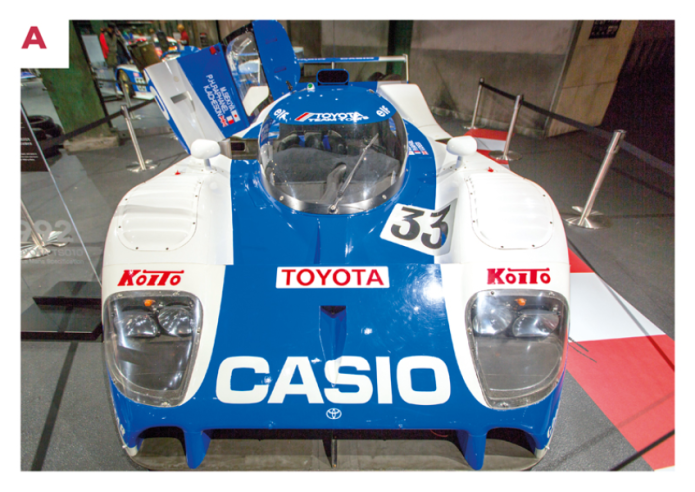
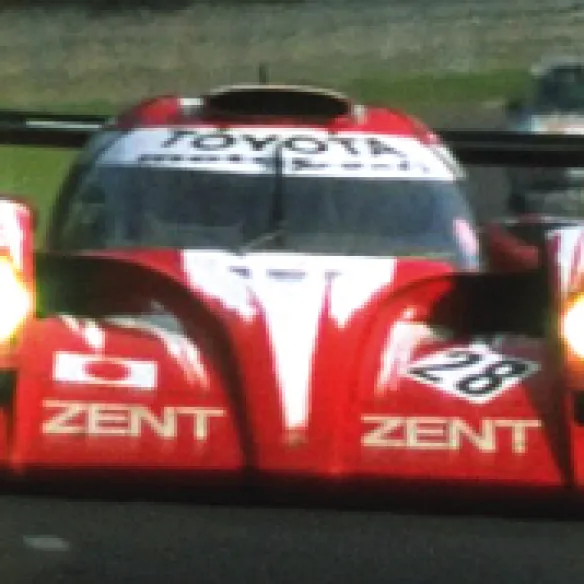
A. The three cars entered by Toyota Team Tom's were in different liveries. The blue and white car that finished second was sponsored by Casio. The others were white and red, and white and light blue, carrying the Nippondenso and Zent logos. © IXO Collections SAS - Tous droits réservés.
Only Mazda caused concern for the frontrunners during the race, taking the lead temporarily. Peugeot rapidly retook the lead, at times with two cars, but a 905 Evo encountered technical problems and lost ground, allowing the Toyota driven by Masanori Sekiya, Pierre-Henri Raphanel and Kenny Acheson to reclaim its position. They finished second, six laps behind the 905 Evo 1 Bis with Derek Warwick, Yannick Dalmas and Mark Blundle, and one lap ahead of the Peugeot with Mauro Baldi, Philippe Alliot and Jean-Pierre Jabouille.
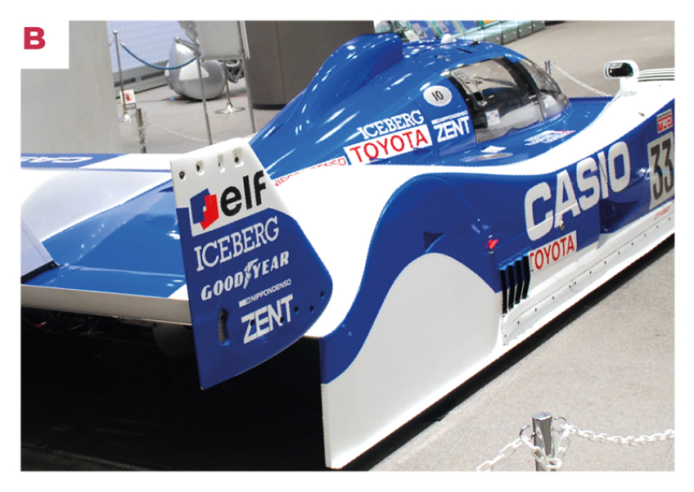
B. The Southgate engineering style is evident, as on the Jaguar-TWR, on the rear wheel fairings, which improve aerodynamics. © IXO Collections SAS - Tous droits réservés.
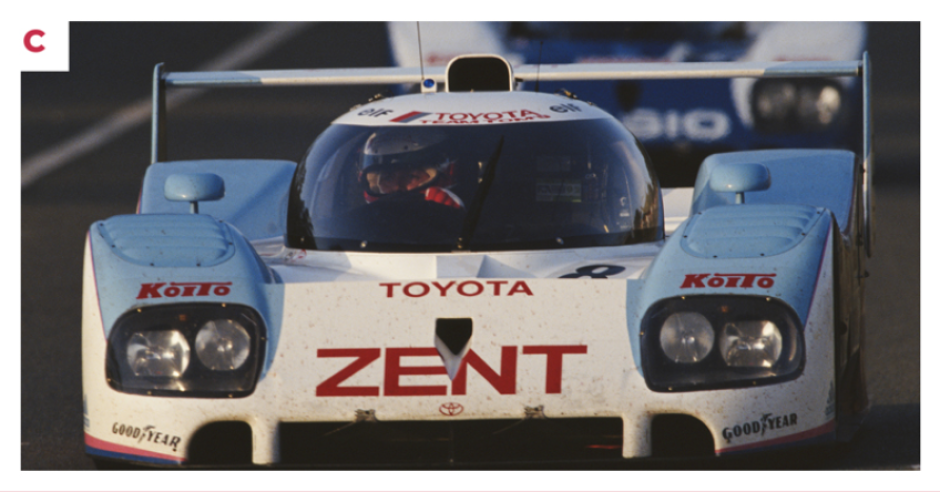
C. The No. 8 Toyota TS 10 driven by Jan Lammers, Andy Wallace and Teo Fabi finished eighth at Le Mans in 1992. © IXO Collections SAS - Tous droits réservés.
Recent articles