 English
 français
 Deutsch
 español
 italiano
 português













30/01/2026
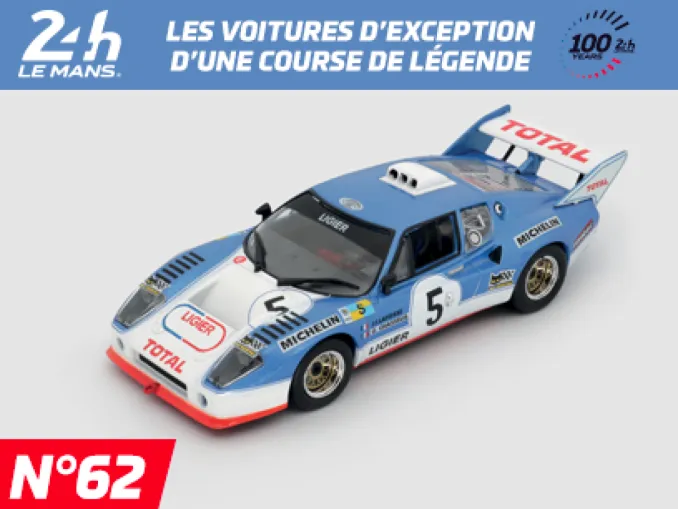
Ligier JS2 – 1975
Ligier JS2
Compared to the JS1, Guy Ligier's second creation, the JS2, was designed as a sporty road car suitable for racing, but its capabilities were limited by the poor reliability of the original Citroën-Maserati engine. Situations improved in 1975, its final year, with the arrival of the well-known Cosworth DFV, allowing it to come close to victory at Le Mans.
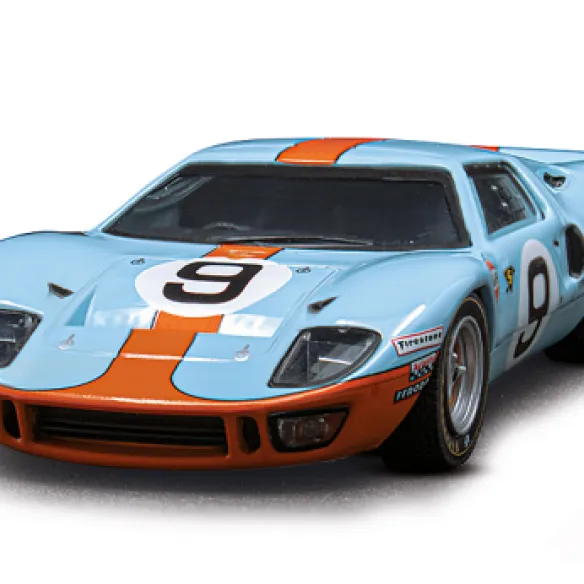
That year's 24 Hours of Le Mans was marked by the challenge between two small manufacturers, Ligier and Gulf-Mirage, with two cars equipped with the same engine. Named after its sponsor, the Gulf Mirage Ford Cosworth emerged in 1967 from the ashes of Ford Advanced Vehicles, the British division of Ford USA that was responsible for the GT40, taken over by John Wyer and John Willment. Initially, they developed the same GT40s, now renamed Mirage-Ford M1, M2 and M3, leading them to victory with the JW Automotive Engineering team during the 1968 and 1969 editions of the 24 Hours of Le Mans, after which they began working on new prototypes equipped with different engines.
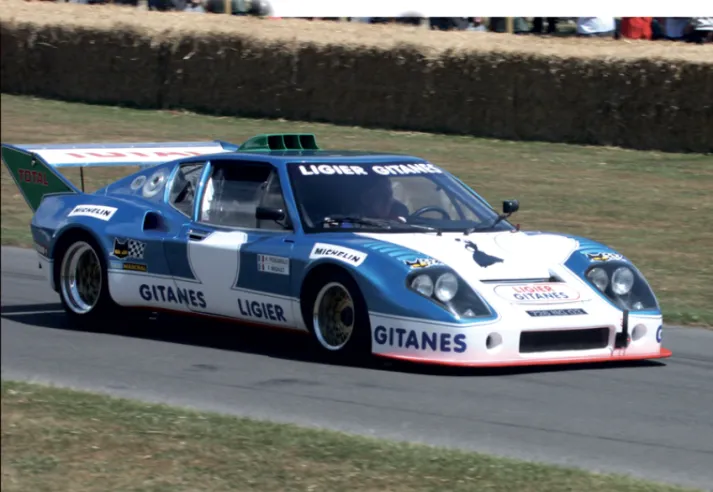
The white and blue livery of the JS2, launched in 1974, replaced BP's yellow and green livery, though the Ligier team only became sponsored by Gitanes and Total in 1975.© IXO Collections SAS - Tous droits réservés.
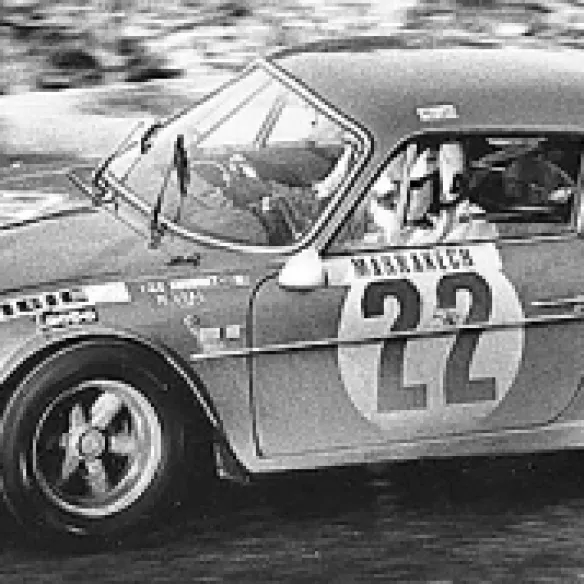
Ligier's story dates back to around the same period. Following the accidental death of his friend Jo Schlesser, former rugby player and racing driver Guy Ligier withdrew from competition in 1968 to launch his own car manufacturing business. His first car, the JS1, was launched in 1969, its name paying tribute to Schlesser by using his initials. Only a few units were produced, including one for racing, participating in events in 1969 and 1970. The car served as the basis for the JS2, manufactured from 1971 onwards, which led to a competition-derived model. Guy Ligier was keen to use Ford Cosworth engines, but these were refused for fear of competition with models such as the Ford GT70. Ligier secured the support of Citroën, the company that had taken control of Maserati, providing him with the SM's engine: a 2.7-litre V6 upgraded to 3 litres, delivering 330 hp. The JS2 (which Ligier, giving up his retirement, drove in several races until 1974) failed to perform satisfactory despite a major aerodynamic revamp in 1973. In its first seasons, it suffered numerous retirements, often due to engine unreliability, scoring only a few placings. The first successes came in March 1974, when Guy Chasseuil won the 4 Hours of Le Mans, a short race completing the spring testing weekend at the Sarthe circuit. At the end of the year, two JS2s triumphed in the Tour de France Automobile.
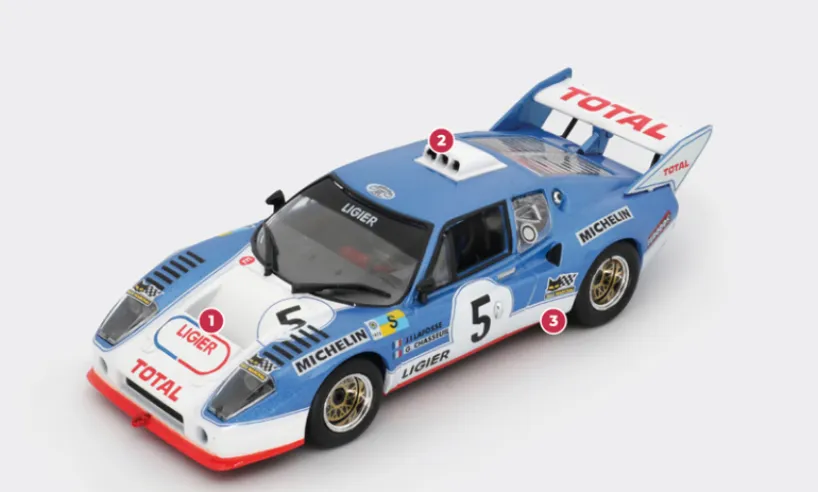
1. Compared to the road version, the JS2 racing car has a longer body and larger aerodynamic appendages.
2. On the roof, a three-inlet periscopic scoop is used to cool the engine compartment.
3. The bodywork, designed by Frua and made of resin and fibreglass, was improved aerodynamically in 1973 thanks a collaboration with Citroën, which also supplied the engine.© IXO Collections SAS - Tous droits réservés.
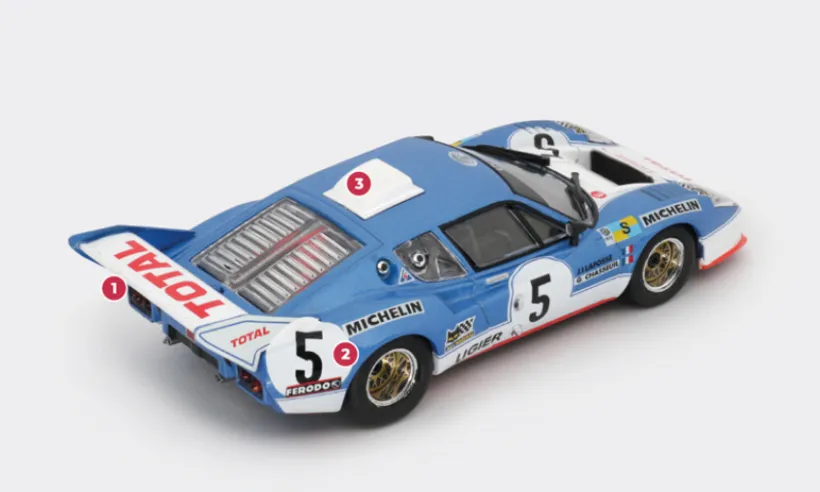
1. The rear wing has an adjustable element held in place by two additional supports.
2. The Ligier JS2 racing version has the same monocoque chassis as the road version, but it is made of aluminium instead of steel.
3. The 3-litre Cosworth DFV V8 engine produces a maximum output of 460 bhp, 130 more than the original Maserati V6 engine used before 1975.© IXO Collections SAS - Tous droits réservés.
Finally, in 1975, Ligier was able to use Ford Cosworth DFV engines, widely used in Formula 1 and endurance racing, and with these he achieved seventh place in the 1000 km Mugello race and sixth place in the 800 km Dijon race, a preparatory event for the 24 Hours of Le Mans, still the main objective for the season. On this occasion, two of the three cars dropped out, but the third, driven by Guy Chasseuil and Jean-Louis Lafosse, embarked on an exciting duel with the Gulf-Mirage GR8, a duel that was also fought over the length of pit stops as both cars experienced technical problems. Ultimately, the battle was won by rivals Jacky Ickx and Derek Bell, who finished less than a lap ahead of the JS2, while the other Gulf GR8, with Vern Schuppan and Jean-Pierre Jaussaud at the wheel, came in third.
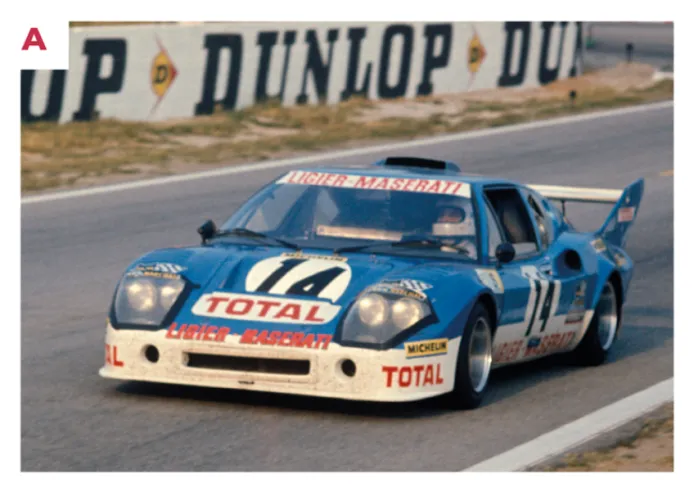
A. One of Ligier's two Citroën-Maserati-powered JS2s at the 1974 Le Mans 24 Hours. Driven by Guy Chasseuil and Michel Leclère, the car was forced to retire due to valve problems.© IXO Collections SAS - Tous droits réservés.
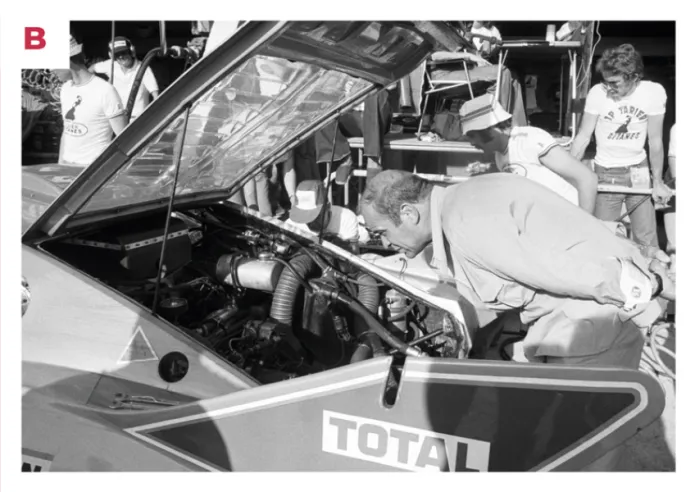
B. Guy Ligier inspects the engine of the JS2, which was revamped for the 1975 Le Mans 24 Hours.© IXO Collections SAS - Tous droits réservés.
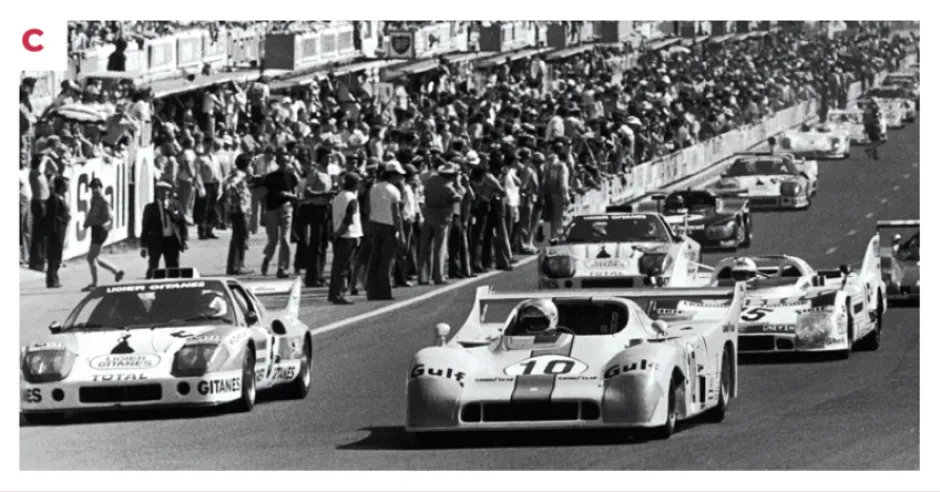
C. Start of the 1975 Le Mans 24 Hours. From left to right, the Ligier JS2 driven by Chasseuil/Lafosse and the Mirage/Gulf GR8 driven by Schuppan/Jaussaud. Both powered by Cosworth engines, they finished 2nd and 3rd behind the Mirage of Jacky Ickx and Derek Bell.© IXO Collections SAS - Tous droits réservés.
Recent articles