 English
 français
 Deutsch
 español
 italiano
 português















23/01/2026
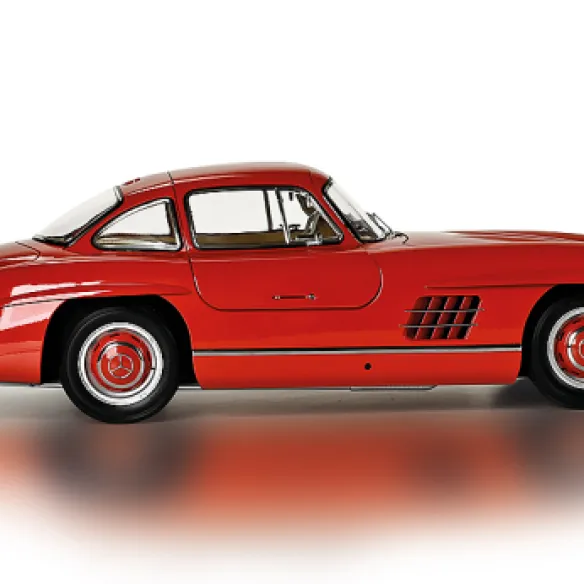
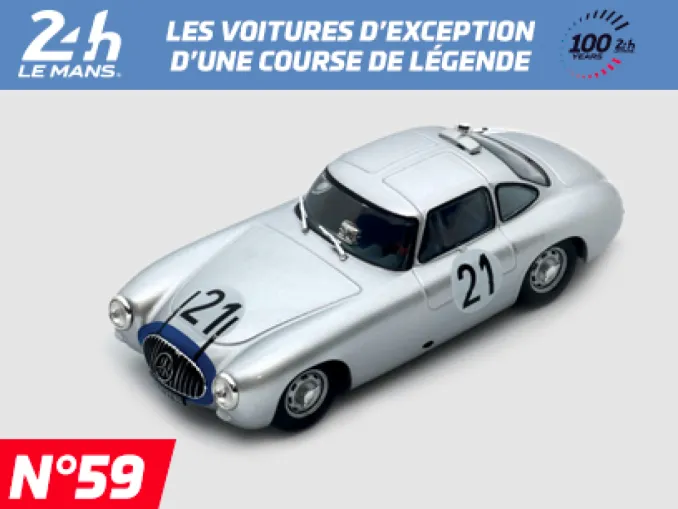
Mercedes-Benz 300SL – 1952
Mercedes-Benz 300SL
With such a long history in the automotive industry, it's hard to believe that Mercedes is not one of the most successful brands in motorsport. Mercedes' victories can be counted on one hand. Its only victory at the 24 Hours of Le Mans took place on 15 June 1952, with the ‘W194’, a six-cylinder sports coupé most commonly known as the 300 SL.
The W194 emerged from a project that marked Mercedes' return to competition after a difficult period following the Second World War. This relaunch was a success. Based on a tubular trellis frame, it was equipped with a 3-litre engine derived from the large 300 models, explaining its official name ‘300 SL’ for Sport Leicht (German for ‘Light Sport’). The car proved to be agile and fast. It made its debut at the 1952 Mille Miglia in May, where the official Daimler team entered four cars plus one reserve, entrusted to a team of drivers comprising renowned names such as Hermann Lang and Rudolf Caracciola. However, the best-performing 300 SL was that of Karl Kling and Hans Klenk, finishing second behind the Ferrari 250 with Giovanni Bracco and Alfonso Rolfo. Two weeks later, the team made up for this at the Bern Grand Prix, where the 300 SLs finished first, second and third ahead of Aston Martin, Lancia and Ferrari.
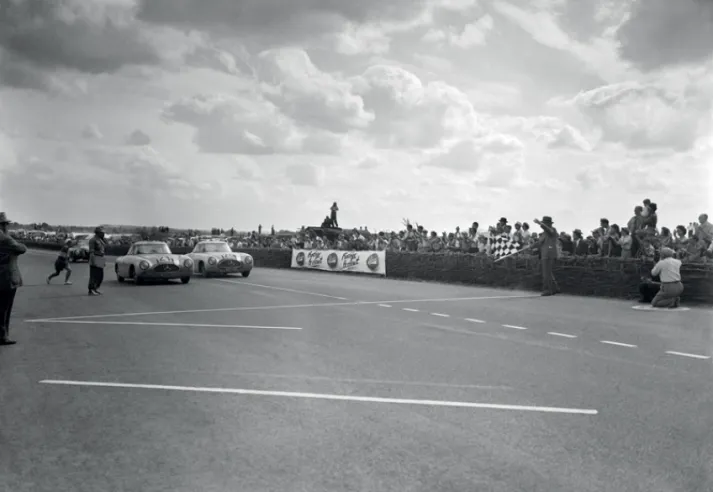
15 June 1952: two W194s finished first and second in the 24 Hours of Le Mans, giving Mercedes its first victory at the Sarthe circuit.© IXO Collections SAS - Tous droits réservés.
Their next race was the 24 Hours of Le Mans. There, the German coupé shifted from underdog to favourite: three cars started the race, but only one, with Kling and Klenk at the wheel, failed to finish due to an electrical fault. The other two cars dominated the race and took first and second place, with Hermann Lang and Fritz Riess in the No. 21 car and Theo Helfrich and Helmut Niedermayr in the No. 20 car, which was only one lap behind. The advantage was even more significant when compared to the competition: the third-placed Nash-Healey, entered by Donald Healey for the higher 5-litre category, completed the race 15 laps behind despite its engine size advantage, whilst Briggs Cunningham's V8 and Luigi Chinetti's Ferrari 340 Vignale followed even further behind.
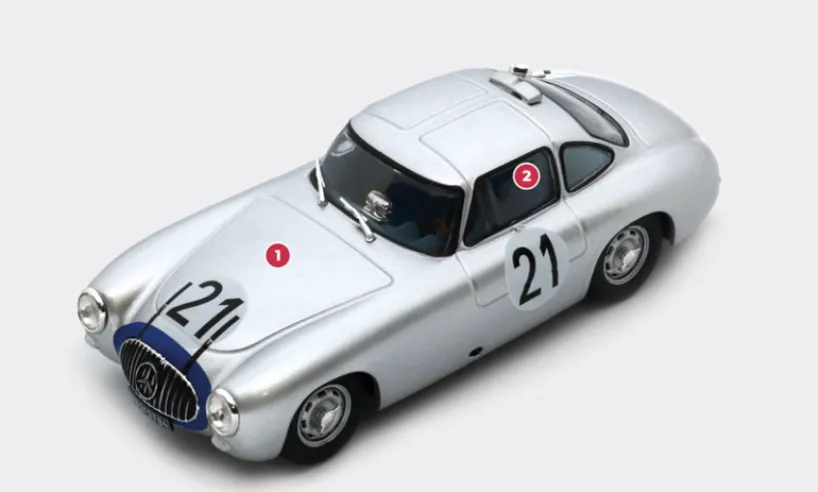
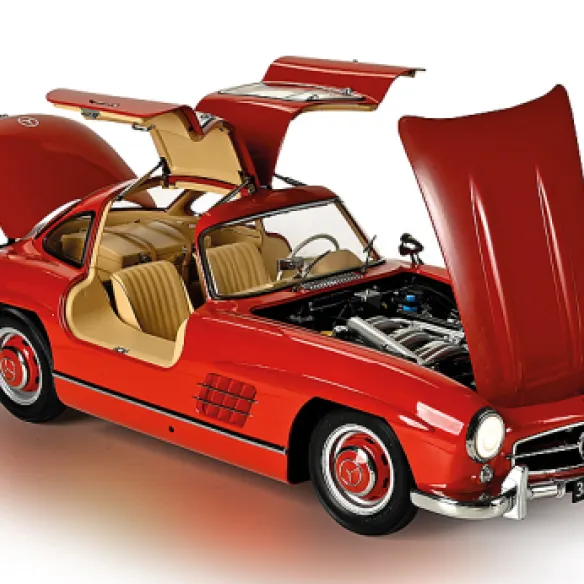
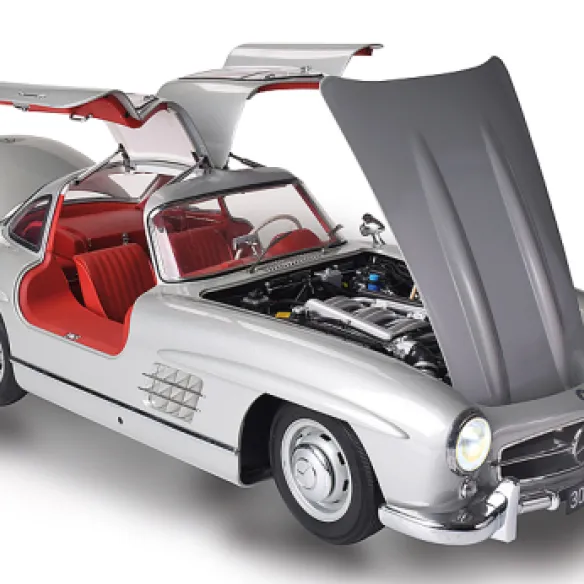
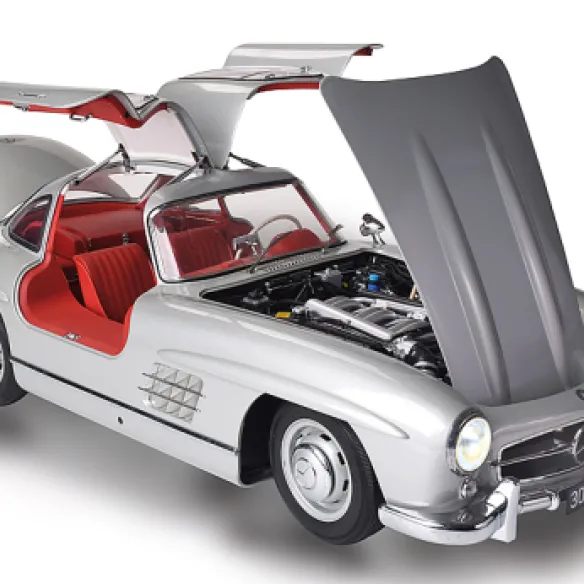
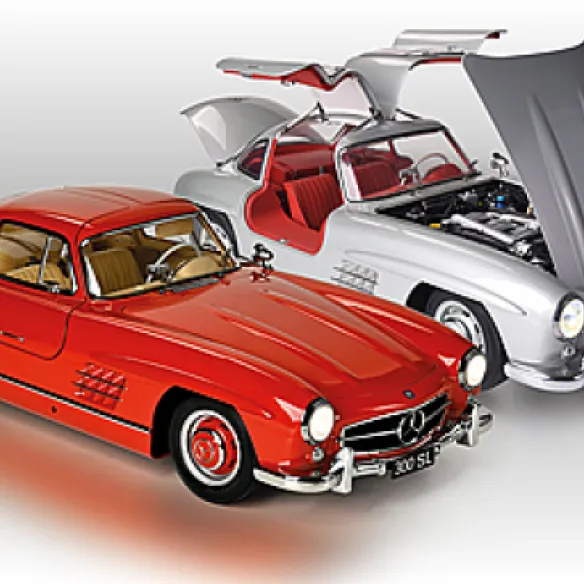
1. The 3-litre six-cylinder engine is tilted 50° to the left to lower that top line of the bonnet, a feature retained on the street-version SL.
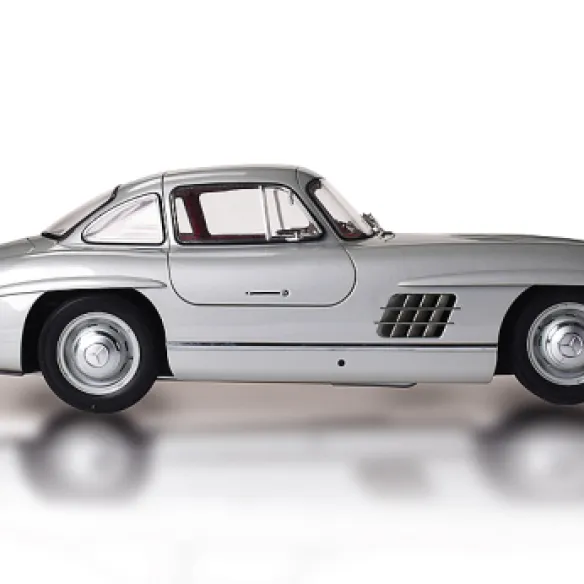
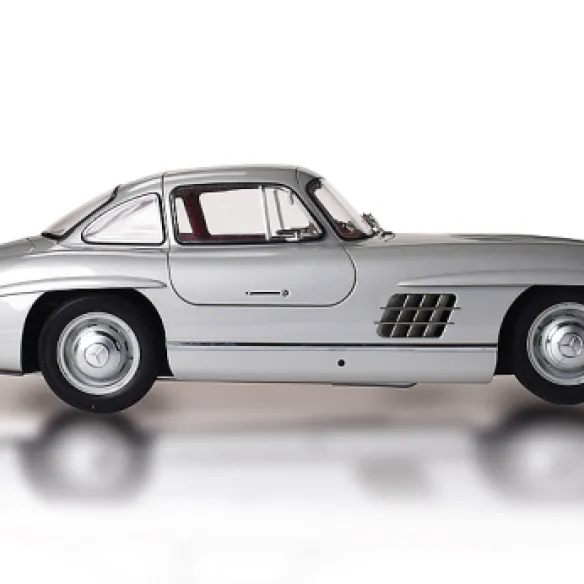
2. On early cars, the opening section providing access to the passenger compartment included part of the roof and the glazing. This opening was then extended to part of the side, taking on the shape known as a ‘butterfly’ or ‘gull wing’.© IXO Collections SAS - Tous droits réservés.
This made the 300 SL the car everyone wanted to beat. At the Nürburgring Grand Prix, the Mercedes team of Lang, Kling, Riess and Helfrich once again took the top four positions. The ultimate triumph came at the Carrera Panamericana, a tough and dangerous road race across Mexico, where Kling and Klenk won again, followed by Lang and Erwin Grupp. Although this season appeared to mark the beginning of a long and triumphant sporting career, Mercedes decided to withdraw its star asset and replaced it with an even more competitive car, the 300 SLR (W196), only to debut in 1955.
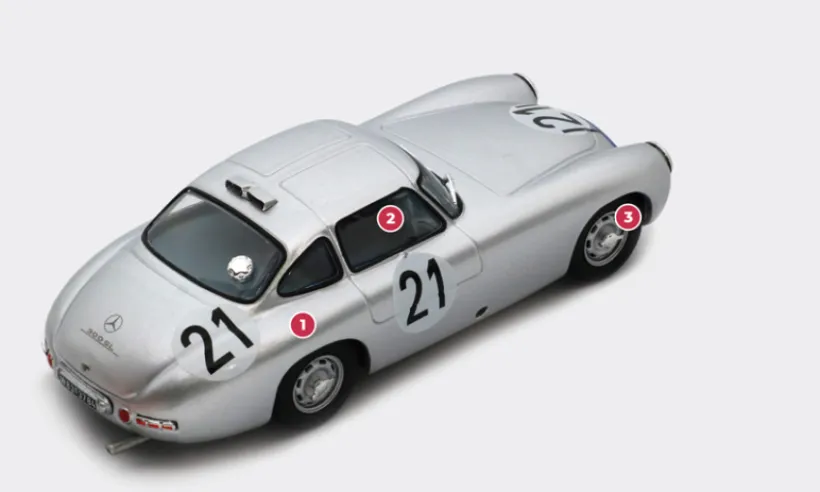
1. The tubular trellis structure that forms the chassis of the 1952 300 SL is very rigid, weighing just 50 kg. The car weighs no more than 900 kg, with the engine accounting for 265 kg.
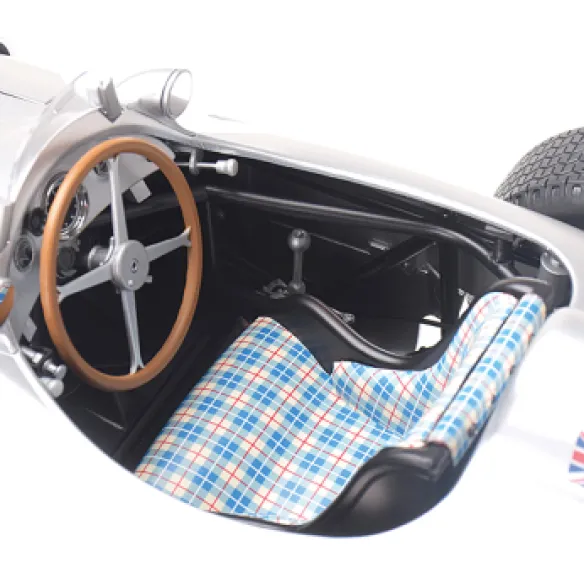
2. For a racing model, the W194's instrument panel is quite extensive. The comfortable seats are upholstered in an original tartan fabric. The steering wheel can be removed to facilitate access to the car.
3. The steel wheels are secured with a single central wing nut, Rudge type.© IXO Collections SAS - Tous droits réservés.
Under the leadership of American importer Max Hoffman, the victories of the W194 encouraged the brand to launch a road version also called the 300 SL, but coded W198, featuring many of the characteristics of the racing model, including the gull-wing doors. However, this was a completely new car, acclaimed as the beginning of the prolonged Mercedes SL dynasty.
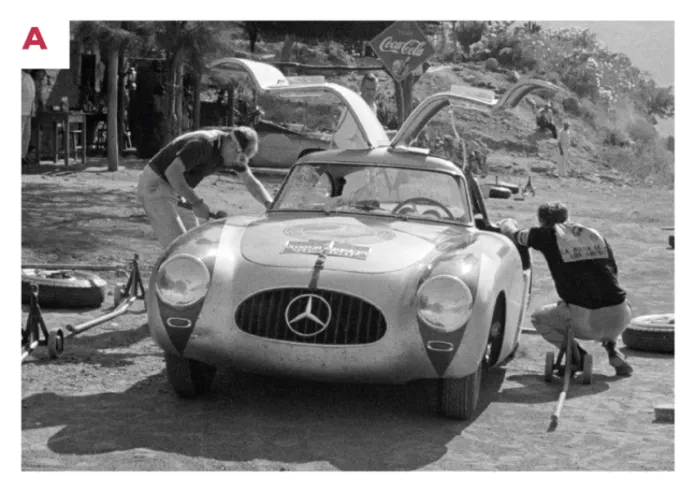
A. The W194 driven by Karl Kling and Hans Klenk during a pit stop to repair the windscreen during the 1952 Carrera Panamericana, in which they were victorious.© IXO Collections SAS - Tous droits réservés.
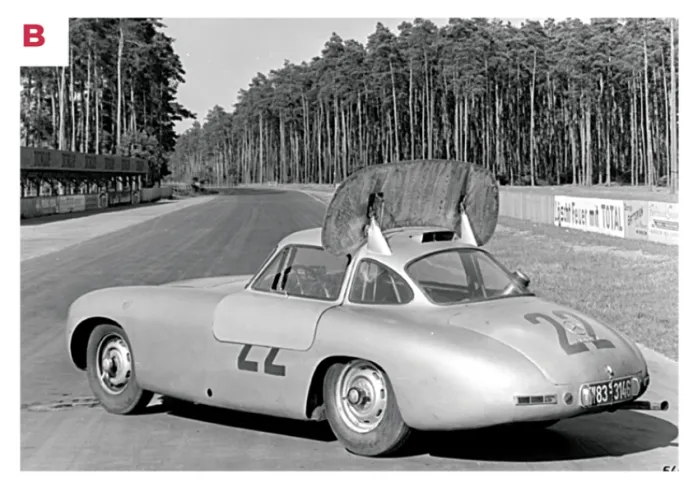
B. During free practice for the 24 Hours of Le Mans, Mercedes tested a movable spoiler mounted on the roof to act as an aerodynamic brake, but it was not used in the race.© IXO Collections SAS - Tous droits réservés.
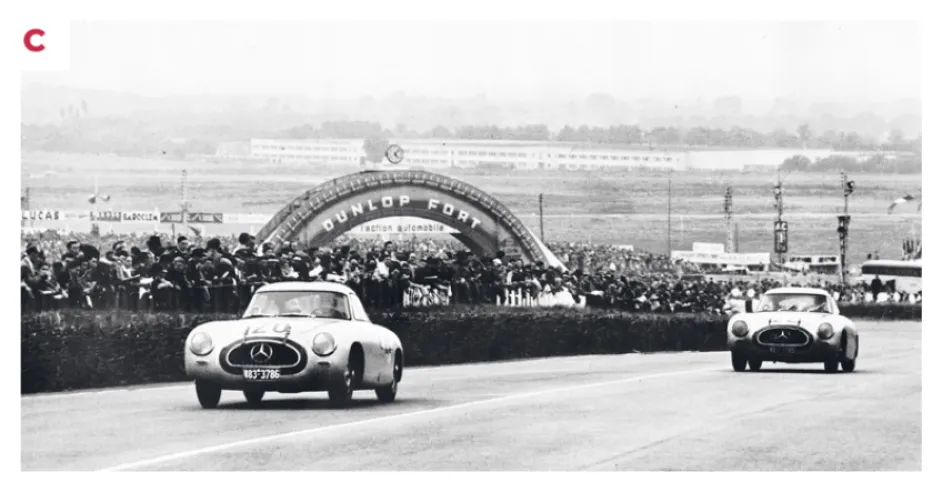
C.Two of the three W194s that competed in the 1952 24 Hours of Le Mans. The car on the right, with number 22, was the only one which did not finish the race.© IXO Collections SAS - Tous droits réservés.
Recent articles