 English
 français
 Deutsch
 español
 italiano
 português













19/04/2026
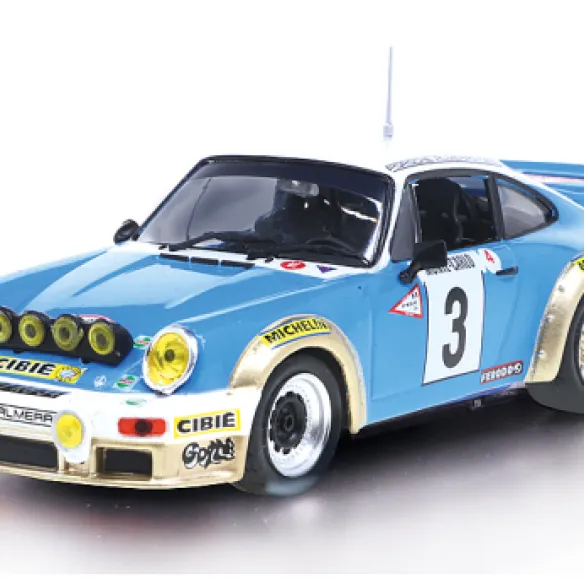
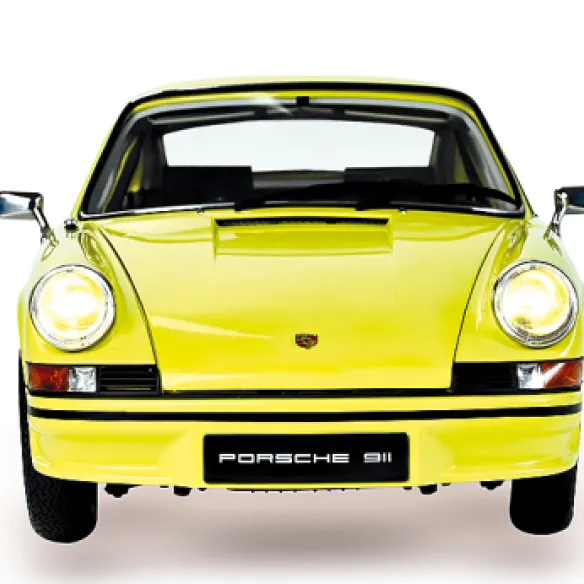
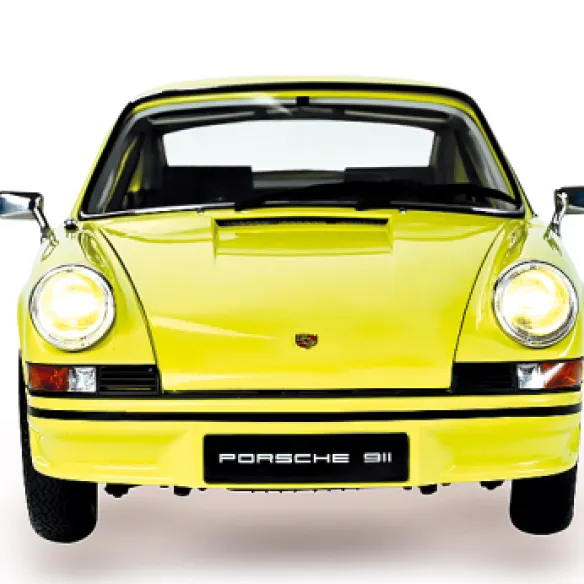
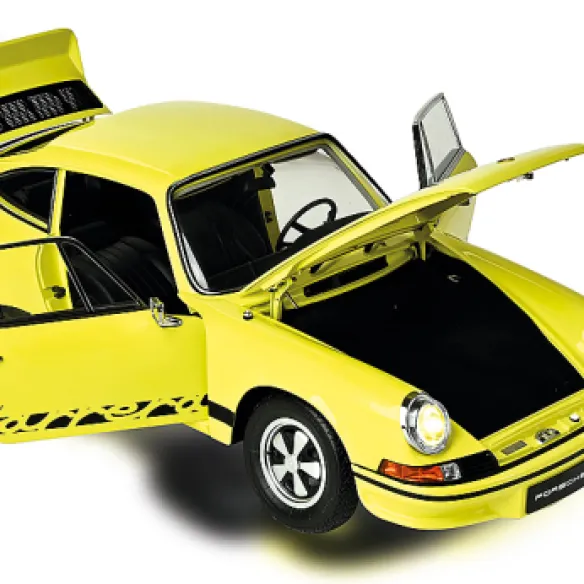
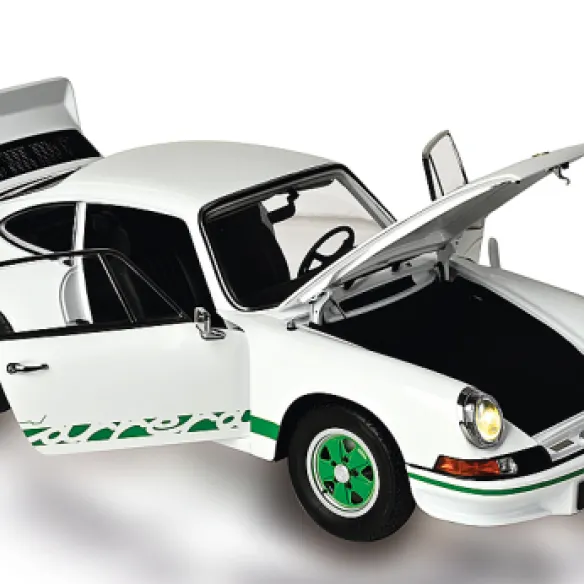
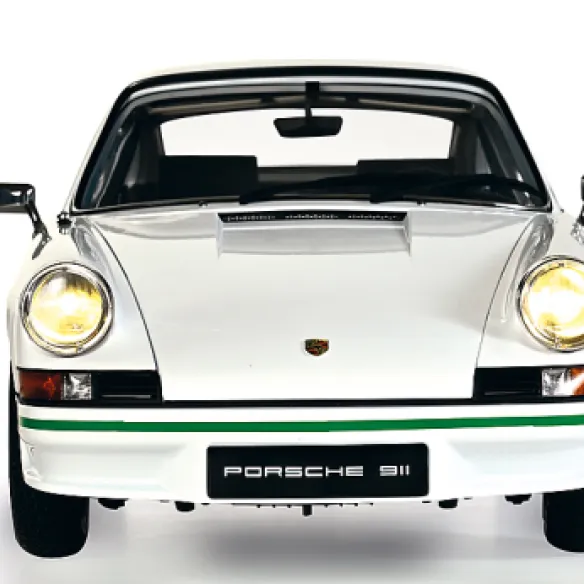
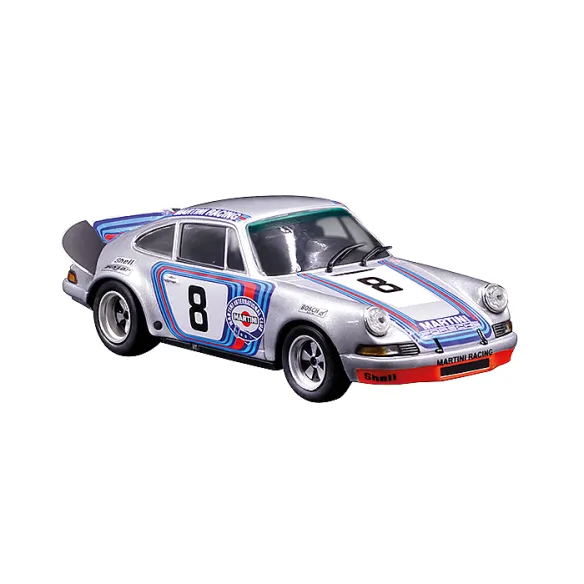
Porsche 911S - 1970
Porsche 911S
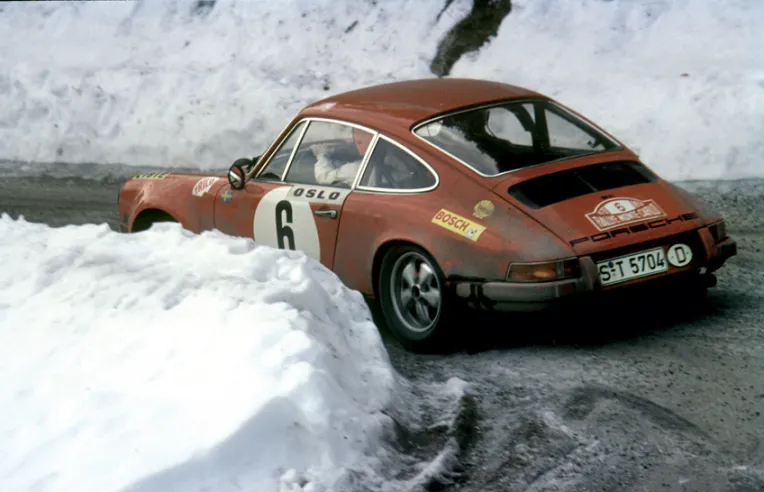
This 911 racing car dominated the world rally championship from its very first event, the monte carlo rally, with swedish driver Björn Waldegåård taking the win.
Throughout its first twenty years of operation, Porsche focused primarily on circuit and hill climb racing, creating cars designed for these specialities, such as the 550 and 718, which also performed well in tougher conditions, for example on the tracks of the Carrera Panamericana. However, a number of customers began to use the 356 and its successor, the 911, successfully in rallying. At the end of the 1960s, following the arrival of an all-new 2.2-litre 911, the company decided to push the car's potential to the limit. As a result, a revised version of the top-of-the-range model, the 911S, was released and entered into the inaugural World Rally Championship.
© IXO Collections SAS - Tous droits réservés.
IT DELIVERED PORSCHE'S FIRST ‘WORLD’ RALLY TITLE
The 911's first rally successes came shortly after its commercial debut, with Herbert Linge and Peter Falk finishing fifth in the 1965 Monte Carlo Rally in a highly tuned series S model. During the following years, the L, T and S versions won, among others, the 1968 and 1969 Monte Carlo rallies, two rallies in Germany, one in San Remo and two in Sweden.
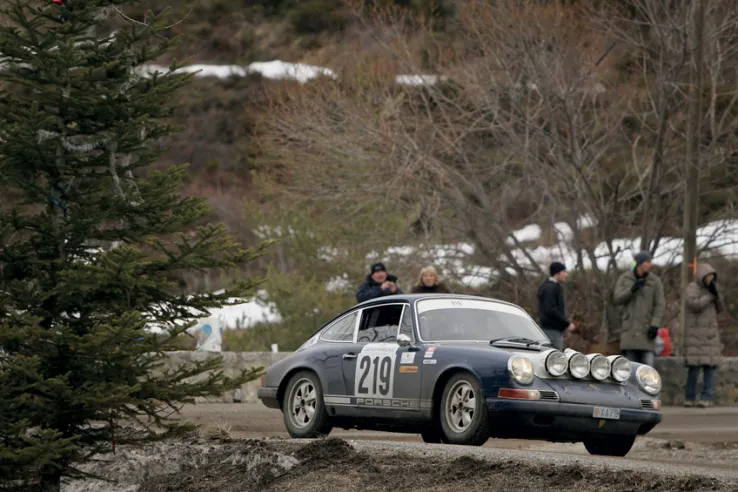
A Porsche 911 S 2.2 from the early 1970s participating in the 2009 Monte Carlo Historic Rally.© IXO Collections SAS - Tous droits réservés.
ARRIVAL OF THE ‘S’ IN THE RACES
The 1970 model of the 911, characterised by an increase in engine capacity to 2.2 litres, made its debut in the same year that the International Manufacturers' Championship was launched, where the title was exclusively reserved for manufacturers during the first three years. (The modern name WRC – World Rally Championship – was adopted in 1973.) Porsche officially entered this new competition and prepared a special version of the new 911 S, referred to internally as the “S/T”, which was improved and lighter than the standard road car. The championship consisted of seven events. Points were awarded to the first six cars (9 for 1st, 6 for 2nd and then 4 to 1 for the next four). Porsche engaged Swedish driver Björn Waldegård (copiloted by his compatriot Lars Helmér) as its official driver. Waldegård took his second consecutive Monte Carlo victory, giving the car a successful debut and Porsche its first points in the standings. Behind him came another 911 S with Frenchmen Gérard Larrousse and Maurice Gélin at the wheel, while a third car, entrusted to another Swedish crew (Åke Andersson and Bo Thorszelius), finished fourth. However, points were only awarded to the first official car. To this success, Waldegård added a ‘home’ victory in the Rally Sweden and, after skipping San Remo and Kenya, he won the Austrian Alps Rally, consolidating Porsche's first place in classification.
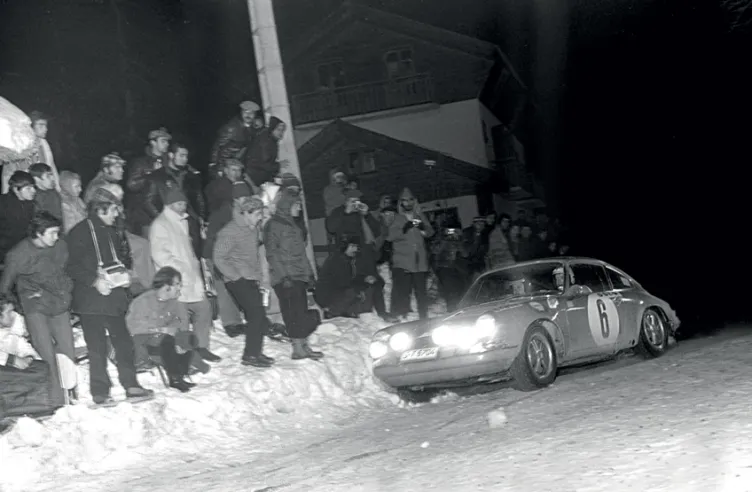
Björn Waldegård and Helmér's 911 during one of the night stages of the 1970 Monte Carlo Rally. The team chose keep the road tyres, which gave them a decisive advantage in dry conditions.© IXO Collections SAS - Tous droits réservés.
THREE VICTORIES JUST AREN'T ENOUGH
Despite three outright victories, securing the title was far from guaranteed: their most dangerous rival was Alpine-Renault, winners at San Remo, with points also scored at Monte Carlo and in Austria. The French car came dangerously close by winning the penultimate round of the championship in Greece, the Acropolis Rally, where Waldegård had to retire due to a broken piston pin. So the teams lined up for the final round, the RAC Rally of Great Britain, with Porsche leading by just three points ahead of its French rivals, with Saab, Opel, Ford and Lancia following at a safe distance. Much to everyone's surprise, it was Lancia, with the Fulvia HF driven by Swedes Harry Källström and Gunnar Häggbom, that took the final victory on the English tracks and finished third in the overall standings.
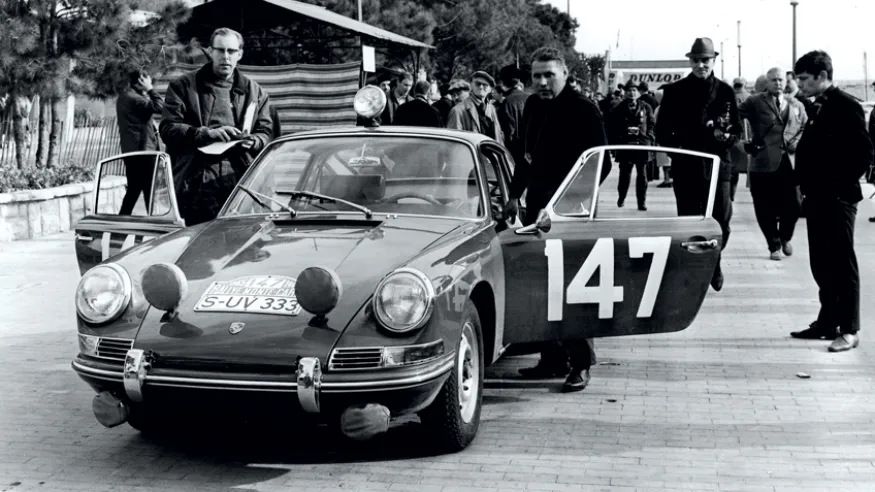
The first 911 to compete in the Monte Carlo Rally was this 2-litre “S” driven by Herbert Linge and Peter Falk, who finished fifth in 1965.© IXO Collections SAS - Tous droits réservés.
[THE TITLE WAS WON WITH THE “HELP” OF THE LANCIA FULVIA]
Both championship contenders ended up settling for the last points positions, with the best Alpine A110 finishing fifth and the best Porsche only sixth, a result that was enough to hold off the French car's comeback. Instead of Waldegård, who had to retire due to gearbox problems, it was Frenchman Gérard Larrousse who won the all-important point. Over the next two seasons the Alpine-Renault, followed by Lancia, dominated the field and the Porsche 911 S, despite the introduction of a more powerful 2.5-litre engine, was only able to achieve a few second places, once again secured by Waldegård, Larrousse and the Polish driver Sobieslaw Zasada.
BJÖRN WALDEGÅRD
Between the late 1960s and early 1970s, Sweden's Björn Waldegård won one Monte Carlo Rally and two Swedish Rallies driving various versions of the 911. It was for this reason that Porsche chose him as their lead driver to compete in the first International Manufacturers' Championship, which they won. Waldegård also won the first Drivers' Championship, introduced in 1979, mostly at the wheel of a Ford Escort 1800 RS, giving the American brand its first World Manufacturers' Championship title. Prior to driving for Ford, the Swede also competed for Lancia, where he left at the end of 1976 after refusing to concede victory in San Remo to his teammate Sandro Munari that year, as ordered by the team. His career started in 1962 and lasted until the early 1990s, before an accident in the 1992 Safari Rally brought it to an end. It was in Kenya in 1990 that Waldegård, driving a Toyota Celica, secured his last World Championship victory, and at 46 years of age became the oldest driver to win a WRC event. In fact, the Swedish driver returned to competition in 1993, participating in minor events, historic races and simple exhibitions, until he gave up completely in 2014.
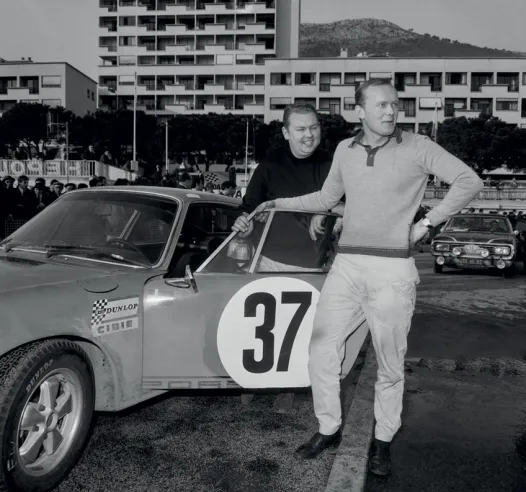
Björn Waldegård (right) and Lars Helmér (left) next to the 2-litre 911 S that they drove in the 1969 Monte Carlo Rally (then part of the European Championship), which they went on to win.© IXO Collections SAS - Tous droits réservés.
Technical sheet
Recent articles