 English
 français
 Deutsch
 español
 italiano
 português


















06/05/2023
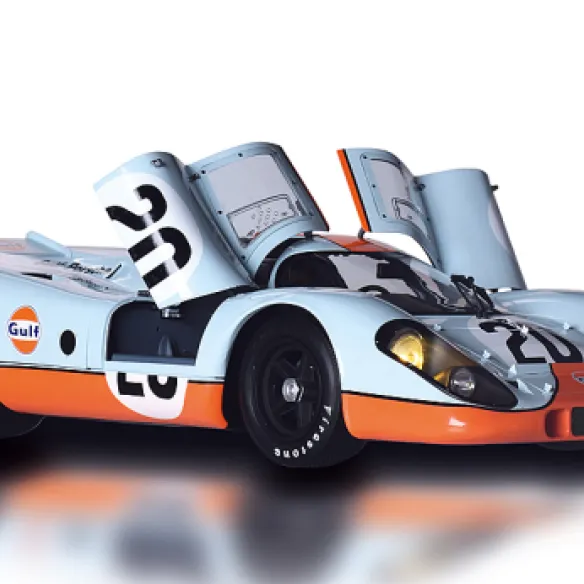
Chaparral 2F - 1967
Les mythes du Mans Chaparral 2F
Author : Cette collection est une adaptation de 24H Le Mans ® Le auto delle corsa più leggendaria al mondo Éditeur : Centauria Editore s.r.l.
Read moreThe name Chaparral Cars might seem like a footnote in the history of the 24 Hours of Le Mans, appearing only twice, in 1966 and 1967, without achieving any significant results. However, this American company managed to leave an indelible mark on motor racing thanks to its innovations.
Chaparral Cars was founded in 1960 by former drivers Hap Sharp and Jim Hall, with the aim of using aeronautical solutions and applying them to cars, and more specifically to racing. The first model produced by the American company was the Chaparral 1, evolved from the front-engined barquette that engineers Dick Troutman and Tom Barnes had previously designed for Scarab. With this car, the team took part in the national championships organised by the North American SCCA association and achieved two class victories in 1962 and 1963. Meanwhile, it commenced development of the rear-engined Chaparral 2, a car that was subject to continuous evolution, resulting in numerous variants as different from each other in appearance as the letters of the alphabet. Two models of the 2A version, although registered for the 1963 24 Hours of Le Mans, did not race due to stability problems caused by a front axle with insufficient grip. Once these problems were corrected, the car went on to win victories and places of honour in American races over the next two years.
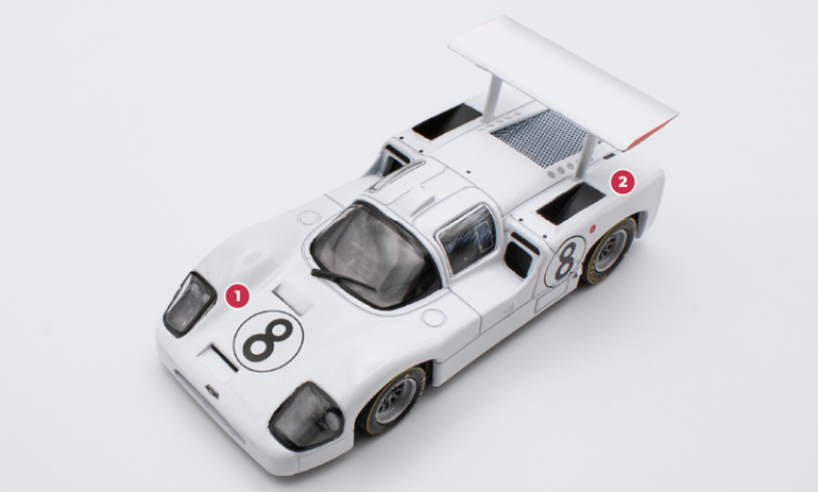
1. The pressure generated by the front air intake serves to prevent excessive compression of the suspension at high speeds.
2. The radiators are installed on the side panels of the 2F, an innovative solution already used on the Chaparral 2E.
© IXO Collections SAS - Tous droits réservés.
Chaparral's real debut at Le Mans came in 1966 with the 2D, the first Chaparral with a closed body. Construction was based on a fibreglass and resin monocoque with steel reinforcements. Like its predecessors, it was powered by a Chevrolet Corvette engine, this time combined with a two-speed automatic transmission designed by Chaparral, a rarity in the world of racing. The 2D, driven by Phil Hill and Jo Bonnier, triumphed at the 12 Hours of Nürburgring. In France, it was less fortunate and abandoned the race after 111 laps due to an electrical failure.
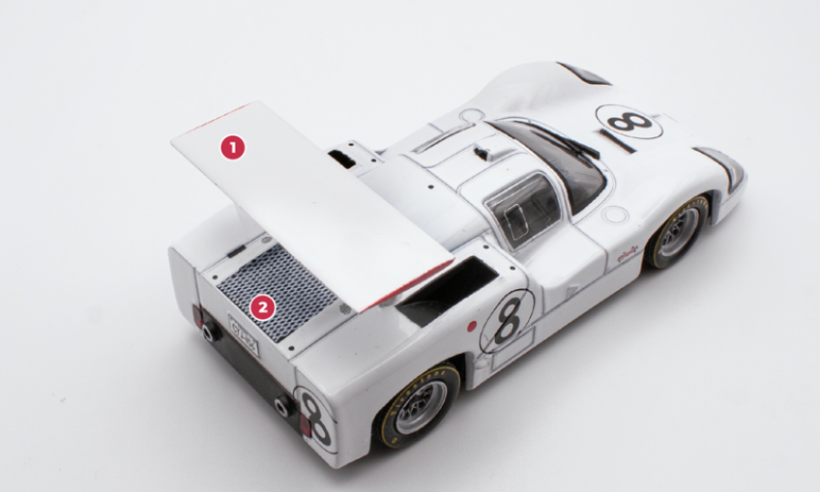
1. The spoiler in its horizontal rest position makes the car very fast on straights. Controlled by a pedal separate of the brake pedal, it tilts, creating downforce on the rear axle and functioning as an aerodynamic brake.
2. The V8 engine is a 7-litre, 525 hp Chevrolet “big block”.
© IXO Collections SAS - Tous droits réservés.
For 1967, Chaparral prepared the 2F, whose level of innovation matched its lack of success: derived from the 2D, it was equipped with a Chevrolet engine, with a displacement of 7 litres and more than 500 hp, coupled with a GM three-speed gearbox, and a large adjustable spoiler already tested on the 2E barquette. These were interesting features, but they were plagued with problems. The standard gearbox struggled to cope with the engine's high power output and caused numerous problems, while the lack of engine brake put too much strain on the disc brakes. During the first few months, practically all of the car's races ended in withdrawal, including at Le Mans, where the two cars bearing numbers 7 and 8, driven by Mike Spence/Phill Hill and Bruce Jennings/Bob Johnson, withdrew due to engine and electrical problems. The Chaparral 2F redeemed itself by winning the 6 Hours of Brands Hatch with drivers Hill and Spence, but in 1968, following the engine capacity restrictions imposed by the new regulations, it was replaced by the more advanced 2G and 2H models.
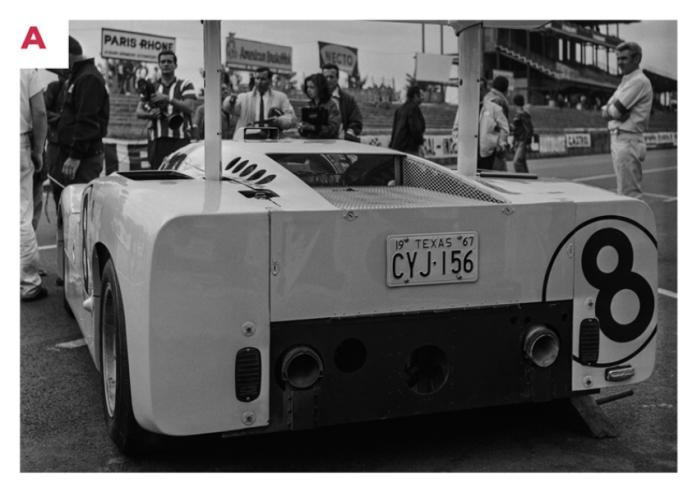
A. The truncated, short rear end keeps the total length of the car under 4 metres.
© IXO Collections SAS - Tous droits réservés.
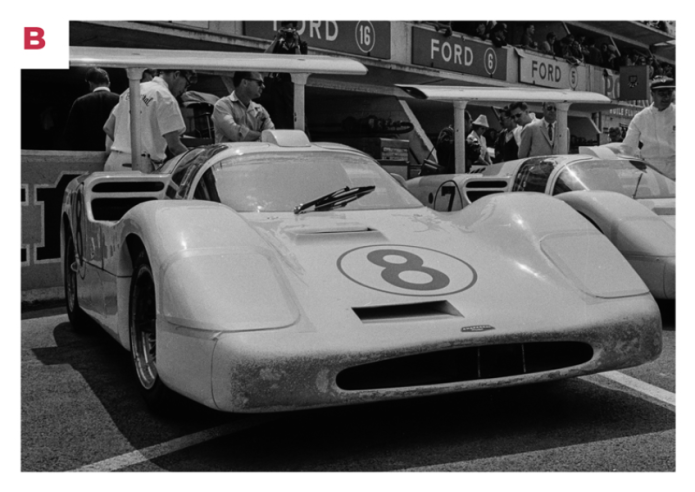
B. The Chaparral 2F's ‘dynamic’ front air intake is equipped with a spring mechanism that opens at high speed, allowing a powerful flow of air to enter and limiting suspension compression.
© IXO Collections SAS - Tous droits réservés.
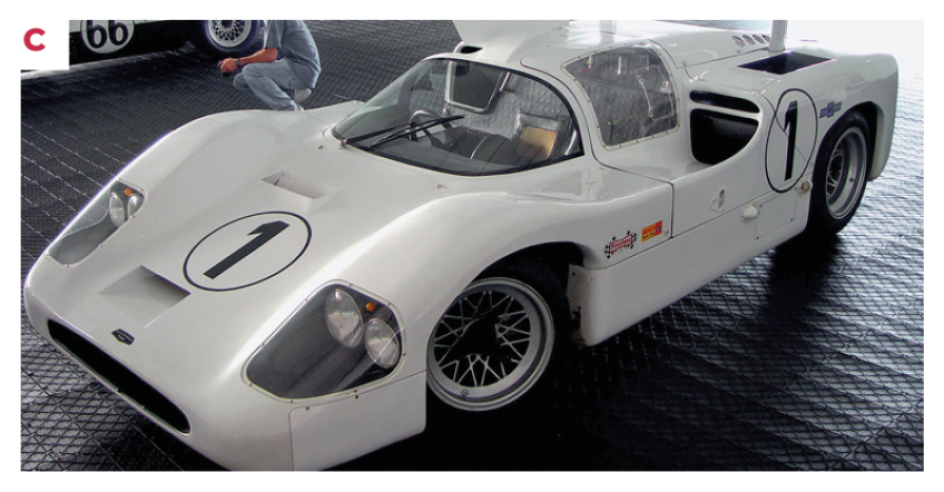
C. The only remaining Chaparral 2R was exhibited at the 2005 Rolex Monterey Historic Races, a historic Californian event for vintage cars.
© IXO Collections SAS - Tous droits réservés.
Recent articles