 English
 français
 Deutsch
 español
 italiano
 português














08/05/2023
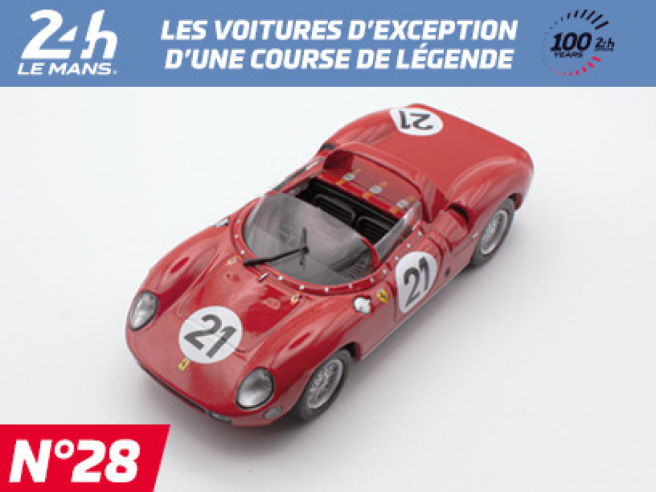
Ferrari 250 P - 1963
Les mythes du Mans Ferrari 250 P
Author : Cette collection est une adaptation de 24H Le Mans ® Le auto delle corsa più leggendaria al mondo Éditeur : Centauria Editore s.r.l.
Read moreEnzo Ferrari's aversion to the rear engine was well known. He agreed to build his first “all-rear” cars on condition that they were equipped with engines that were not too powerful, such as the V6s of the Dino family. In the 1960s, it was clear that to benefit from the advantages of this architecture, power needed to be considered. So in 1963, the V12 production engine was moved to the rear.
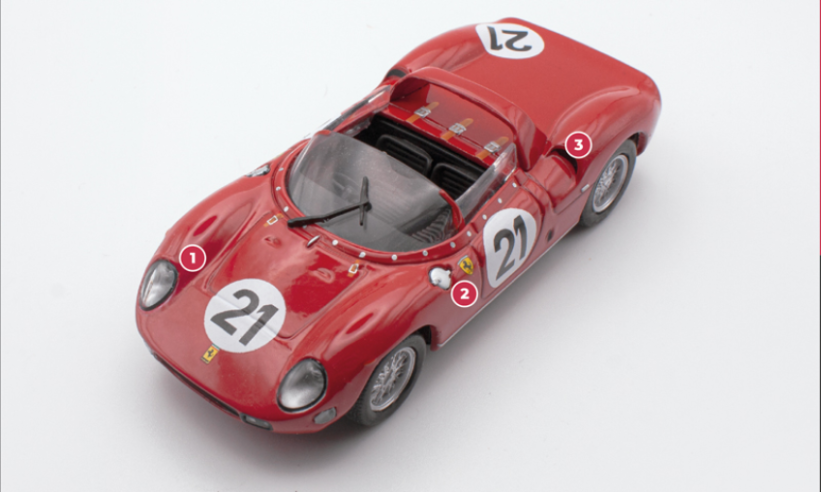
1. The streamlined bodywork designed by Pininfarina and manufactured by Fantuzzi would be used for all subsequent models, including the 250 LM, with very little variation.
2. At the front of the car are the radiators and the fuel tank, as demonstrated by the filler cap in front of the door.
3. The bonnet is smooth, with no openings or glazing. The engine ‘breathes’ through the two large air intakes positioned in front of the wheels.
© IXO Collections SAS - Tous droits réservés.
With its pure, sleek styling, the 250 P was homologated as a ‘Sport Prototype’, a category destined ultimately to become the queen of endurance racing and the 24 Hours of Le Mans at the expense of the GT category. The new car was created by transplanting the powerful 3-litre engine of the 250 GTO and Testa Rossa onto a chassis derived from the 246 SP, i.e. a steel tubular trellis structure with transverse quadrilateral front and rear suspensions. The aluminium bodywork was uncovered, while the engine, with its six Weber carburettors in this variant, produced around 310 bhp. The new Ferrari with this rear-engine configuration appeared on the grid for the 1963 season, and in March it took first and second place in the 12 Hours of Sebring with the teams composed of John Surtees/Ludovico Scarfiotti and Lorenzo Bandini/Willy Mairesse/Nino Vaccarella.
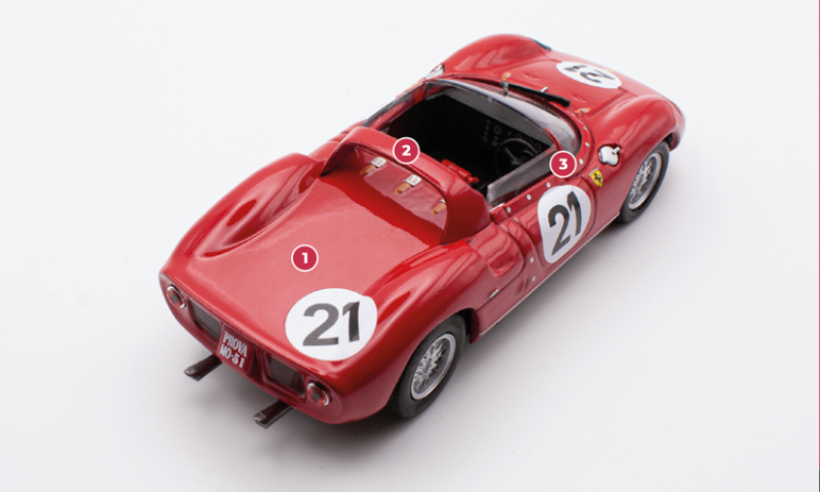
1. The rear brakes are fitted “in board”, at the differential exit, and before the half-shafts to reduce the non-suspended mass.
2. The 250 P, designed with an open body, is fitted with a solid roll bar behind the passenger compartment.
3. The almost frameless windscreen and side windows are fixed in position with solid rivets.
© IXO Collections SAS - Tous droits réservés.
The following month, a 250 P was sent to the first Le Mans test with the same drivers plus Mike Parkes (who replaced Nino Vaccarella). While the car set the fastest lap, none of the cars entered managed to finish in the following event, the Targa Florio. The 250 P made a comeback shortly afterwards in Germany at the 1000 km Nürburgring, where Surtees and Mairesse scored an outright victory ahead of two other Ferraris.
This victory was the perfect motivation for the 24 Hours of Le Mans, where Scuderia Ferrari was determined to continue the series of victories it had begun in 1960, and had even won in 1958 with the only interlude of the 1959 edition, won by Aston Martin.
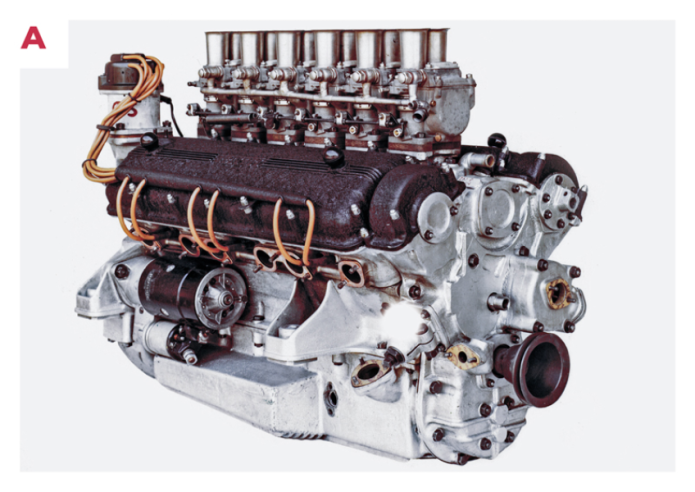
A. For the first time, the 250 P's 60° V12, designed by engineer Gioacchino Colombo, was installed at the rear of the passenger compartment, together with the gearbox and differential.© IXO Collections SAS - Tous droits réservés.
The Cavallino cars, which were split between those of the official team and those of the Belgian Francorchamps team and the Belgian National Team, the American NART and the British Maranello Concessionaires, dominated the race completely, with the competitive 250 GTOs and 330 LMs alternating at the front of the field with the new 250 P cars. The latter took centre stage with the No. 21 of Lorenzo Bandini and Ludovico Scarfiotti 16 laps ahead of the 250 P of their team-mates Mike Parkes and Umberto Magioli and the 250 GTO of the Belgian Beurlys/Gérard Langlois van Ophem (Belgian National Team), which missed out on second place by around a hundred metres.
The third official 250 P, driven by Surtees and Mairesse, had to retire after 252 laps due to an accident followed by a fire.
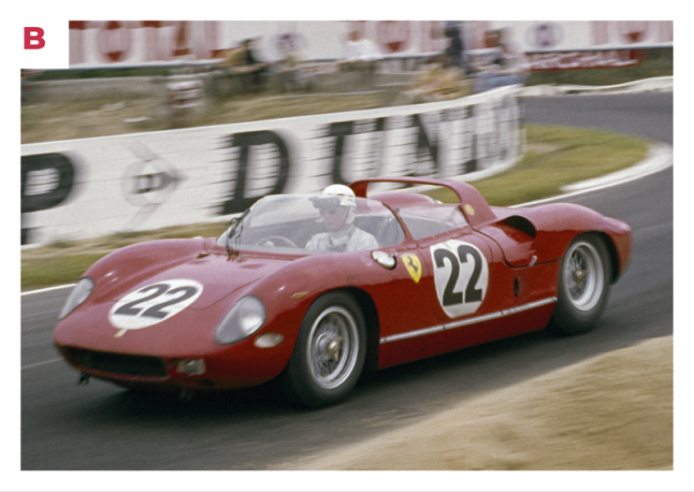
B. The second official 250 P (car no. 22 with drivers Mike Parkes and Umberto Magioli) finished third in the 1963 Le Mans 24 Hours.© IXO Collections SAS - Tous droits réservés.
At Maranello in the meantime, the car underwent a number of improvements, notably to the engine, with the addition of 3.3-litre and 4-litre blocks that resulted in the 275 P and 330 P models, which would dominate the Le Mans 24 Hours again in 1964. The 250 P's last victory was at the Canadian GP at Mosport in 1963, with Pedro Rodriguez finishing third at Le Mans.
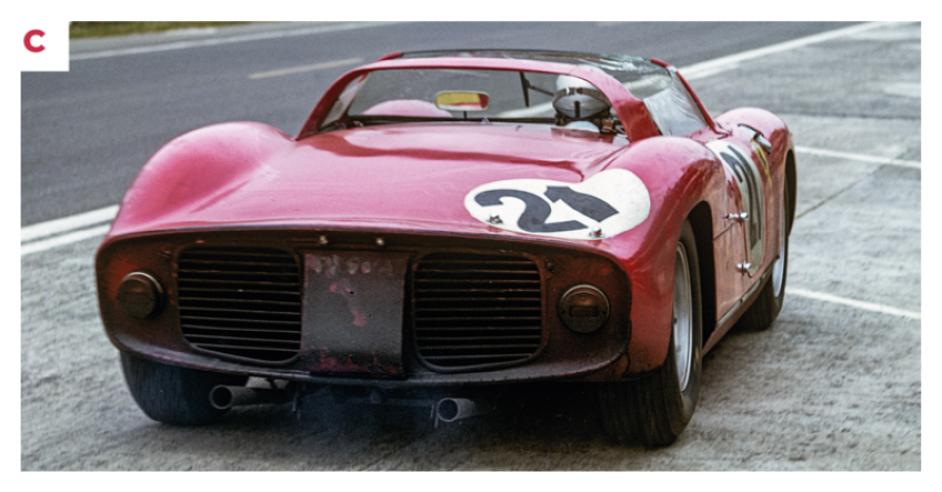
C. Despite its powerful 12-cylinder engine, the 250 P had a twin exhaust system which, on the 250 LM, was replaced by four separate lines. © IXO Collections SAS - Tous droits réservés.
Recent articles