 English
 français
 Deutsch
 español
 italiano
 português















08/12/2025
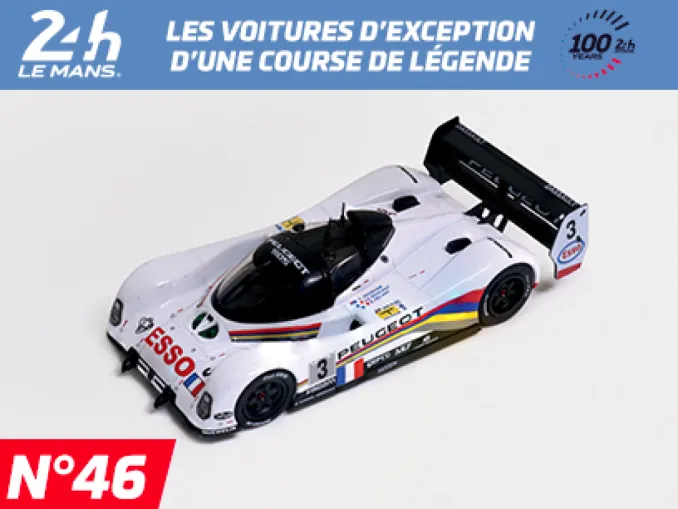
Peugeot 905 – 1993
Peugeot 905 – 1993
Following a triumphant 1992 season that brought Peugeot its last WSC title (reserved for sports cars) before the championship was discontinued, the Peugeot-Talbot team won once again at Le Mans with the Evo 1 Bis, completing its career by repeating the previous year's success.
Peugeots campaign in endurance racing, in which the lion brand sought new glory after achieving victory in rallying with the 205 and 405, was far from a success. In 1988, Peugeot announced a new programme, but it wasn't until two years later that the 905, designed by André de Cortanze, was presented. This car was made from carbon fibre and powered by a naturally aspirated 3.5-litre V10 engine, in accordance with the new regulations for the top category of Group C (called ‘Sport 3.5 litres’). The first version, called the ‘905 Evo 1’, competed in two races in 1990 before being rolled out in full force in 1991, driven by Mauro Baldi/Philippe Alliot and Keke Rosberg/Yannick Dalmas. At the start of the season, the first crew secured a victory at Suzuka. During the summer, Peugeot launched the variant developed for 1992, the ‘Evo 1 Bis’, driving Keke Rosberg and Yannick Dalmas to victory at Magny-Cours and Mexico City. Elsewhere, the two crews experienced a series of withdrawals, including at Le Mans, where the two 905s, despite starting at the front of the grid as the best of the 3.5-litre Sports cars, were forced to retire after only a few dozen laps.
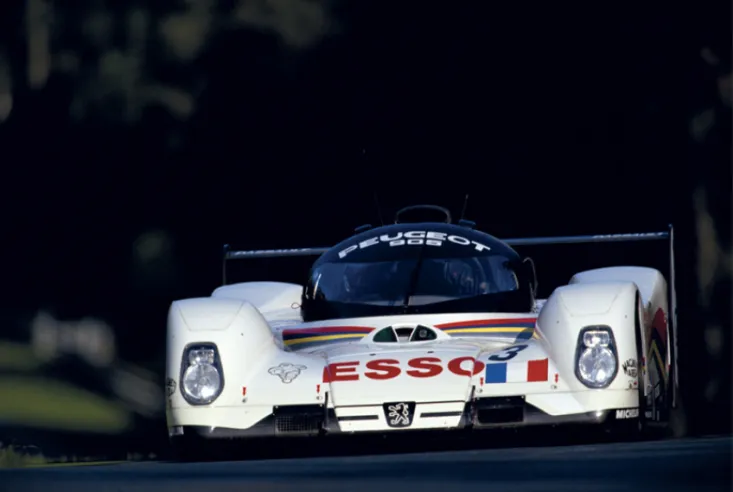
The 905 Evo 1 Bis has a very different style to that of the first Evo 1, but this LM version, competing at Le Mans in 1992 and 1993, differs further in terms of its grille and headlights.
© IXO Collections SAS - Tous droits réservés.
The Evo 1 Bis, reworked in terms of bodywork and with mechanical improvements, achieved its best results in 1992: Yannick Delmas, teamed with Derek Bell, secured three victories – including the 24 Hours of Le Mans (with Mark Blundell as third driver), at which the car made its appearance in a new variant called the ‘Evo 1 Bis LM’ – and two second places, with the car finishing first in the championship. The other 905, driven by Alliot and Baldi (plus veteran Jean-Pierre Jabouille at Le Mans), claimed two wins and two third places to finish second in the championship ahead of its most tenacious rivals, the Toyotas, to whom Peugeot only conceded the 500 km of Monza.
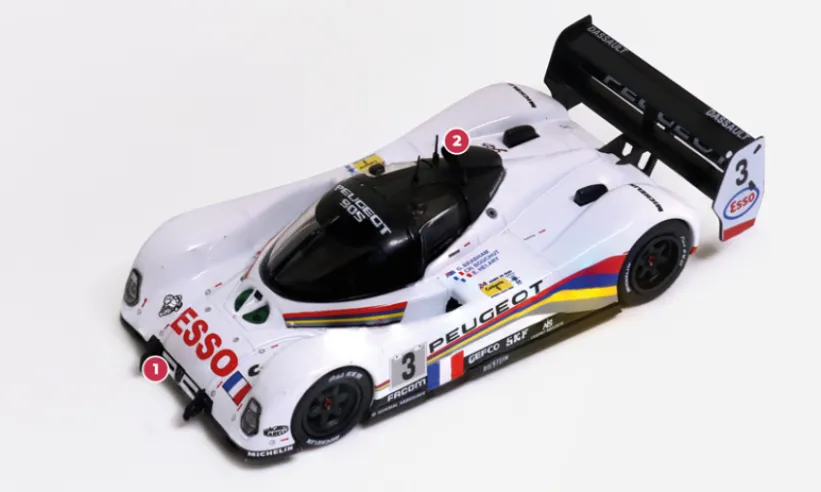
1. The large open button holes on the front are used to attach the additional front deflector, that was never installed on the Le Mans version.
2. The periscopic air intake on the cockpit is one of the few elements that remained unchanged on all variants of the 905.
© IXO Collections SAS - Tous droits réservés.
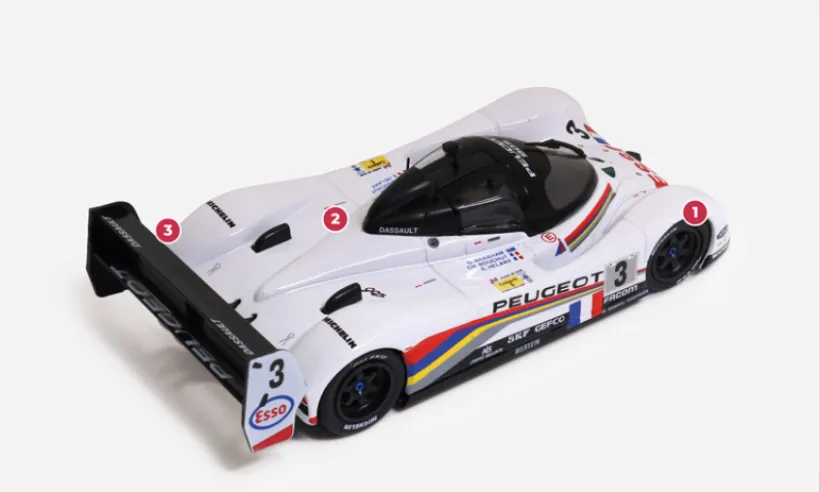
1. The 905 Evo 1 Bis LM is fitted with reinforced brakes to withstand the violent braking demanded at the end of the long straight leading up to the Mulsanne corner.
2. The 80° V10 engine has been specially tuned for Le Mans, limiting the maximum revs to just under 12,500 rpm. In addition, the transmission is reinforced.
3. The large biplane rear wing, slightly modified for the 24 Hours of Le Mans, has a smaller surface area to reduce drag and optimise airflow.
© IXO Collections SAS - Tous droits réservés.
In 1993, the championship was cancelled due to lack of interest, but the Group C cars were allowed to compete in the 24 Hours of Le Mans, an event considered to be independent. Peugeot ceased development of the next evolution, the Evo 2, and entrusted the defence of its colours to the now very reliable Evo 1 Bis, that repeated the duel in the C2 category with the Toyota TS010 and the ever more efficient Porsche 962 ‘veterans’. At the May tests, Baldi and Alliot clocked the fastest times. Peugeot entered three cars in June, which, at the end of a qualifying session disrupted by numerous accidents, shared the front row with Toyota. The race itself lasted only a few hours, after which the three 905s took the lead to finish with a fantastic one-two-three. The winner was the ‘added’ crew of Éric Hélary, Christophe Bouchut and Geoff Brabham, who finished just ahead of Thierry Boutsen, Yannick Dalmas and Teo Fabi and, somewhat further back, Alliot, Baldi and Jabouille.
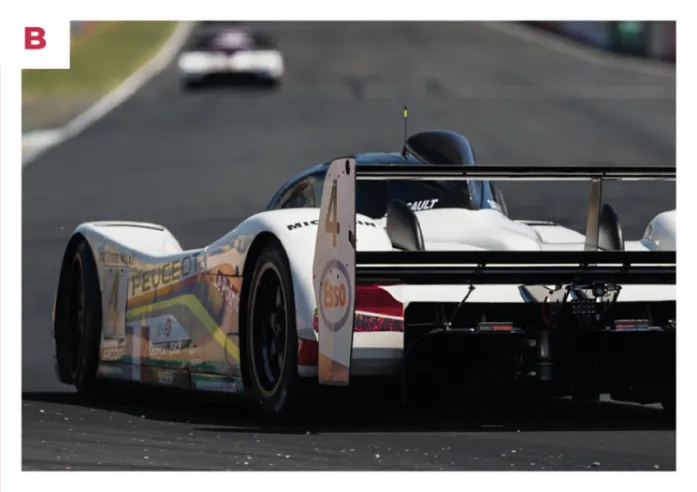
A. The 1993 24 Hours of Le Mans was won by the No. 3 905 Evo 1 Bis LM driven by Geoff Brabham, Christophe Bouchut and Éric Hélary. © IXO Collections SAS - Tous droits réservés.
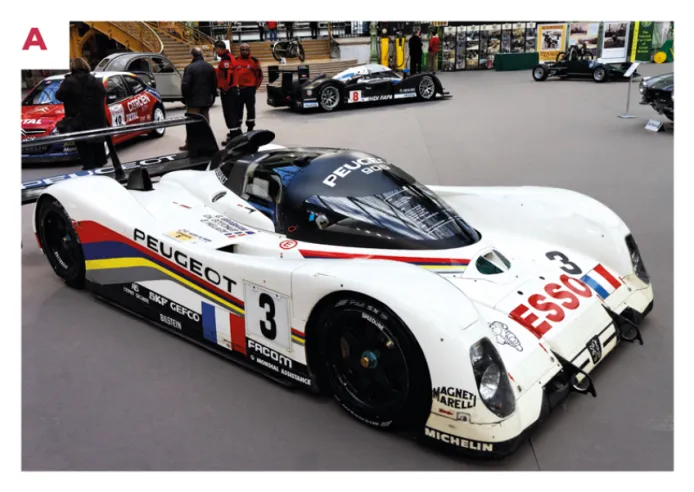
B. The 2018 Le Mans Classic Group C race featured a 905 Evo 1 Bis LM.© IXO Collections SAS - Tous droits réservés.
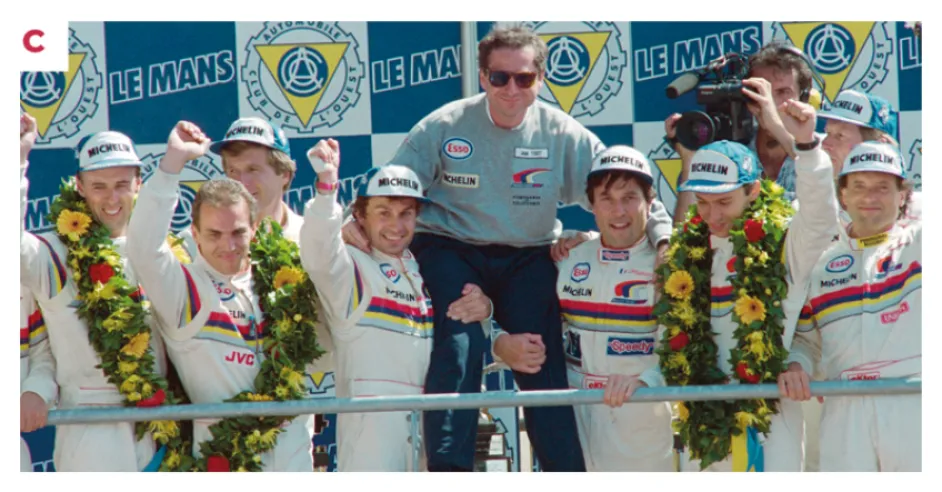
C. The Peugeot-Talbot team celebrates its triple victory at Le Mans in 1993. Centre: sporting director Jean Todt carried by Yannick Delmas and Philippe Alliot. The three winning drivers wearing flower crowns are Brabham, Éric Hélary and Christophe Bouchut. © IXO Collections SAS - Tous droits réservés.
Recent articles