 English
 français
 Deutsch
 español
 italiano
 português

















18/12/2025
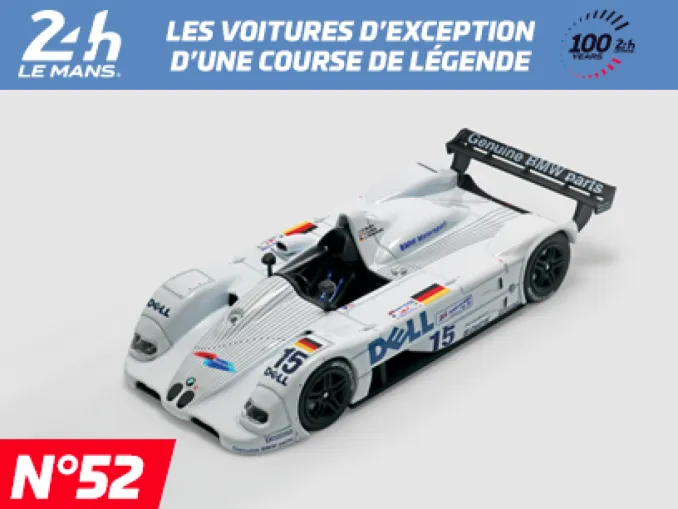
BMW V12 LMR - 1999
BMW V12 LMR
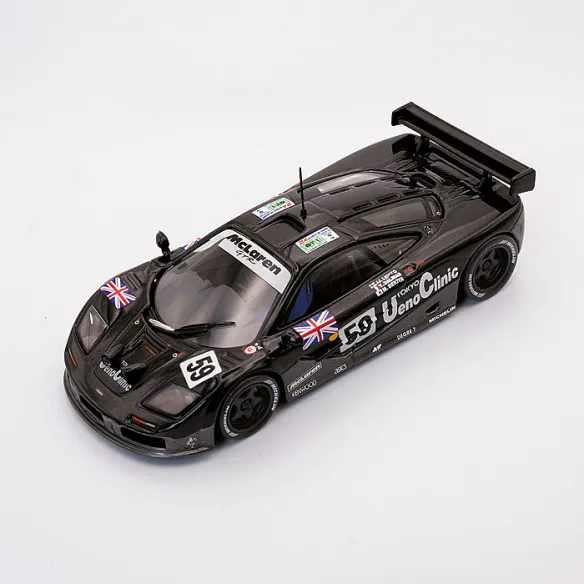
The success of the McLaren F1 powered by its V12 engine at the 1995 Le Mans 24 Hours sparked the interest of BMW, which, after supporting the British team for two years, decided to take part with its own car. But victory would only be achieved a year later, following significant developments.
The first version of the BMW V12 LM was built using the engine which had made the McLaren F1 so successful. But unlike the latter and its most credible rivals (such as the Mercedes-Benz CLK LM and Porsche 911 GT1-98), the BMW is not a GT1, but rather an LMP1 prototype. For its production, BMW turned to Williams, with whom it had a collaborative agreement to access Formula 1 from 2000 onwards. This British factory developed a car with some attractive basic features, but with a few flaws, so its debut at the 1998 24 Hours of Le Mans was a semi-disaster, with both cars dropping out after just a few dozen laps. However, despite this setback, the partners gathered valuable experience for the following year and prepared the V12 LMR, a car that had been almost completely redesigned, especially in terms of its bodywork, and which rewarded their efforts. Taking part in the American Le Mans Series, the car started by winning the 12 Hours of Sebring with J.J. Lehto, Tom Kristensen and Jörg Müller, while the second car, driven by Yannick Dalmas, Pierluigi Martini and Joachim Winkelhock, was forced to retire following an accident.
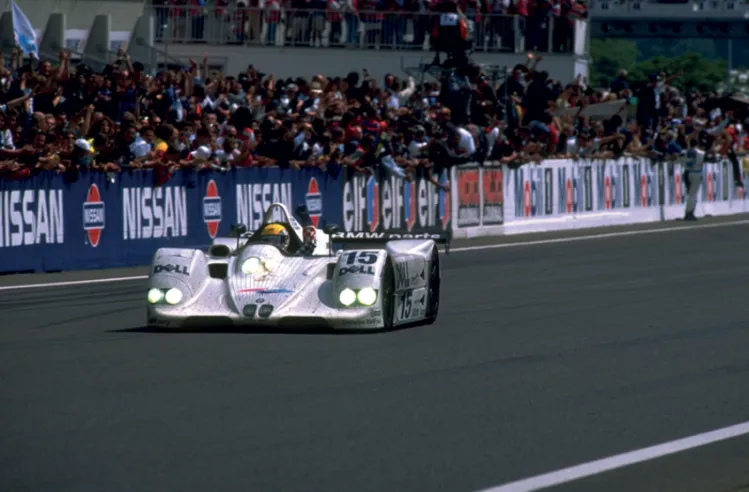
Whilst the chassis and mechanics remained unchanged, the two 1999 V12 LMRs (including the No. 15 car that won the race) were not built by “ transforming” the previous V12 LMs, but were constructed from scratch.© IXO Collections SAS - Tous droits réservés.
In May, during the Le Mans test sessions which assessed qualifying positions ahead of the June race, BMW entered three cars which finished 4th, 7th and 24th. Two months later, during the 24 Hours, the two BMW V12 LMRs secured the 3rd and 6th places on the grid during qualifying. In the meantime, the GT1 category was discontinued because the cars, thanks to very permissive regulations, were more like prototypes than the street-legal models they were intended to be based on. As a result, the ACO created the LMGTP category for closed-body cars derived from GT1 models. Initially, these cars proved to be the fastest, especially the Toyota GT-One, claiming pole position. Its direct rival, the Mercedes-Benz CLK LM, experienced serious aerodynamic problems and, following a series of frightful take-offs during qualifying and at the start of the race, fortunately leaving the drivers unharmed, the team opted to withdraw. Victory was therefore limited to a duel between BMW and Toyota, which seemed to be turning in BMW's favour before it encountered technical problems. A few hours before the finish, Kristensen, Lehto and Müller's V12 LMR had to retire due to an accident; the second car, now in the lead, had to withstand attacks from the Toyota driven by Ukyo Katayama, who was gaining seconds lap after lap. In the final stages, the two teams battled it out for the win, but while BMW opted to put their fastest driver, Pierluigi Martini, in charge, Toyota chose to reduce the length of their pit stops by eliminating wheel changes. That decision proved fatal, as tyre wear, with one of them exploding a few laps from the finish, prevented Katayama from continuing his recovery on Martini's V12 LMR, and condemned him to second place.
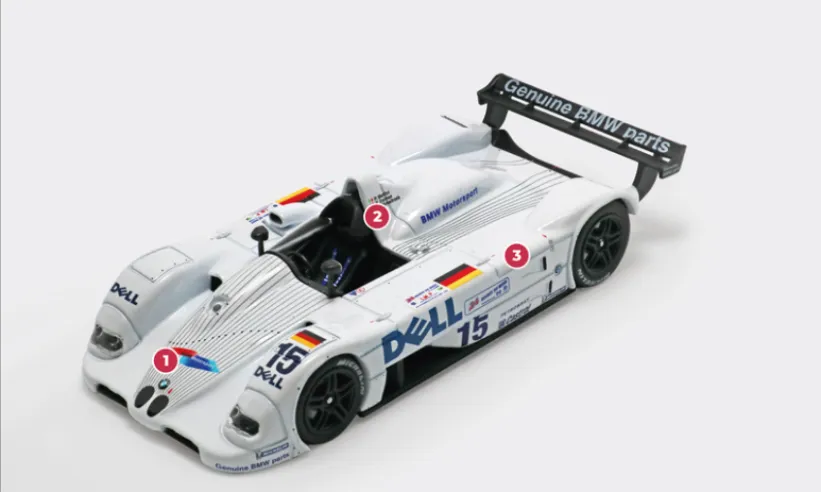
1. Unlike the V12 LM from 1998, the cooling air on the LMR is taken from the top of the bodywork rather than from below. This explains the lowered front end and the open air intakes in the nose and wings.
2. Whereas previously it covered the entire passenger compartment, now the anti-rollover safety structure has been moved to the right behind the driver's seat.
3. The weight of the V12 LMR is less than 900 kg, the minimum required by the regulations, allowing BMW to position the ballast to optimise weight distribution.© IXO Collections SAS - Tous droits réservés.
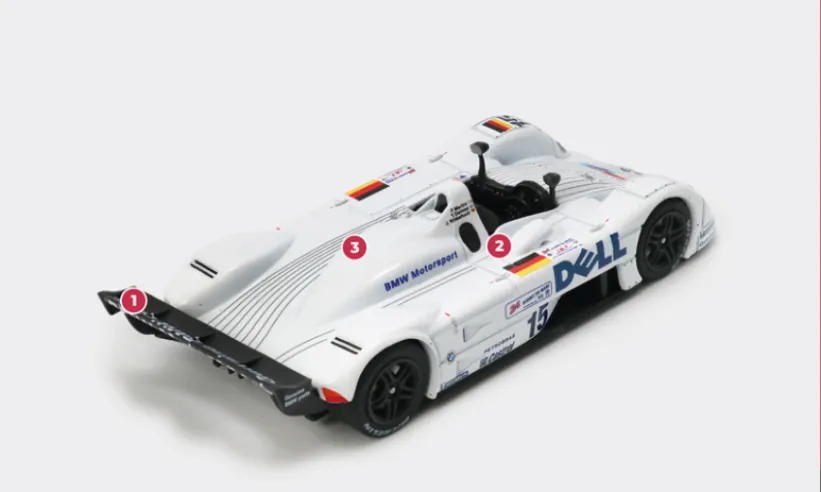
1. As usual, a simplified rear wing is used for Le Mans, generating less aerodynamic downforce.
2. The engine is supplied with air via a single periscope intake on the right side.
3. The naturally aspirated 6-litre S70/3 V12 engine, an upgrade of the unit fitted to the McLaren F1 GTR, develops just under 600 bhp with the regulation flange on the intake. © IXO Collections SAS - Tous droits réservés.
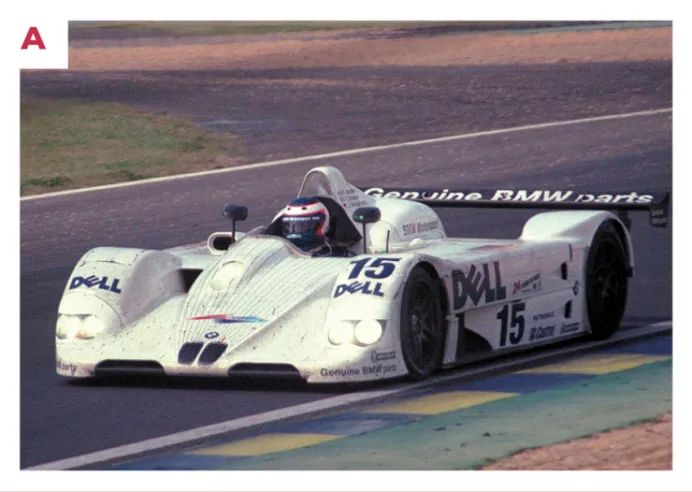
A. The V12 LMR's asymmetrical design and aerodynamic solutions inspired many other prototypes. The small additional dashboard spotlight is also a distinctive feature.© IXO Collections SAS - Tous droits réservés.
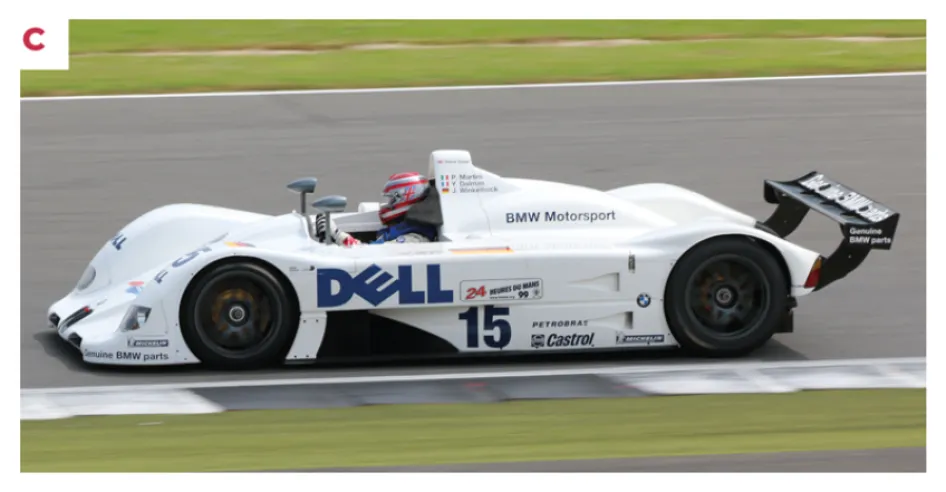
B. The first team for Le Mans 1999: Yannick Dalmas, Pierluigi Martini and Joachim Winkelhock.© IXO Collections SAS - Tous droits réservés.
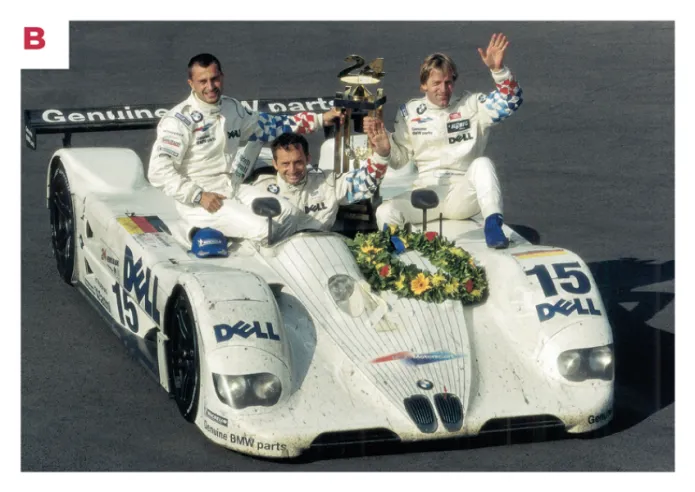
C. The car with chassis number 003/99 scored one single victory, at the 24 Hours of Le Mans, but two second places: one at the Petit Le Mans at Road Atlanta and one at the Las Vegas Grand Prix.© IXO Collections SAS - Tous droits réservés.
Recent articles