 English
 français
 Deutsch
 español
 italiano
 português













30/01/2026
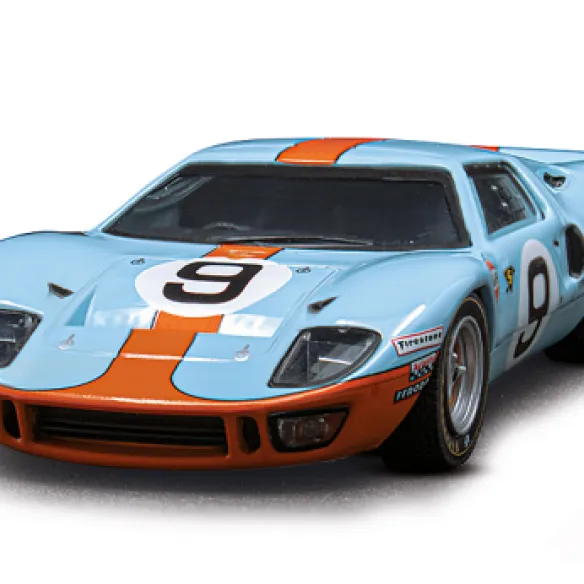
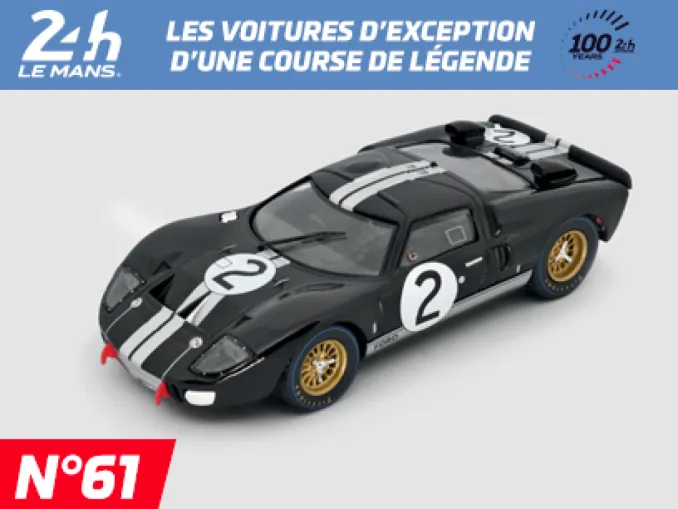
Ford GT40 Mk II – 1966
Ford GT40 Mk II
The GT40, famous for allowing Ford to take revenge on Ferrari, which the American giant failed to buy in 1963, needed almost two years before it reached full maturity with the Mk II. It dominated the 1966 edition of the 24 Hours of Le Mans, resulting in one of the most controversial finishes in the history of the race.
Although Henry Ford II's desire for revenge was successfully realised in a venture carried out with lavish American-style expenditure, the GT40 was more British than American in origin. Following his failed attempt to acquire Ferrari, which was winning races everywhere and had dominated Le Mans since 1960, Ford decided to beat Ferrari where it was strongest and launched an expensive programme to create a car capable of winning. Looking for the perfect option, they ended up in England, where Ford Advanced Vehicles had just been set up looking to work with small manufacturers like Cooper, Lotus, and Lola. The proposal from Lola, who built a car based on their Mk 6 GT powered by a Ford V8 engine, won them over.
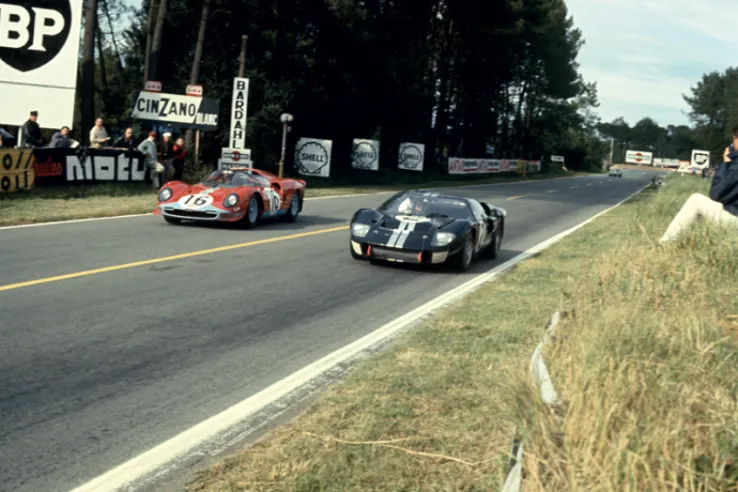
The GT40 Mk II driven by Bruce McLaren and Chris Amon remained in second place behind Ken Miles and Denny Hulme for a long time, eventually beating them on the finish line.© IXO Collections SAS - Tous droits réservés.
Called the GT40 and equipped with an engine derived from the 4.2-litre series, the car made its debut in 1964. From its very first races, including the 24 Hours of Le Mans, problems with reliability and aerodynamics became apparent, leading to a series of withdrawals. Carroll Shelby, winner of the French race in 1959 with the Aston Martin DBR 1 and owner of the Shelby American team, which in 1964 won three GT class victories in the World Sportscar Championship with the Ford-powered Cobra Daytona and finished fourth at Le Mans behind three Ferraris, was then brought on board with the project. With Shelby in charge, the GT 40 began to enjoy some success in 1965, including the 2,000 km of Daytona with Ken Miles and Lloyd Ruby. However, at Le Mans, none of the GT40s finished, including the first prototypes of the soon-to-be Mk II with a 7-litre engine, whose transmission proved to be seriously problematic.
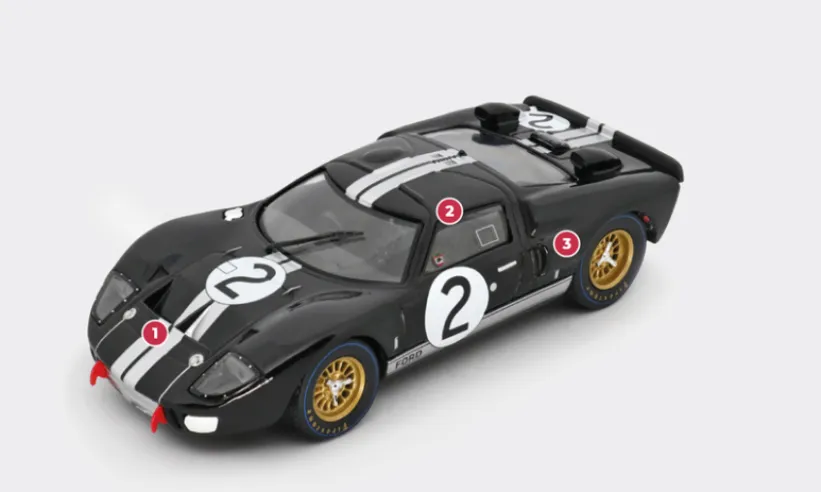
1. The GT40 Mk II has a longer, more streamlined front end than the original model from 1964.
2. The doors, which open up to the roof, are inherited from the Lola MK6 GT, from which the GT40 is derived.
3. Compared to the early 1965 prototypes with 7-litre big block engines, the 1966 Mk II model had more powerful brakes and additional cooling air intakes.© IXO Collections SAS - Tous droits réservés.
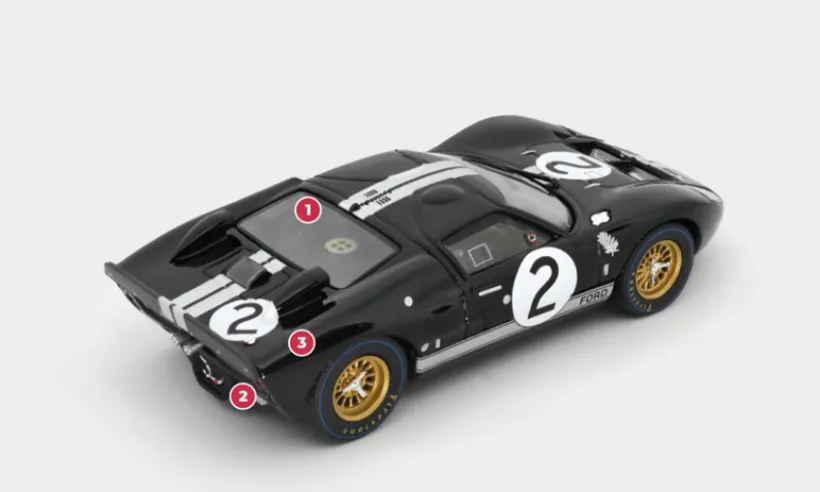
1. The GT40 earned its name from its total height of approximately 40 inches, or just over one metre, measured from the top of the windscreen.
2. Its 427 V8 engine, with a displacement of nearly 7 litres, features a dry sump in order to be installed at a lower position in the chassis.
3. The 4-speed gearbox was created from scratch, as none of the existing gearboxes could handle the engine's power of nearly 500 bhp. However, reliability was not perfect at first.© IXO Collections SAS - Tous droits réservés.
Fine-tuned for 1966, the GT40 Mk II, now with an engine producing nearly 500 hp and a more reliable transmission, achieved success early in the year with another victory at Daytona, again with the Miles/Ruby team. At the 24 Hours of Le Mans, personally flagged off by Henry Ford II, there were eight Mk IIs. Three were entered by Shelby American and the others by the British teams Holman & Moody and Alan Mann. The agile and powerful American cars dominated the race, pushing their rivals to an unsustainable pace which, after numerous breakdowns and accidents, put even the Ferraris out of action. Ken Miles, teamed up with Denny Hulme, solidly took the lead, but at the very end of the race, he was asked by his team to slow down and hold back for the cars driven by Bruce McLaren/Chris Amon and Ronnie Bucknum/Dick Hutcherson in order to give Ford a triumphant group finish. He paid a heavy price for this: he was passed by McLaren just before the finish line and the latter was declared the winner because, according to the rules, having started a few metres behind, he had covered a slightly greater distance than Miles in the same time.
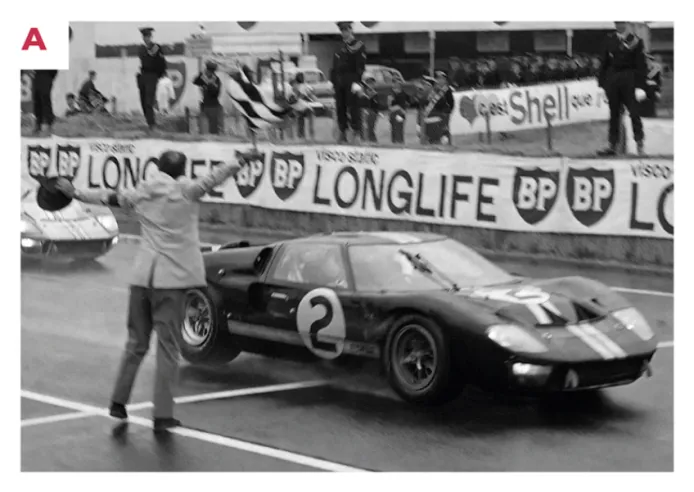
A. The McLaren/Amon GT40 was the first to cross the finish line at the 1966 Le Mans 24 Hours having overtaken the Miles/Hulme car.© IXO Collections SAS - Tous droits réservés.
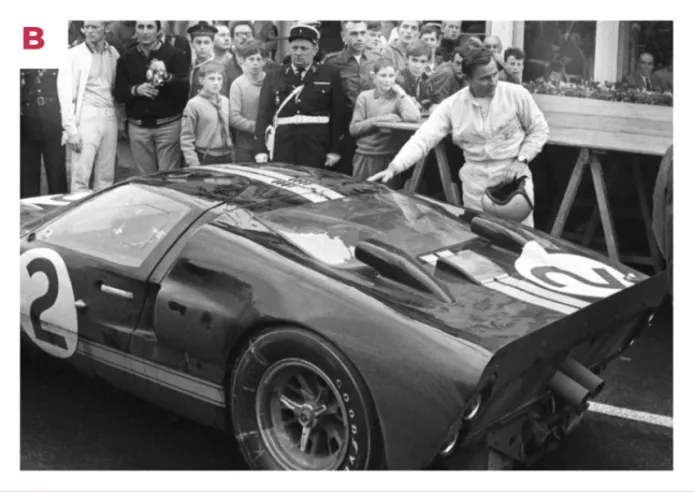
B. New Zealander Bruce McLaren next to his winning car just after the race finish.© IXO Collections SAS - Tous droits réservés.
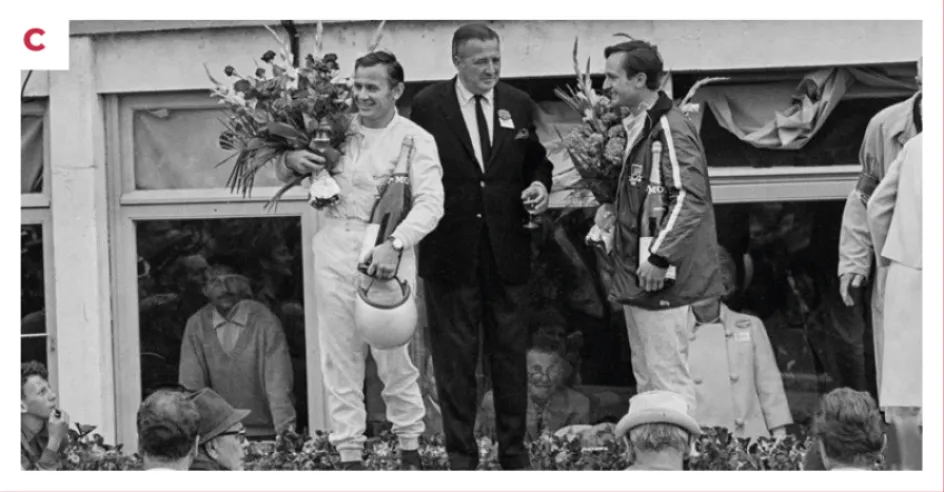
C. Bruce McLaren (left) celebrating his victory with his compatriot Chris Amon (right) and ‘big boss’ Henry Ford II (centre) following the unexpected result of the 1966 Le Mans 24 Hours, which saw the GT40s triumph over the Ferraris.© IXO Collections SAS - Tous droits réservés.
Recent articles