 English
 français
 Deutsch
 español
 italiano
 português














30/04/2023
Nissan R390 GT1 - 1998
Les mythes du Mans Nissan R390 GT1
Author : Cette collection est une adaptation de 24H Le Mans ® Le auto delle corsa più leggendaria al mondo Éditeur : Centauria Editore s.r.l.
Read moreThe GT1 class, introduced in 1994, made it possible to use cars derived from the production model, but with modifications and performance closely resembling that of prototypes. Nissan resumed its dream of winning Le Mans, but the Skyline GTR Nismo was not as fast as its rivals. The result was the R390, a more competitive car that achieved a podium position, but not victory.
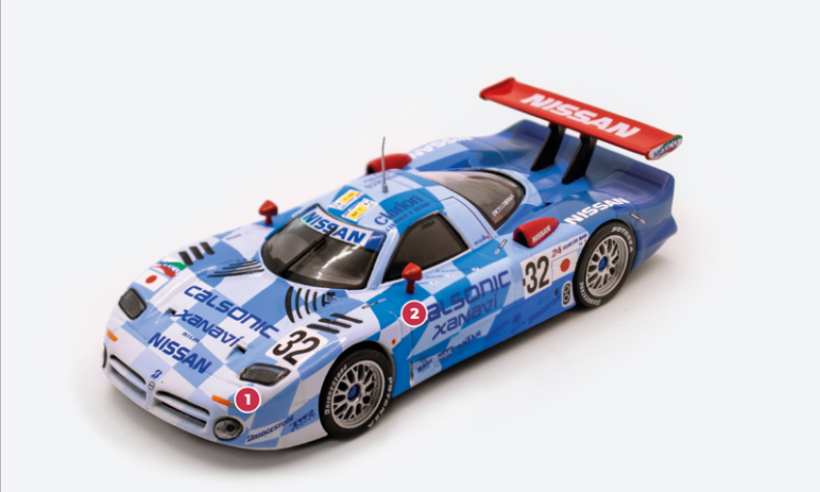
1. The shape of the R390 GT1 is distantly reminiscent of the sports road cars. However, it utilises the front lights from the contemporary Nissan 300ZX and the cross pattern grille from the production models.
2. The structure and chassis designed by the TWR team are based on the familiar solutions of a carbon fibre monocoque and double wishbone suspension.
© IXO Collections SAS - Tous droits réservés.
The GT1 regulations required no minimum number of units produced of the model on which the racing car is “theoretically” based. Instead, only one roadworthy unit is required to make the racing version compliant with the regulations. The Japanese brand however enlisted the help of Tom Walkinshaw and his company TWR, which was successful with Jaguar in 1988 and 1990 and helped lay the foundations for the car that beat the 911 GT1 Le Mans in 1996. The British team worked on a GT with a carbon fibre monocoque for which Ian Callum, Jaguar's future design director, developed a body with simple lines, but not without character. For the engine, Nissan returned to its 3.5-litre VRH turbo engine, which had been used in previous years for the Group C prototypes. Three examples of the R390 were built, plus a fourth that was approved for road use, to compete in the Le Mans preliminaries in May 1997. One of these cars, driven by Martin Brundle and Jörg Müller with start number 21, recorded the absolute best time, while the other two finished in twelfth and seventeenth place. Almost a month later, during the official tests prior to the race, the No 22 car driven by Eric van de Poele, Riccardo Patrese and Aguri Suzuki finished third behind a TWR-Porsche WSC-95 and a Porsche 911 GT1. The team consisting of Brundle, Müller and South African Wayne Taylor finished seventh. The third team, consisting of Kazuyoshi Hoshino, Erik Comas and Masahiko Kageyama, failed to do better than fourteenth place, but would ultimately be the only one to finish the race, coming in twelfth, highlighting the reliability issues of the R390 GT1.
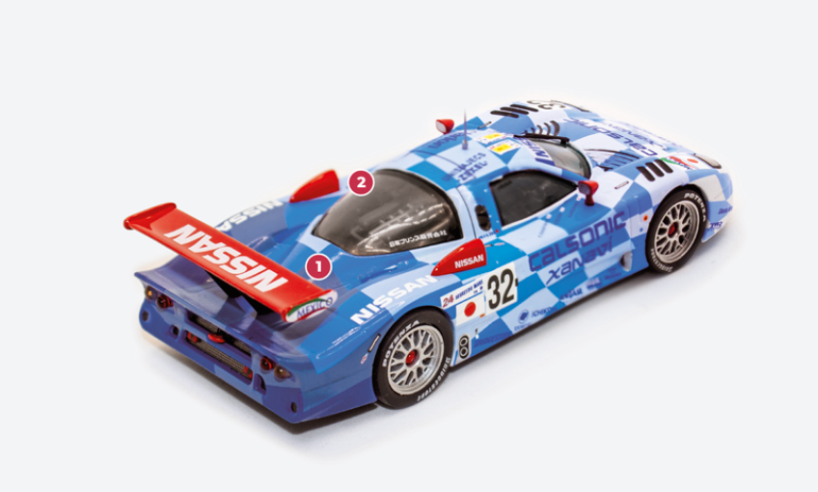
1. The 1998 Nissan R390 GT1 stands out in particular for its elongated rear end compared to the previous year's model.
2. The twin-turbo 3.5-litre V8 engine is similar to that of the previous Group C cars. Suitably revised and despite the intake restriction, it develops over 650 bhp.
© IXO Collections SAS - Tous droits réservés.
Four improved cars were built for the 1998 season (plus a road model), but Nissan only brought three of them onto the track, in combination with a 1997 model that had been adapted to the new specifications, which was used in both the preliminary rounds and during the race. To improve their chances, Nissan Motorsport enlisted experienced drivers such as Jan Lammers and John Nielsen, who had achieved victories for TWR-Jaguar a few years earlier. However, this change did not bring the desired result: during the preliminary rounds in May, the three new cars finished in sixth, seventh and eighth place, while the fourth only managed sixteenth. In the tests in June, Franck Lagorce achieved the best result with a tenth place. The R390 GT1 remained slower than its competitors, but ultimately proved to be more reliable. And although they did not pose a real threat to the Porsche 911 GT1-98, which finished first and second, all cars made it to the finish line. The number 32 took third place on the podium with its Japanese crew consisting of Aguri Suzuki, Kazuyoshi Hoshino and Masahiko Kageyama, while the other three cars finished fifth, sixth and tenth.
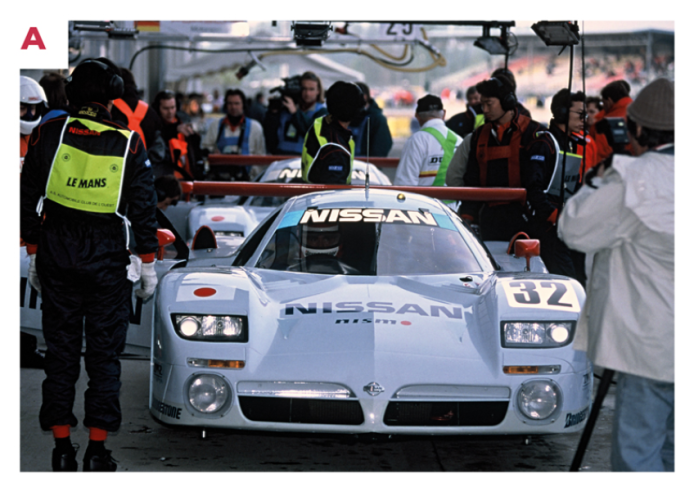
A. Pictured is the Nissan R390 GT1 during pre-qualifying in May 1998, when the car was still without a sponsor, as evidenced by the absence of any branding on the nose. The car finished eighth with Japanese drivers Hoshino and Suzuki at the wheel.© IXO Collections SAS - Tous droits réservés.
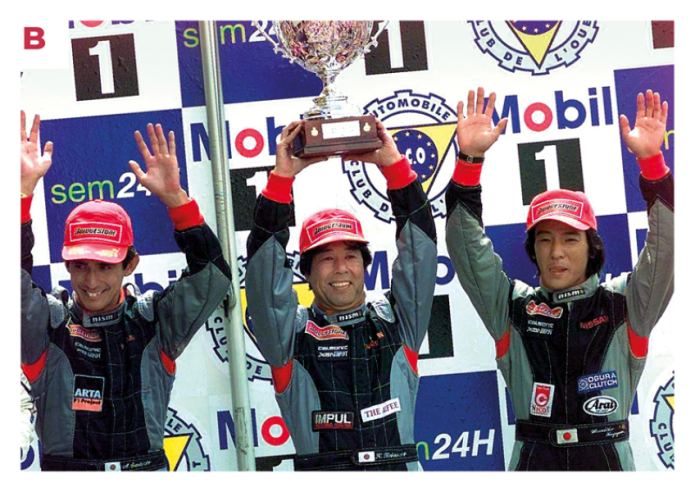
B. From left to right: Aguri Suzuki, Kazuyoshi Hoshino and Masahiko Kageyama celebrating their third place in the 1998 24 Hours of Le Mans.© IXO Collections SAS - Tous droits réservés.
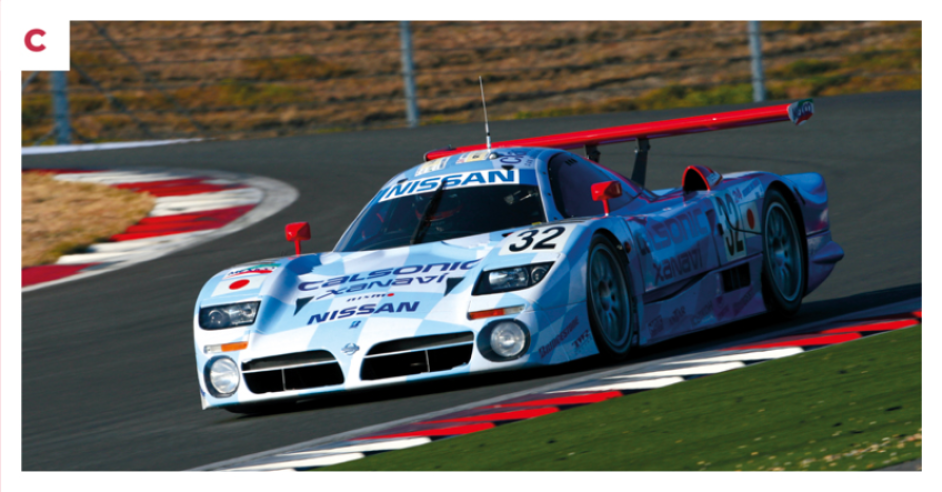
C. The R390's front end features the signature two-aperture grille design of Nissan cars of that era.© IXO Collections SAS - Tous droits réservés.
Recent articles