 English
 français
 Deutsch
 español
 italiano
 português













19/04/2026
Porsche 911 GT3 RS - 2001
Porsche 911 GT3 RS
BASED ON THE 1999 911 GT3 R, THE RS NOT ONLY ACHIEVED CLASS WINS AT LE MANS BUT ALSO OVERALL VICTORIES AT DAYTONA
Introduced in 1997, the Porsche 911 ‘996’ series was revolutionary in its design and marked the transition to liquid-cooled engines. With this model, the company developed a new competition version, compliant with the FIA GT3 regulations, and launched in spring 1999 as the 911 GT3 R. The car immediately achieved remarkable results in the FIA GT Championship and at the 24 Hours of Le Mans, where it won its class two years in a row. This success story continued in 2001 with the arrival of the 911 GT3 RS, winning not only in its own class but also across various categories, with several teams entering multiple cars in the FIA GT Championship and other competitions.
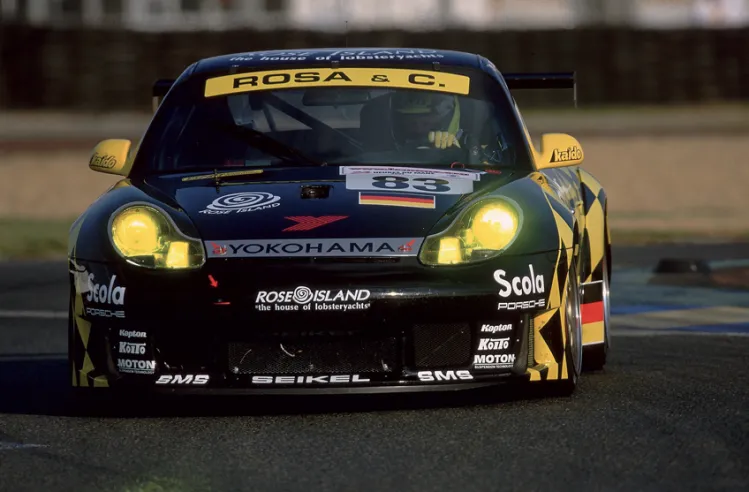
© IXO Collections SAS - Tous droits réservés.
FROM 2001 TO 2003, THERE WAS LITTLE ROOM FOR OTHER GRAND TOURISM MODELS
The 2001 season kicked off with the official test sessions in January at Daytona (according to history, there was actually one car that took part in the 2000 Final Test), which saw seven 911 GT3 RS cars in action. Entered by five different teams, including the German Seikel Motorsport team (the only one, alongside the American The Racers Group, to enter two cars), the cars all finished between 34th and 56th place. At the end of the month, the team from Stuttgart secured its first victory in Brazil (repeating the feat the following year). A few days later, at the 24 Hours of Daytona, two of the GT3 RS cars – out of a total of 12 on the starting grid – took second and third places respectively for the White Lightning and Freisinger teams. This time, the Seikel team secured a creditable 5th place with drivers Gabrio and Fabio Rosa, Alex Caffi and Fabio Babini. The Porsche sports coupe continued to score podium finishes, victories and class wins in numerous races, including the 12 Hours of Sebring with the Alex Job team, the 6 Hours of Watkins Glen with G&W, and the 1000 km of Estoril once again with Freisinger. Meanwhile, the Seikel Motorsport team secured two successive triumphs in endurance races, taking first place in its class at the 1,000 km of Monza and the 24 Hours of Le Mans, finishing 7th and 6th overall respectively.
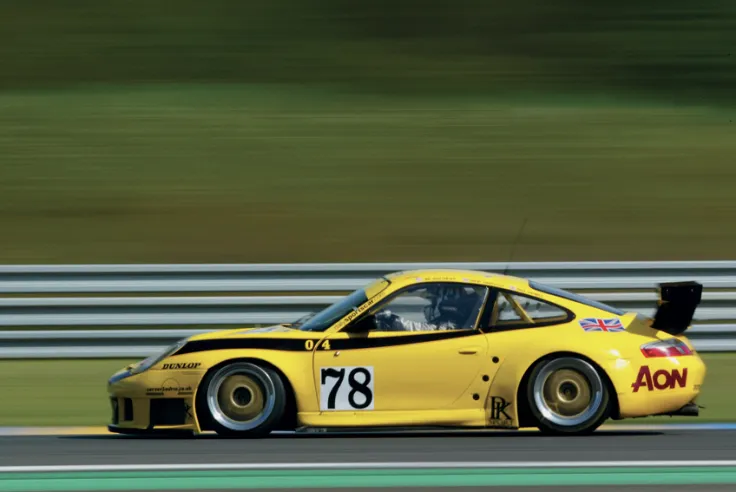
The 911 GT3 RS entered by the British PK Sport team was one of ten cars taking part in the April 2004 test at Le Mans, where it set the 47th fastest time.© IXO Collections SAS - Tous droits réservés.
[AHEAD OF THE CALLAWAY… AND THE FERRARIS]
At Le Mans, with the 911 GT3 RS models accounting for almost all the cars entered in the LMGT class, they faced a formidable rival in the Callaway C12-R, a highly sophisticated front-engined GT car based on the Chevrolet Corvette and entered by the Aspen Knolls MCR team, which, during qualifying, finished ahead of all ten Porsches and set the fastest time in this class. But the situation changed for the American car during the race, as it had to retire before the 100th lap due to engine overheating, clearing the way for the German cars. Of the two Seikel cars, victory went to car no. 33, piloted by Gabrio Rosa, Fabio Babini and Luca Drudi – practically the same line-up that was the centre of attention at Monza, with Drudi replacing Fabio Rosa. Behind them, less than a lap behind, was Freisinger's best crew, consisting of Frenchmen Romain Dumas and Philippe Haezebrouck and American Gunnar Jeannette, who managed to keep the fastest of the official Corvettes at bay, winners of the LMGTS class. Four other Porsches followed, including Seikel’s second team of Tony Burgess, Max Cohen-Olivar and Andrew Bagnall, finishing 12th overall and 6th in their class.
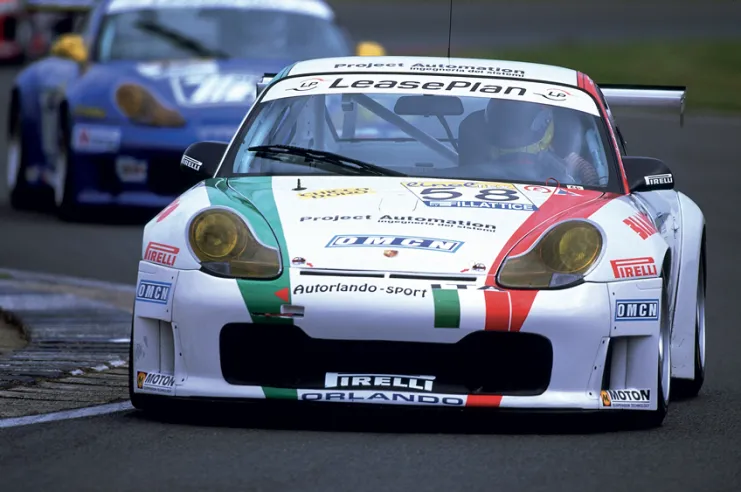
At the 2002 Silverstone 500 km, the best-performing GT3 RS was that of the Autorlando Sport team, finishing 13th overall and second in its class.© IXO Collections SAS - Tous droits réservés.
ALMOST UNBEATABLE IN GT
The year 2002 proved even more successful for the 911 GT3 RS, which dominated its class in almost every endurance race, with Alex Job's team taking the honours with three victories (Sebring, Road America and Petit Le Mans) followed by Racers Group, which won at Daytona and Le Mans yet failed to secure a podium finish. Seikel's greatest successes were a 2nd place at Sebring and a 4th at Le Mans. History repeated itself more or less in 2003, but this time it was the experienced Racers Group that enjoyed success, securing a significant overall victory at Daytona with drivers Kevin Buckler, Michael Schrom, Timo Bernhard and Jörg Bergmeister, finishing nine laps ahead of the Ferrari 360 Modena GT of their rivals Risi Competizioni. A few months later, Freisinger achieved the same result at the 24 Hours of Spa with Stéphane Ortelli, Marc Lieb and Romain Dumas, finishing ahead of the BMS Ferrari 550 Maranello. In 2004, the 911 GT3 RS underwent a minor update that gave it a slight boost in power. Both the R and the RS would continue to compete for a few more years before the arrival of a new evolution of the 996 race car, the RSR.
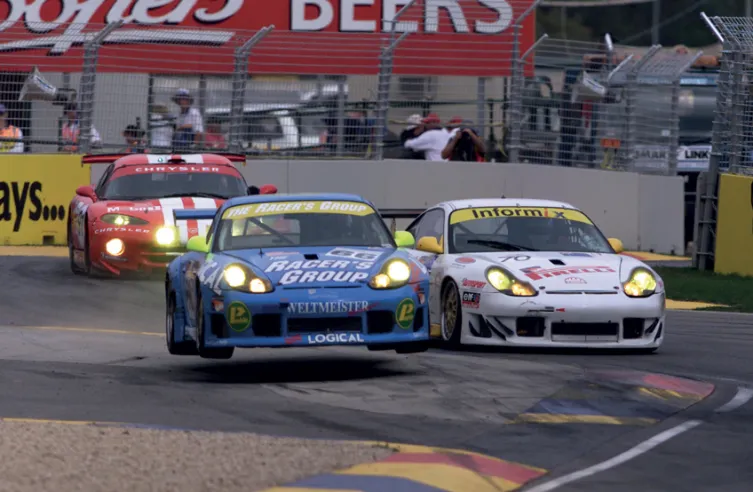
Two 911 GT3 Rs competing on the Adelaide circuit in the final round of the 2000 Le Mans Asia-Pacific Series.© IXO Collections SAS - Tous droits réservés.
GABRIO ROSA, FABIO BABINI ET LUCA DRUDI
The three drivers that won the GT class at Le Mans in 2001 followed fairly similar career paths. The eldest of the three is Gabriele ‘Gabrio’ Rosa, from Bergamo, born in 1954. After gaining experience in rallying, he turned his attention to endurance racing starting in the 1990s. His name is closely associated with Porsche, particularly from 1999 onwards when he began racing in the 911 993 GT2 and later the 996 GT3 R for the Haberthur and Seikel teams, competing in European races and the American Le Mans Series. He competed in the 24 Hours of Le Mans three times between 2000 and 2004, recording his best result in 2001. Fabrio Babini, born in Faenza in 1969, competed in the FIA GT Championship, the ALMS and Formula 3. He took part in Le Mans on several occasions, securing two second-place finishes in his class in 2008 and 2009 driving a Ferrari F430 for the BMS team. As for Luca Drudi, born in 1962 in Rimini, his successful 2001 result followed that of 1998 with the Oreca team, with whom he secured victory in the GT2 class at the wheel of a Chrysler Viper GTS-R shared with Justin Bell and David Donohue, sons of legendary racing drivers Derek Bell and Mark Donohue.
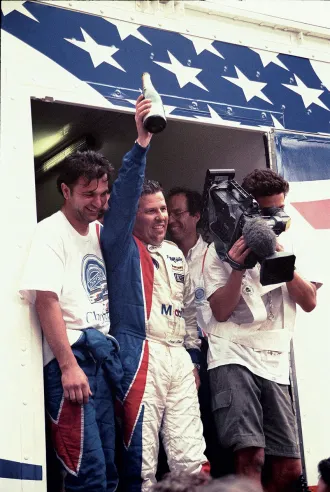
Luca Drudi (centre) celebrates 11th place overall and first in the GT2 class at the 1998 24 Hours of Le Mans with the Oreca team’s Viper
© IXO Collections SAS - Tous droits réservés.
Technical sheet
Recent articles