 English
 français
 Deutsch
 español
 italiano
 português













28/04/2023
Porsche 917K - 1971
Les mythes du Mans Porsche 917K
Author : Cette collection est une adaptation de 24H Le Mans ® Le auto delle corsa più leggendaria al mondo Éditeur : Centauria Editore s.r.l.
Read moreAfter a successful season in 1970, the 917 seemed to be at the start of a long career, until bad news arrived. The FIA announced that from 1972 onwards, the maximum cylinder capacity for sports cars would be limited to three litres. However, Porsche's showpiece made a glorious farewell by winning again at Le Mans with the “short” version.
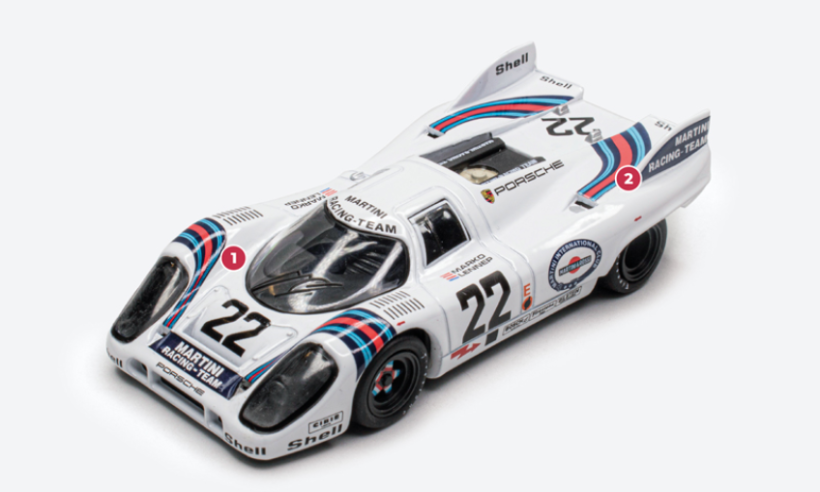
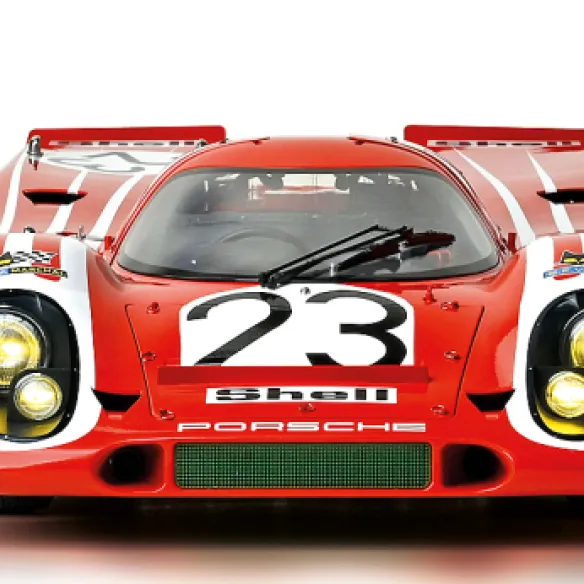
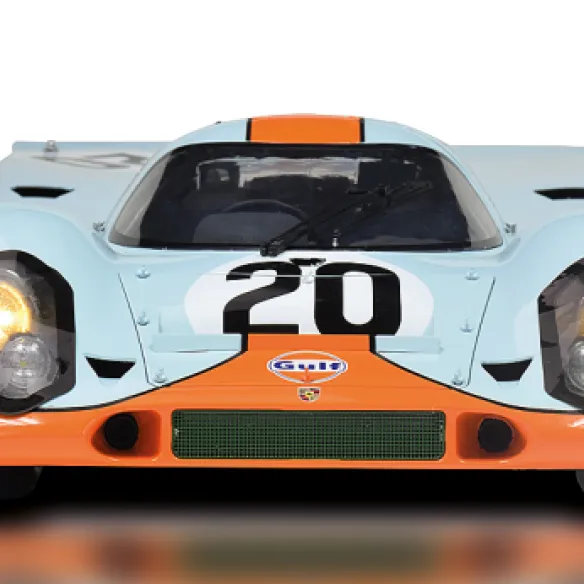
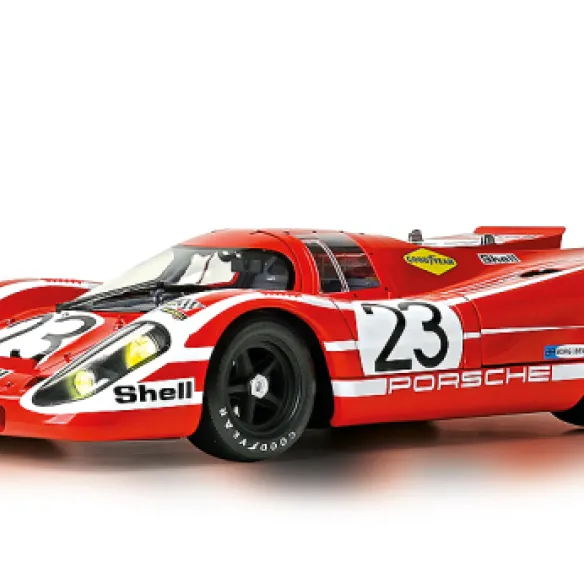
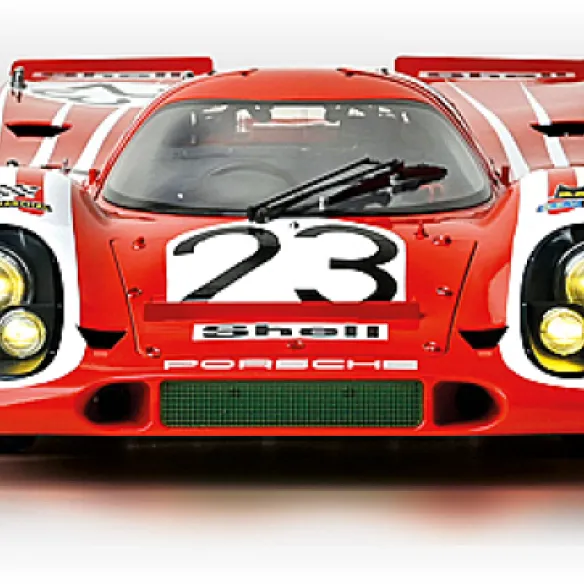
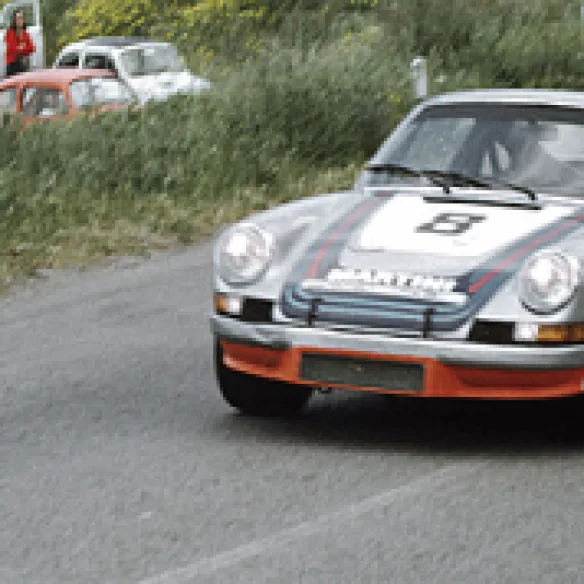
1. The car driven by the Porsche Martini team that won the 1971 Le Mans 24 Hours is one of the few 917 Ks to feature an aluminium and magnesium alloy chassis.
2. The short-tail version known as the ‘K’ (from the German Kurzheck, meaning ‘short tail’) was developed in late 1969 to solve the stability problems of the first series production 917, which had a body similar to that of the 908 coupé.© IXO Collections SAS - Tous droits réservés.
Although 1971 was the last year in which the 917 actively participated in the World Championship for Sports Prototypes, it was a successful season. The car won almost all the races it entered: the 1000 km of Buenos Aires, the 1000 km of Spa, the 24 Hours of Daytona, the 12 Hours of Sebring and the 1000 km of Monza, before registering at Le Mans with almost ten cars, divided between the official team and the satellite teams. These included a number of long-tail versions, which were favourites on circuits such as La Sarthe with its very long straights thanks to their improved aerodynamics, as well as the remarkable 917/20, nicknamed the “pink pig”, a version that was an attempt to combine the characteristics of the “KH” and the “LH”. During the qualifying races, the first three places went to three 917 LHs, ahead of two Ferrari 512 Ms, Porsche's great rivals, followed by Porsche Martini's 917 K with Helmut Marko and Gijs van Lennep at the wheel, and then the 917/20. During the race, the “long” cars are faster, but they lack stamina: between the 9th and 18th hour, engine and transmission problems, oil leaks and accidents eliminate the 917s, including the “pink pig”, leaving only the official “K” of Martini and that of the English team J.W. Automotive team, owned by Richard Attwood (winner in 1970 with Hans Herrmann in the colours of the Salzburg team) and Herbert Müller, remain on the track.
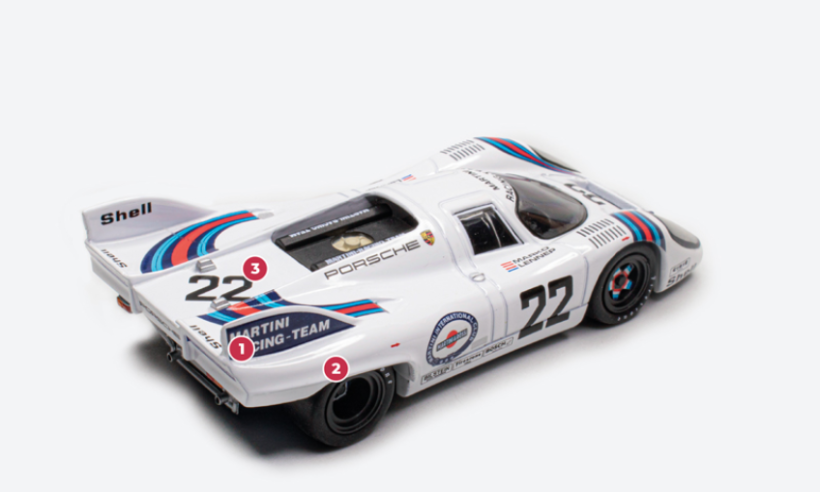
1. Some 917 Ks have a smooth rear end with a movable spoiler mounted at the end of the middle passage, while others, like this one, have two side fins that act as stabilisers.
2. Apart from being shortened and redesigned, the rear end of the Porsche 917 K was also made wider to accommodate wider tyres.
3. The 917 K that won at Le Mans in 1971 was fitted with a 4.9-litre 180° V12 engine producing 600 bhp. But by the end of 1970, a 5-litre version producing 630 bhp was available.© IXO Collections SAS - Tous droits réservés.
Their task was to keep the Ferrari 512 M and the competitive Matra-Simca MS 660 at bay, which, after leading for a long time, dropped out six hours before the finish due to mechanical problems. The two Porsches then extended their lead and battled for victory: Marko and Van Lennep finished with 397 laps, two more than their rival teammates, leaving the first Ferrari of Sam Posey and Tony Adamowicz, driving for the North American Racing Team, more than 30 laps behind.
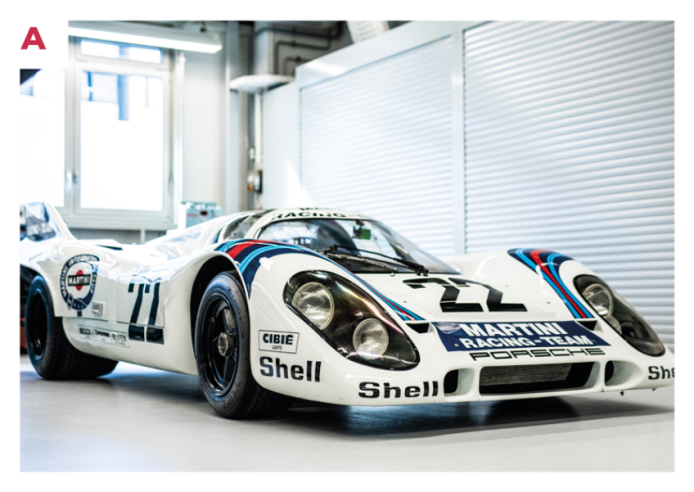
A. The 917 of the Porsche Martini team races in different liveries: the one that won at Le Mans in 1971 is white, but there are also silver versions and ‘psychedelic’ ones in yellow/red and green/purple.© IXO Collections SAS - Tous droits réservés.
After Le Mans, the 917 K won again at the Österreichring with John Wyer's team and drivers Richard Attwood and Pedro Rodriguez, while the final race of the championship, at Watkins Glen, was won by Autodelta and the Alfa Romeo T33/3. The Italian team thus secured three victories (including the Targa Florio and the 1000 km of Brands Hatch) and 51 points, while the Martini and J.W. team's 917 K, with seven wins in total (plus one with the 908/3 at the Nürburgring), earned Porsche the World Manufacturers' Championship title with 72 points. In 1972, several 917 Ks were entered in smaller races. One of them, with modified bodywork and a 5.4-litre engine, competed in several Interserie races for David Piper's team. Another 917 K raced in the Brazilian Cup at Interlagos, winning a race with Wilson Fittipaldi.
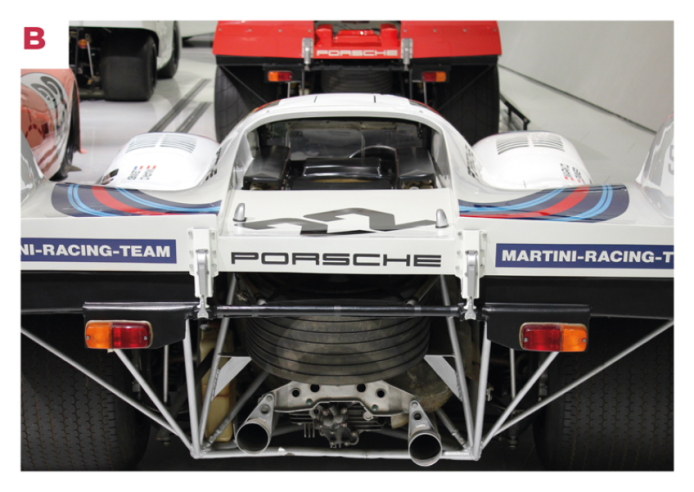
B. Apart from the two exhaust pipes coming out under the crossbar, the rear view shows the mandatory spare wheel housed above the differential.© IXO Collections SAS - Tous droits réservés.
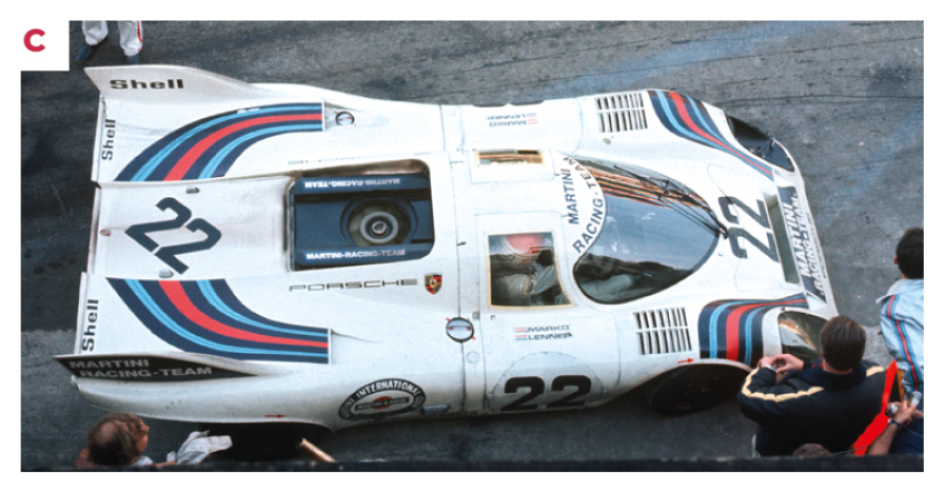
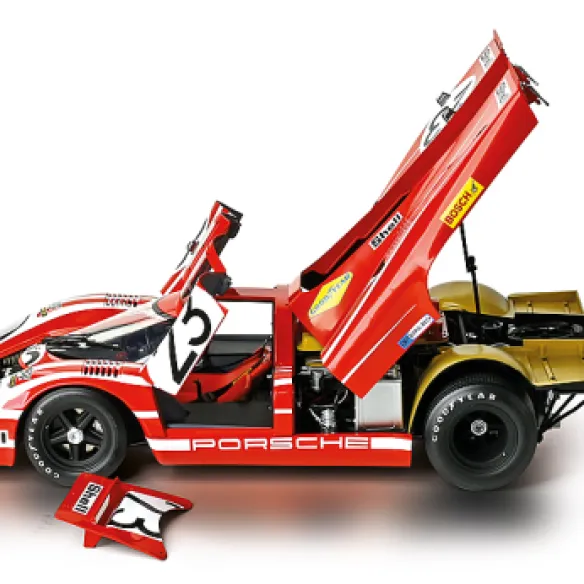
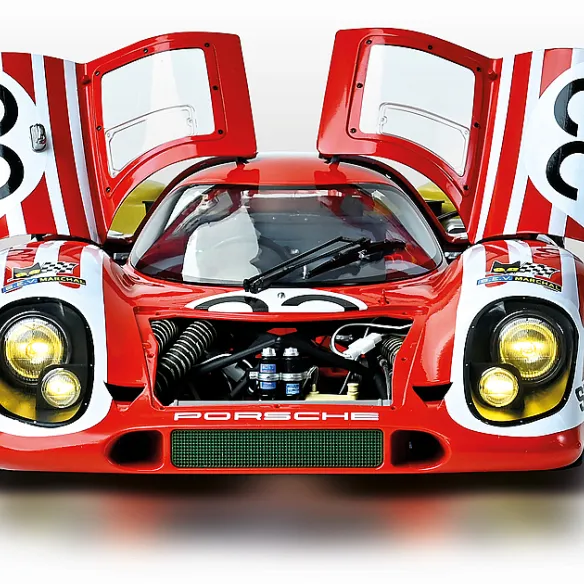
C. The bonnet reveals the top of the engine and a large fan that draws air under the body to improve downforce.© IXO Collections SAS - Tous droits réservés.
Recent articles