 English
 français
 Deutsch
 español
 italiano
 português













09/12/2025
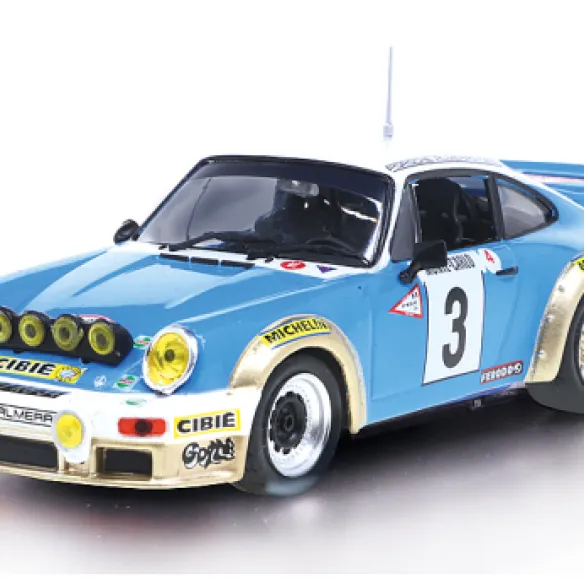
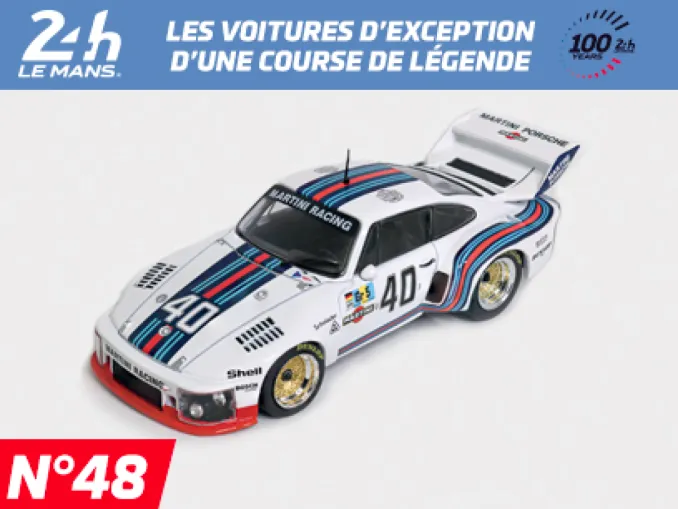
Porsche 935 - 1976
PORSCHE 935
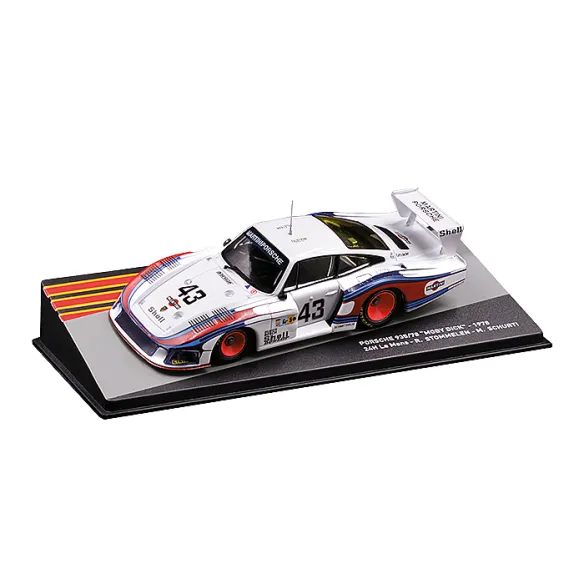
The Porsche 935, destined to become the most famous of the ‘silhouettes’, made its debut in 1976 and immediately became the queen of the new Group 5. For its first 24 Hours of Le Mans, it narrowly missed out on a podium finish.
The 1976 FIA regulations reshaped the landscape of racing cars and the GT category. The new Groups 4 and 5 welcomed cars derived from production models; in the case of Group 5, greater freedom was allowed for modifications, enabling cars to be prepared that could compete with the Group 6 prototypes that competed in a separate championship. Porsche took advantage of this to enter a new car in each category: in Group 6, a 936 barquette with a 2.1-litre turbo engine; and in Groups 4 and 5, the 934 and 935, derived from the street 911 Turbo (designated ‘930’).
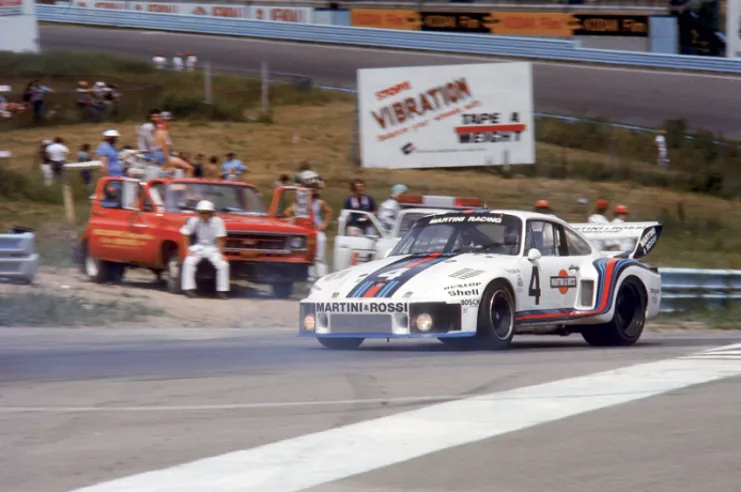
In 1976, the 935 won four of the seven events in the World Championship for Manufacturers, including the 6 Hours of Watkins Glen with Rolf Stommelen and Manfred Schurti at the wheel.© IXO Collections SAS - Tous droits réservés.
The 935 exploited every possibility offered by the regulations. Initially, it even had a body similar to that of the street model, broadened but respecting the silhouette of the production model (hence the nickname given to the category). After successes in the first two events of the World Championship for Manufacturers (open to Groups 1 to 5), namely the 6 Hours of Mugello and Vallelunga won by the duo Jochen Mass and Jacky Ickx, project manager Norbert Singer decided to make an even bolder revision to the car's design. The regulations allowed modifications to the wings, but did not specify that the headlights had to remain in the same position as on the production model. Taking advantage of this ‘ omission’, Porsche changed the typical front end of the 911, with its two headlights placed at the ends of the wings, to a new, lowered, sloping nose in which the headlights were mounted at a very low position. This solution greatly improved aerodynamics, giving an added advantage to a car that was already highly competitive thanks to its new 2.8-litre turbo engine and a meticulous revision of the chassis.
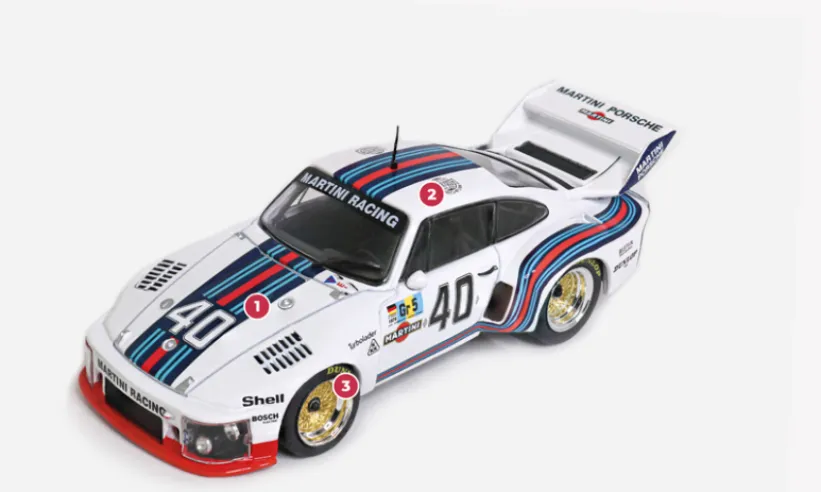
1. Plastic and fibreglass/resin doors and bonnet, and Plexiglas windows reduce the weight to 900 kg. Since the minimum weight imposed on the 4-litre engine category is 970 kg, Porsche takes advantage of this margin to install ballast weights that improve the car's balance.
2. The Group 5 regulations require the body of the production model to be retained, hence the name ‘silhouette’ given to this category.
3. Thanks to the freedom given by the regulations, Porsche replaced the torsion bars with coil springs and added an adjustable front anti-roll bar.© IXO Collections SAS - Tous droits réservés.
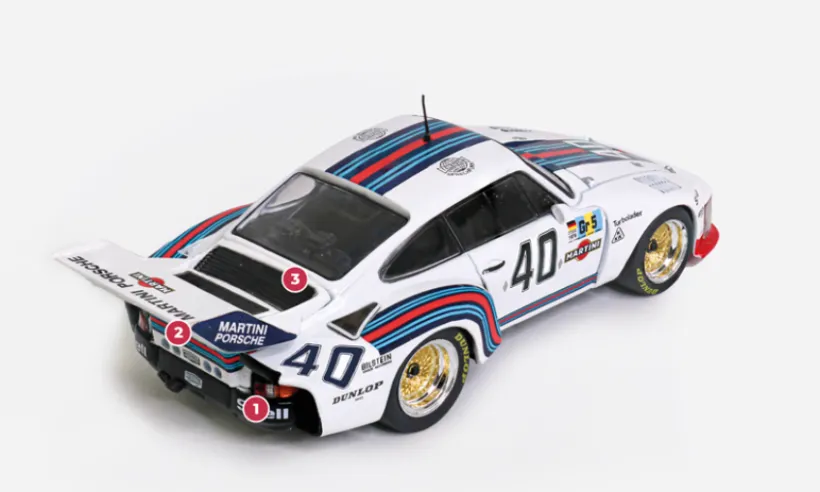
1. Like the 934, the first version of the 935 was equipped with a large turbocharger, which from 1977 onwards was replaced by two smaller turbos.
2. Turbo engines are subject to a cubic capacity equivalence coefficient of 1.4. To be homologated in the maximum 4-litre category, the actual displacement of the 935 had to be limited to 2.8 litres.
3. Initially, Porsche installed a higher bonnet to make room for the large heat exchanger that cooled the turbo air, but the FIA insisted that the standard bonnet shape be retained.© IXO Collections SAS - Tous droits réservés.
At Silverstone, the official 935 finished tenth, while the Kremer team with Bob Wollek and Hans Heyer finished second. In the following race at the Nürburgring, the official Porsche drivers, who were registered for the Monaco Formula 1 Grand Prix, were replaced by Rolf Stommelen and Manfred Schurti, who claimed pole position with the new front end before being disqualified , as were the Kremer crew as a result of unauthorised repairs, handing over victory to the BMW 3.5 CSL. These two cars once again appeared at the 24 Hours of Le Mans (outside of the World Championship for Manufacturers and the Championship for Sport-Prototypes), which welcomed all categories and, above all, where Groups 5 and 6 battled it out for overall victory. The prototypes monopolised the podium, but the official 935, with Schurti and Stommelen as drivers, put up a fierce fight during qualifying, where it clocked the third fastest time. In the race, it finished fourth just behind the 936 driven by Jacky Ickx and Gijs van Lennep, the first Mirage M8 and the De Cadenet Lola.
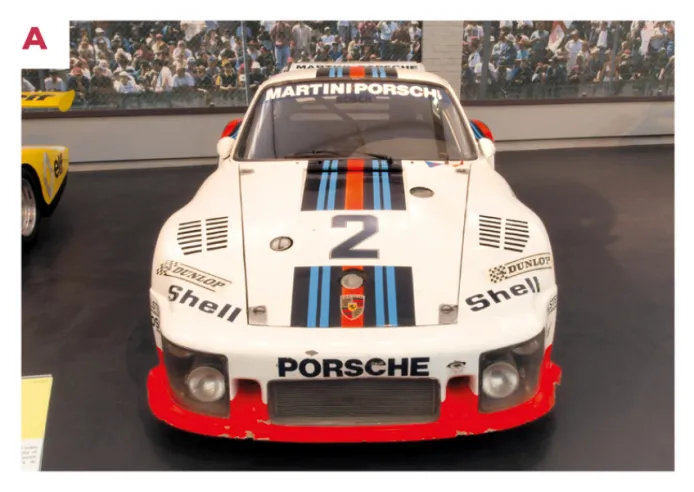
A. The nose of the 935, with its headlights integrated into the lower section, increased the car's speed while improving aerodynamic penetration.© IXO Collections SAS - Tous droits réservés.
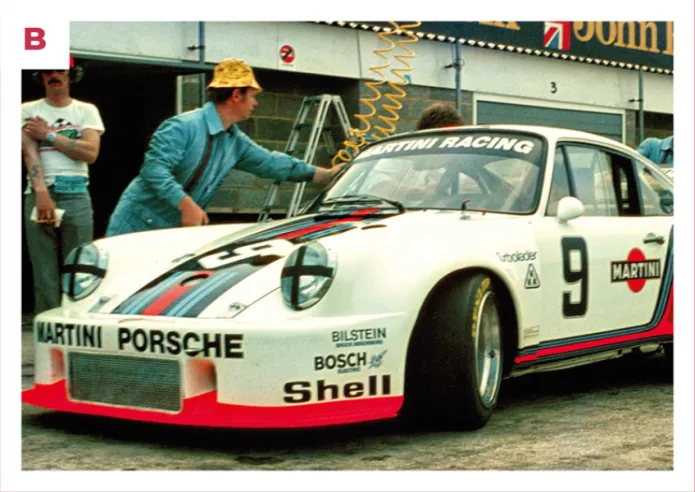
B. The 935 driven by Jacky Ickx and Jochen Mass at the 1976 Silverstone 6 Hours. The front end, identical to that of the standard 911, was modified shortly afterwards.© IXO Collections SAS - Tous droits réservés.
As the season progressed, BMW began to make a comeback, dominating in Austria, but Porsche's victories at Watkins Glen and Dijon secured them the World Manufacturers' Championship title.
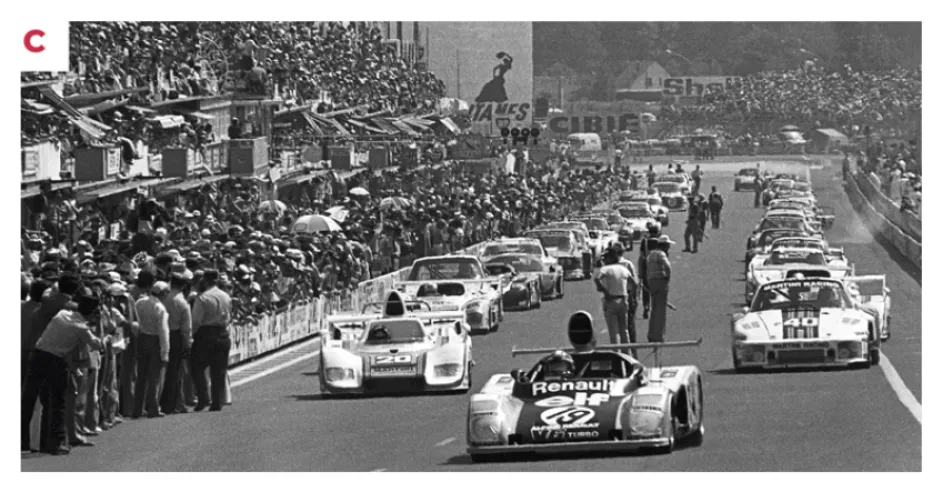
C. The 1976 Le Mans 24 Hours starting grid: Schurti and Stommelen's 935 is third behind Jabouille-Tambay-Dolhem's Alpine Renault A442 and Ickx and Van Lennep's 936.© IXO Collections SAS - Tous droits réservés.
Recent articles