 English
 français
 Deutsch
 español
 italiano
 português













19/04/2026
Porsche 962C - 1987
Porsche 962C
The 962 was an evolution of the 956, designed to meet the safety standards introduced by IMSA in 1984, and to race in America. Its series of victories at Le Mans continued, adding two consecutive wins to its four previous successes. The last victory, in 1987, also marked the debut of the new 3-litre engine developing nearly 800 bhp.
The Porsche 962 was born a winner. Essentially a 956, it benefited from a roll cage and a longer wheelbase to position the front axle in front of the pedals, thereby providing better protection for the drivers, in accordance with the regulations imposed by the IMSA in 1984 following a series of accidents that fuelled widespread criticism regarding the safety of many prototypes.
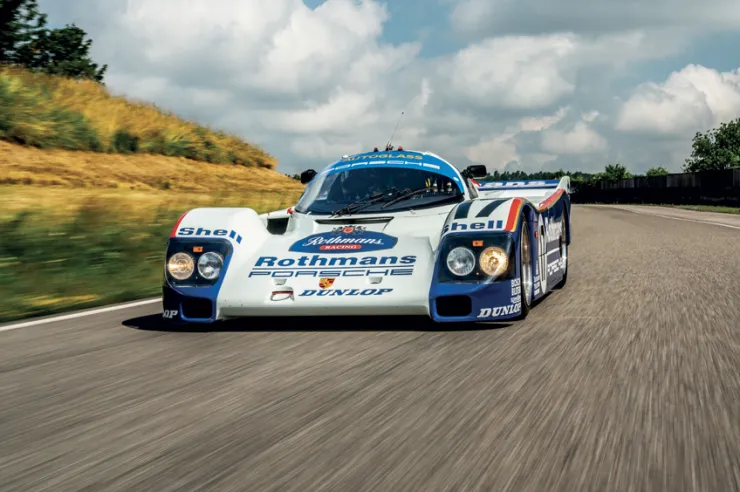
The car that won at Le Mans in 1987, chassis 006, began its career at the Spa 1000 km race the previous year, finishing seventh with Jochen Mass and Bob Wollek. © IXO Collections SAS - Tous droits réservés.
The start of the World Sportscar Championship (WSC) coincided with the FIA adopting the same regulations in 1985, while allowing existing cars to continue racing for another two years. Cars competing in this championship had slightly different specifications to those competing in IMSA events, where the use of single turbochargers was permitted. The FIA-approved version in Group C, designated 962C, inherited the 2.65-litre twin-turbo 6-cylinder boxer engine from the 956, undergoing various cylinder capacity increases over the following years.
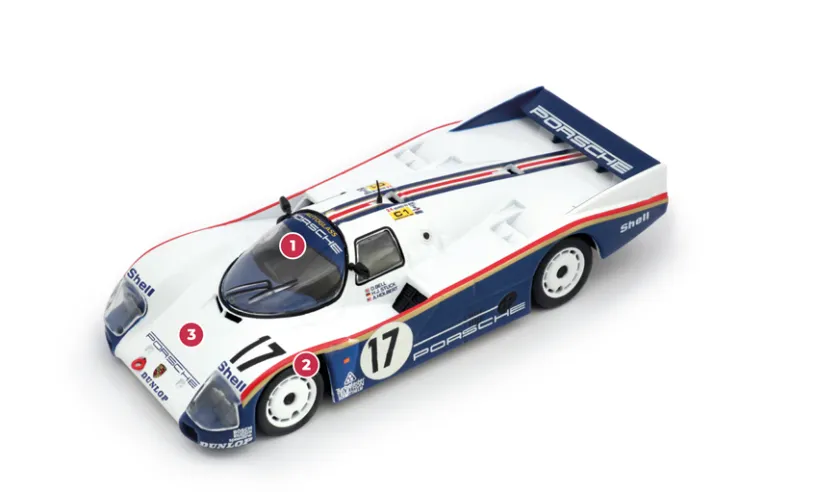
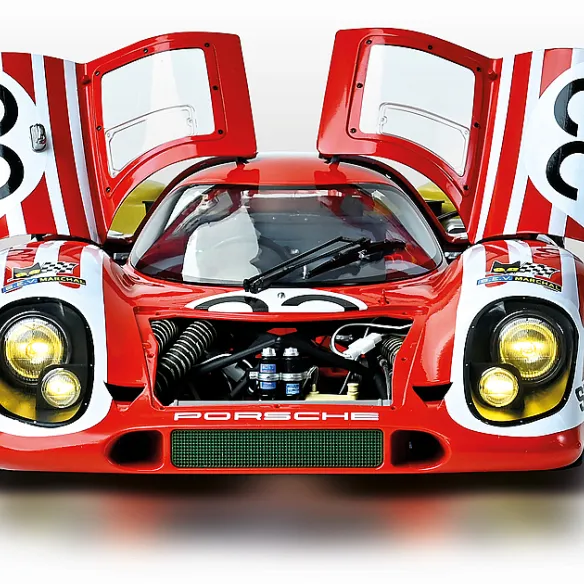
1. Another innovation is the roll cage installed to protect the driver's compartment. The increase in weight of a few dozen kilograms is offset by greater rigidity and a more powerful engine.
2. The wheelbase of the 962 is 12 cm longer, which is enough to move the front axle forward in front of the pedals. However, the overall length is the same as that of the 956.
3. The winner at Le Mans in 1987 was an ‘original’ 962 built in accordance with the rule changes. From 1987 onwards, many 956s that were no longer eligible to race were converted into 962s.© IXO Collections SAS - Tous droits réservés.
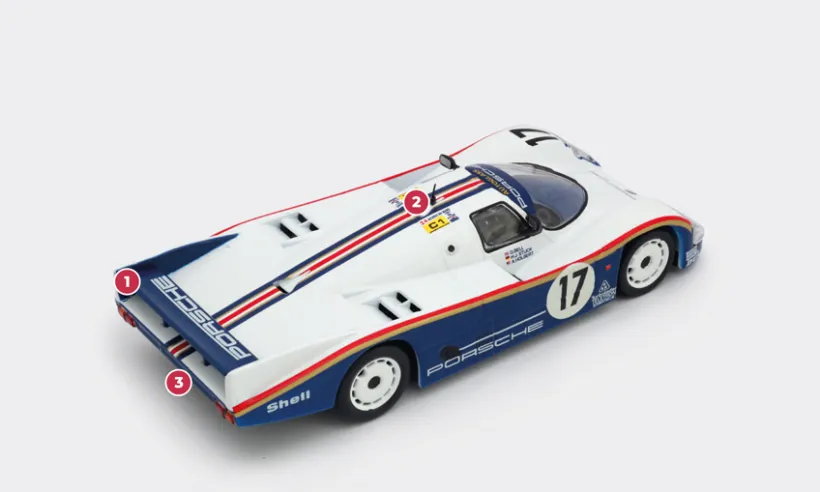
1. Like the 956, the 962 benefited for Le Mans from a special aerodynamic configuration adapted to the circuit, characterised by a rear bonnet of the same length but with a lower, horizontal spoiler to enhance top speed on the straights.
2. The 3-litre engine producing nearly 800 bhp, which made its debut in 1987, was the second evolution of the original 2.65-litre twin-turbo boxer engine from the 965, first increased to 2.85 litres, then to 3 litres, and finally to 3.2 litres, but still as reliable as ever.
3. The engine and gearbox serve as load-bearing elements. The gearbox, integrated with the engine, acts as a support for the upper suspension mountings.© IXO Collections SAS - Tous droits réservés.
Victory at Le Mans did not come immediately, although the brand was once again rewarded, with the 1985 edition marking the fourth consecutive win for a 956. Recognition for the 962 came in 1986 with the official Rothmans Porsche team and specialist drivers Derek Bell, Al Holbert and Hans-Joachim Stuck at the wheel. This result was repeated in 1987, when the official Porsches benefited from a 3-litre engine producing nearly 800 hp, introduced in selected races during the spring. Bell, Holbert and Stuck each scored their personal double victory (in fact, Bell had already won two successive editions in 1981 and 1982 with Jacky Ickx) during this season in which Porsche lost the world title and supremacy in Group C, which was taken over by a new queen, the Silk Cut Jaguar XJR-8. The latter won eight out of ten races, leaving the German brand with only the 24 Hours of Le Mans and the Norisring (where the private Liqui Moly Equipe team won with a modified 962C GTi) in addition to two early season successes at the 24 Hours of Daytona and the 12 Hours of Sebring, both of which were not part of the WSC calendar.
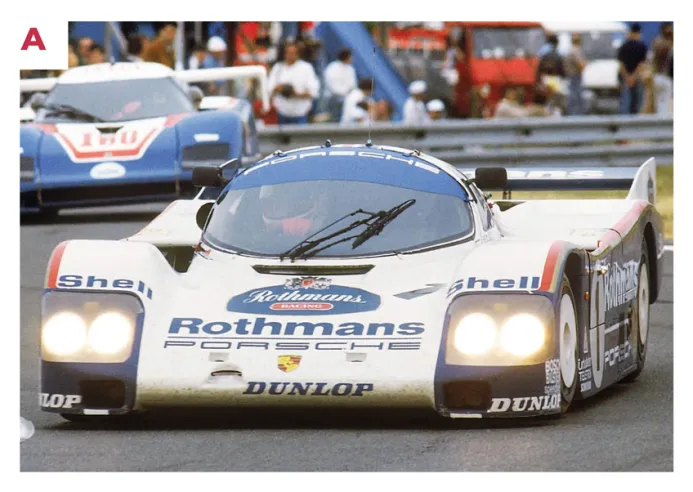
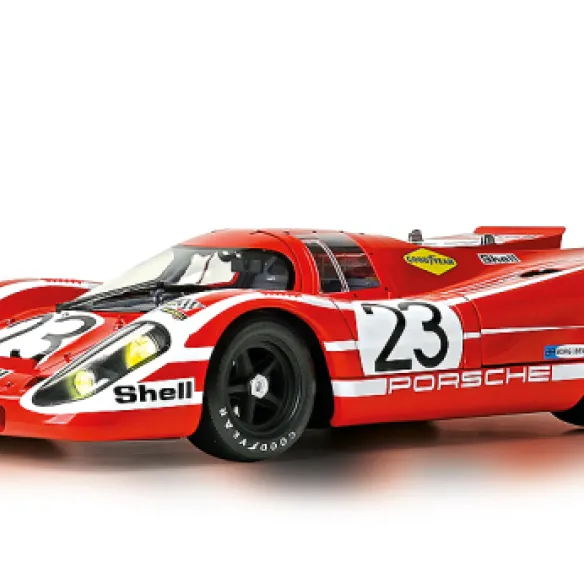
A. The 962C that won at Le Mans in 1986. It has the same colours and crew members as the car that won in 1987, also finishing second in practice. © IXO Collections SAS - Tous droits réservés.
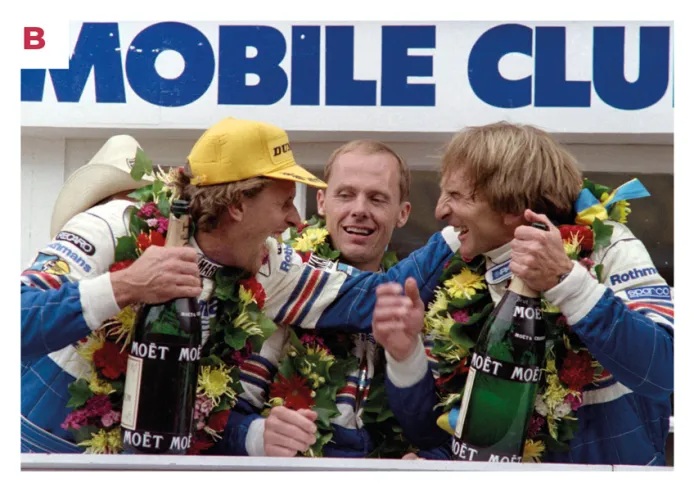
B. From left to right, Hans-Joachim Stuck, Al Holbert and Derek Bell celebrating their second consecutive victory at Le Mans on 14 June 1987. © IXO Collections SAS - Tous droits réservés.
Despite the difficulties affecting Porsche in the days leading up to the race, the atmosphere in Sarthe was different. The team lost one of its four cars in an accident during practice, prior to the start of the Le Mans race; a second car suffered the same misfortune during qualifying, where Bob Wollek's 962C managed to secure pole position, ahead of defending champions Stuck, Bell and Holbert and three Jaguars. But during the race, Wollek, who was racing alongside Jochen Mass and Vern Schuppan, found himself quickly eliminated by the new fuel being supplied by the ACO, which caused a veritable massacre among the 962s, forcing several private cars to retire from the race within an hour of the start. The 1986 winners weren't affected and triumphed with a 20-lap lead over another 962, that of the French team Primagaz Compétition, that also secured a podium finish for a Cougar C20.
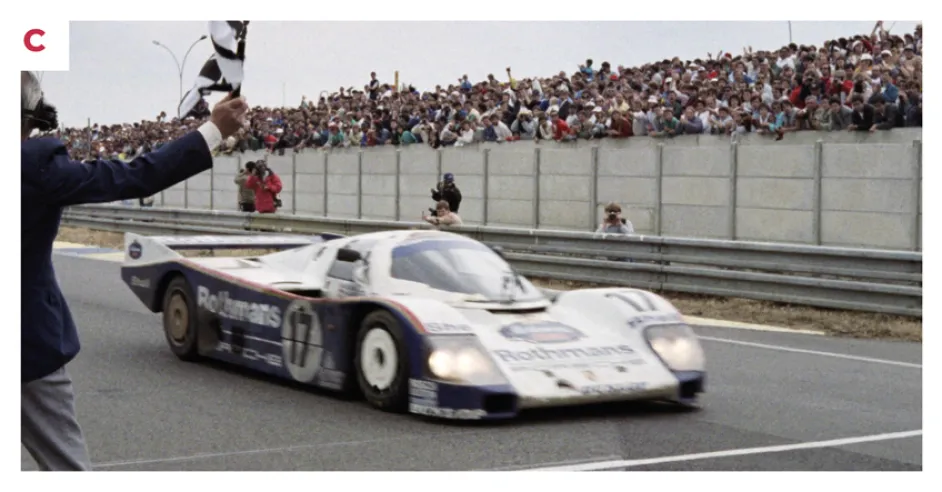
C. After its victory at Le Mans in 1987, this 962C appeared in the following edition, but in the yellow and red colours of Shell, before returning to the Rothmans livery as it made its way into the Porsche Museum. © IXO Collections SAS - Tous droits réservés.
Recent articles