 English
 français
 Deutsch
 español
 italiano
 português













10/05/2023
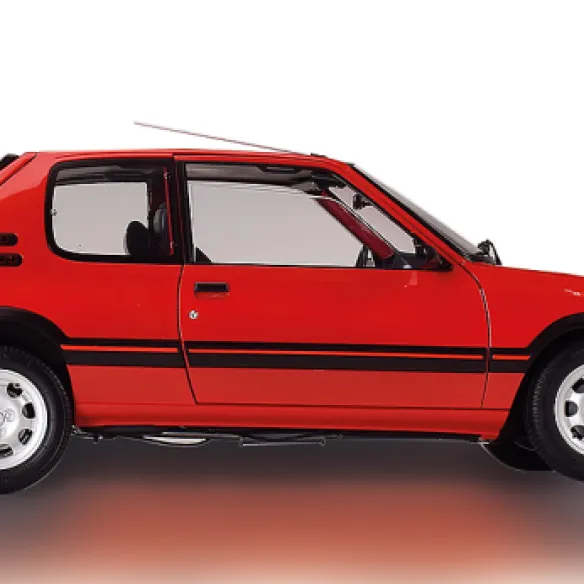
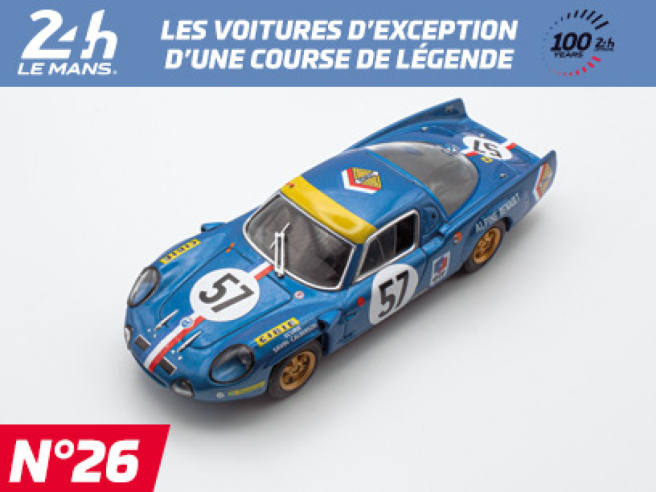
Renault Alpine A210 - 1968
ALPINE A210
Author : Cette collection est une adaptation de 24H Le Mans ® Le auto delle corsa più leggendaria al mondo Éditeur : Centauria Editore s.r.l.
Read moreThe Le Mans 24 Hours of 1966 are best remembered for Ford's victory over Scuderia Ferrari. This epic duel was accompanied by other great successes, such as that of the little French Sport-Prototype, the Alpine A210, which raced from 1966 to 1968 in three engine classes and won the under 1,150cc class twice.
The car's origins can be traced back to the “M63” project launched by Jean Rédélé, founder of the small Dieppe-based brand a few years earlier. After obtaining Renault engines, which he initially planned to install in a chassis derived from the Lotus 23, Rédélé worked from scratch on a prototype car inspired by the Lotus, initially with a central beam chassis, later replaced by a tubular trellis in accordance with the new technical regulations.
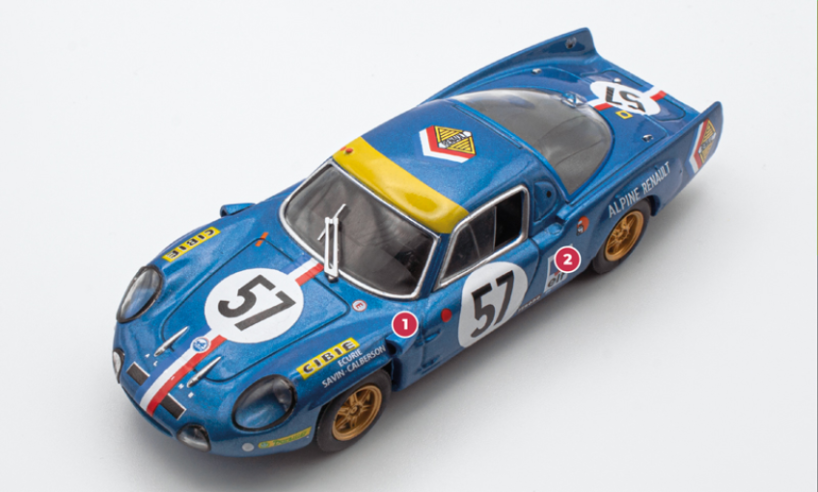
1. The Alpine A210 features more refined aerodynamics. The air intakes in front of the doors are taken from the M64.
2. The first Alpine M63, from which the A210 was derived, initially had a central beam chassis inspired by that of a Lotus, later replaced by a tubular steel trellis to comply with the new technical regulations.
© IXO Collections SAS - Tous droits réservés.
The objective of Alpine's creator was to win the fuel efficiency index and the performance index at the 1963 Le Mans 24 Hours, as well as victory in the under 1-litre category. But the attempt failed: after a promising start, the M63s were forced to withdraw three times, one of which was a fatal accident that cost the life of Brazilian Christian Heins. In 1964, the brand returned with the M64, an evolution with a 1,149 cm3 engine, which this time won the fuel efficiency index and the category Prototypes under 1,150 cm3. The following year, with the M65 powered by a 1.3-litre engine, Alpine won its class at the 12 Hours of Reims and the Nürburgring 500 km, but at Le Mans all the Alpines dropped out.
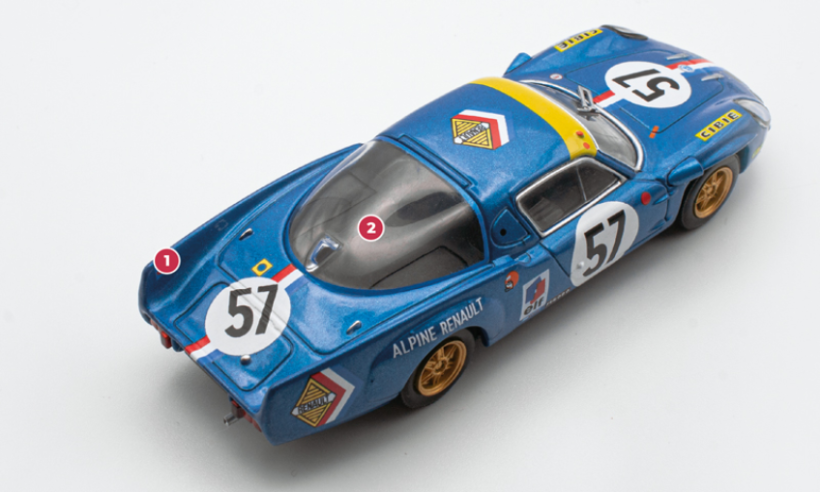
1. The Alpine A210 has a typical ‘long tail’ configuration, with the lateral fins slightly angled inwards.
2. The car driven by Le Guellec and Serpaggi, which came ninth at Le Mans in 1968, was powered by a Renault Gordini engine upgraded from 1.3 to 1.5 litres.
© IXO Collections SAS - Tous droits réservés.
For 1966, the car was redesigned, particularly in terms of aerodynamics. This led to the creation of the A210, of which six cars were entered: one with a one-litre engine in the sub-1.15-litre class and five with a 135bhp 1.3-litre engine.
During qualifying, the fastest A210 was the No. 47 of Pauli Toivonen and Bernt Jansson, which was forced to retire due to a broken connecting rod. The fleet of French cars remained constantly on the tail of the Ferraris, who in turn attempted to attack the Porsches and the super-powerful Ford GT40s.
In the end, one Alpine succeeded in breaking the 10th-place barrier: the No. 62 driven by Henri Grandsire and Leo Cella of the official Alpine team, finishing 9th and first in the under 1.3-litre category. The other three cars took 11th, 12th and 13th place. The trio also won the fuel efficiency index, Alpine monopolising the podium with a victory for Roger Delageneste and Jacques Cheinisse from the Savin-Calberson team.
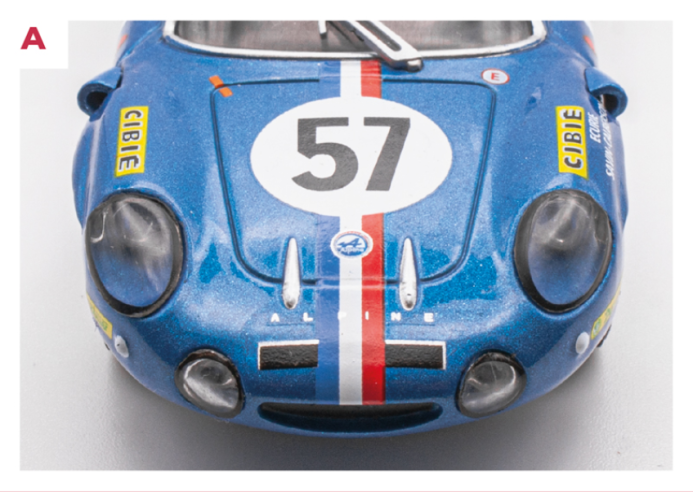
A. The front end has clean, streamlined lines with fully integrated main and auxiliary lights.
© IXO Collections SAS - Tous droits réservés.
Changes to the regulations prompted Alpine to develop the V8-powered A220 for the 1968 season. In the meantime, the A210 repeated its 9th place at Le Mans (the first in the class), again with Grandsire and José Rosinski. The same result was achieved in 1968 when Alain Le Guellec and Alain Serpaggi (Savin-Calberson team) finished 9th ahead of three A210s (the Jean-Luc Thérier and Bernard Tramont team winning the 1.3-litre category). Jean-Pierre Nicolas and Jean-Claude Andruet won the performance index and, as in 1966, three Alpines dominated the fuel efficiency index.
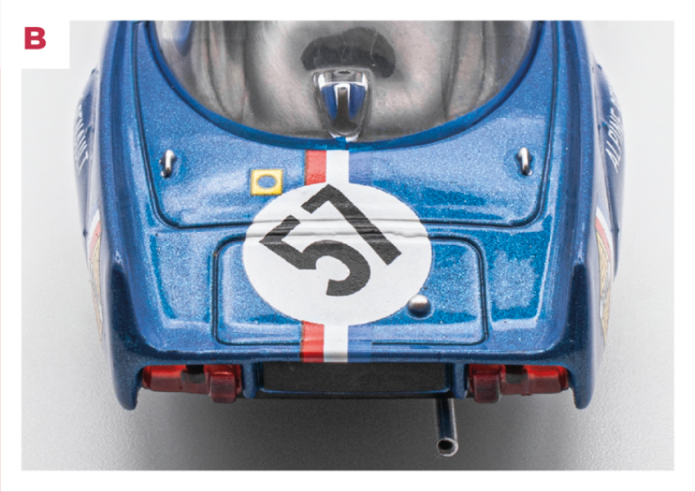
B. The bodywork features a large bonnet and hatches at the rear for easy access to the engine without compromising the aerodynamics.
© IXO Collections SAS - Tous droits réservés.
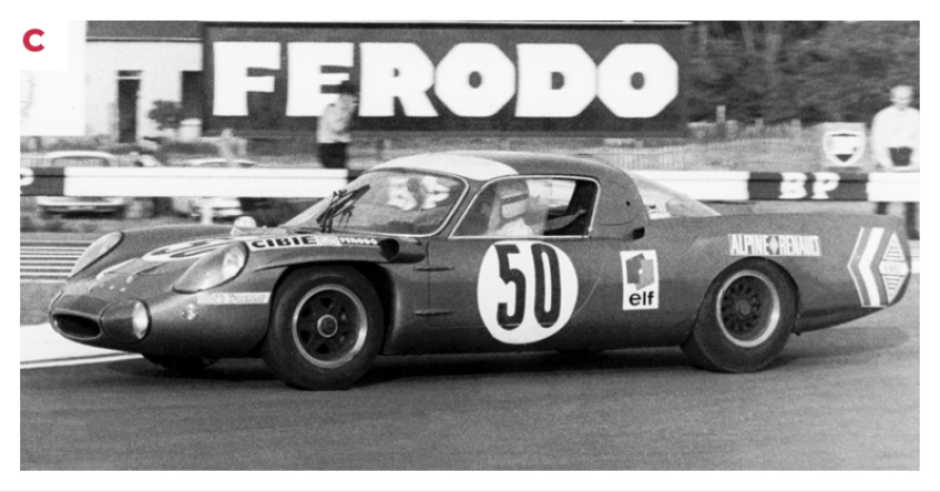
C. The A210 No. 50 driven by Alain Serpaggi and Christian Ethuin finished twelfth and first in the 1.5-litre class at Le Mans in 1969. The team also won the special performance index classification.
© IXO Collections SAS - Tous droits réservés.
Recent articles