 English
 français
 Deutsch
 español
 italiano
 português















25/11/2025
Aston Martin DBR9 – 2008
Aston Martin DBR9
Two years after its debut, the English coupé, developed for the new GTI category, achieved a class victory at Le Mans in 2007. The following year, this success was confirmed once again after a fierce battle against its Chevrolet rivals.
The GTI category, which was redefined in 2005, did not produce the same cars as ten years earlier, with cars that could claim overall victory at Le Mans. Although the new GTIs were still derivatives of production models, and even of genuine supercars such as the Maserati MC12, Lamborghini Murciélago and Saleen S7, they were no longer prototypes “disguised” as road cars, such as the Porsche 911 GTI and the Dauer 962. And while some sometimes achieved more than honourable places, they did not really reach the level of the LMPs.
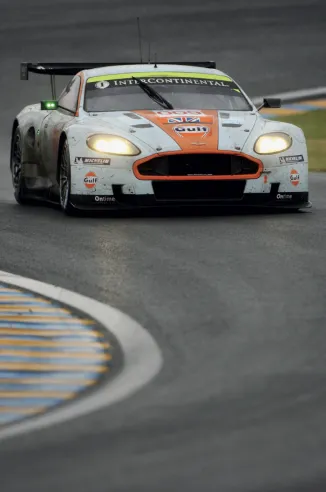
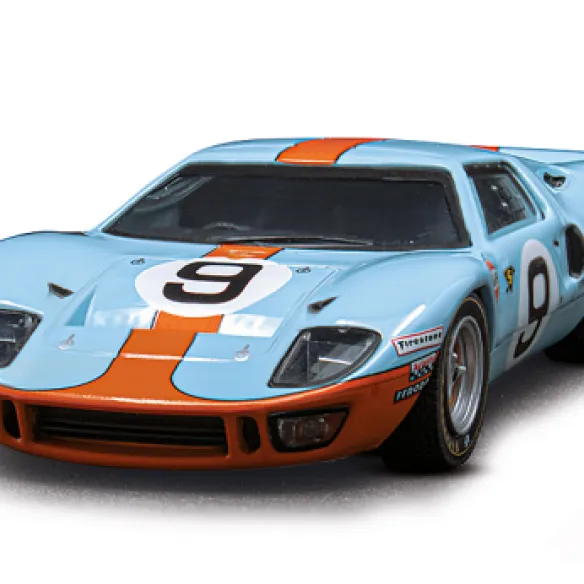
For the 2008 edition of the 24 Hours of Le Mans, where it secured its second consecutive class victory, the official Aston Martin team's DBR9 wore the historic light blue and orange livery of its sponsor Gulf.© IXO Collections SAS - Tous droits réservés.
Aston Martin seized this opportunity to collaborate with the Prodrive team to produce a genuine GTI racing car based on the DB9 (a 2+2 coupé). It was named the DBR9, a reference to the glorious DBR1 that won the 24 Hours of Le Mans in 1959 with Carroll Shelby and Roy Salvadori.
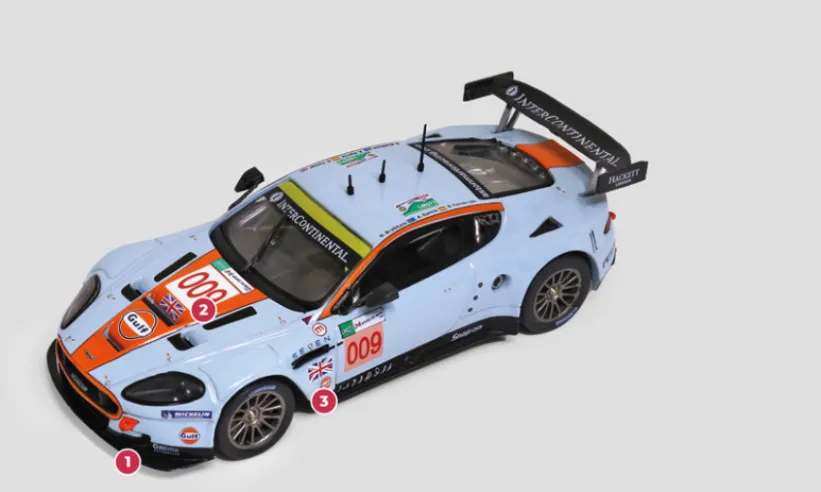
1. A generous aerodynamic splitter, also made of carbon fibre, is mounted at the bottom front end.
2. The 6-litre V12 engine retains the block and cylinder heads from the road version. It develops up to 620 hp, but is mounted more centrally because the gearbox has been moved to the rear axle.
3. The wider wings of the Aston Martin DBR9 are ‘mixed’: half carbon fibre and half aluminium.© IXO Collections SAS - Tous droits réservés.
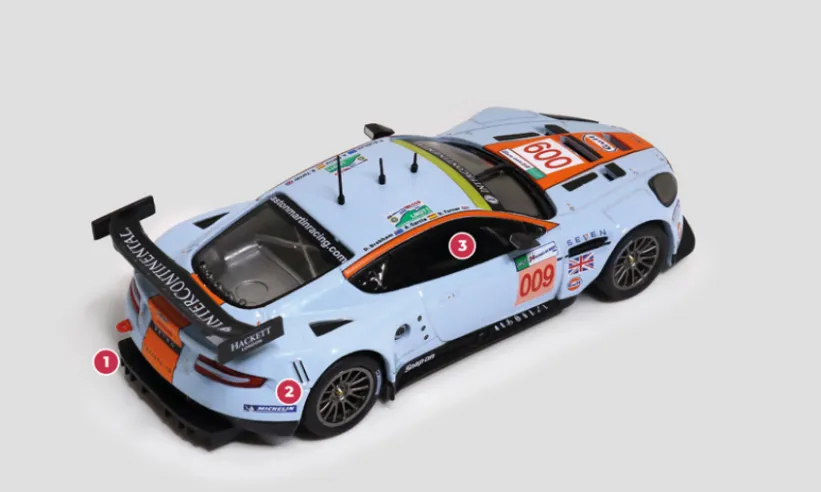
1. In addition to the rear wing, the Aston Martin DBR9 is equipped with a large, prominent air extractor.
2. The XTrac sequential gearbox is mounted as a single unit with a rear differential to better balance the car's weight.
3. The body is reinforced by a roll cage visible in the passenger compartment.© IXO Collections SAS - Tous droits réservés.
The British GT, which had more than 600 hp and optimal balance, was unable to compete with the Chevrolet Corvette during its first two seasons in the American Le Mans Series and the FIA GT Championship, despite a promising start with a victory in its class at the 12 Hours of Sebring in 2005. In 2005, Aston Martin finished fifth in the team rankings (in ALMS) and the manufacturer championship (in FIA GT). But in 2006, the brand finished first in Europe and second in America, without winning the drivers' championship. At Le Mans, an event not contested by the official Aston Martin team, the best DBR9 finished 9th in 2005 and 6th in 2006, well behind the Corvette C6R, which narrowly missed the podium in 2006.
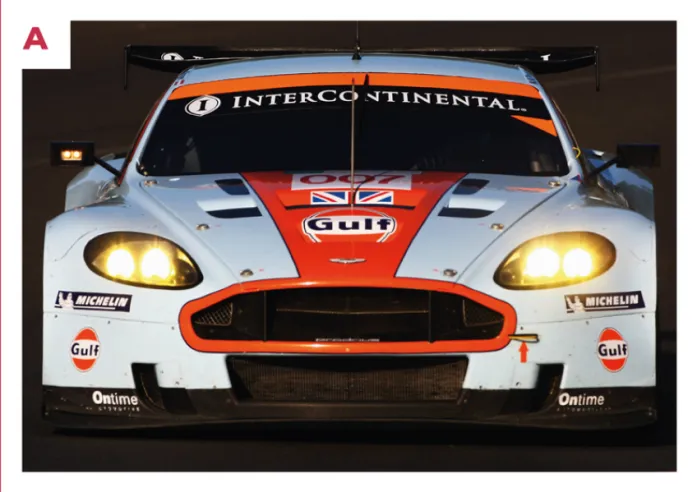
A. Front view of the Aston Martin DBR9: note the positioning of the asymmetrical mirrors, designed to give the best possible angles.© IXO Collections SAS - Tous droits réservés.
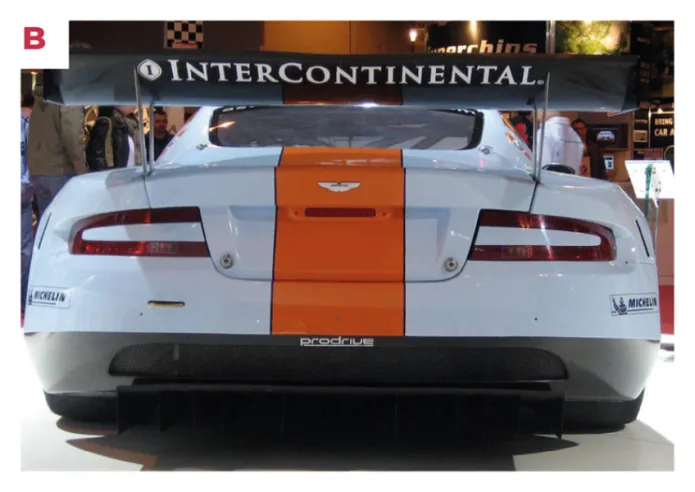
B. The large rear spoiler extends to the very edge of the bodywork.© IXO Collections SAS - Tous droits réservés.
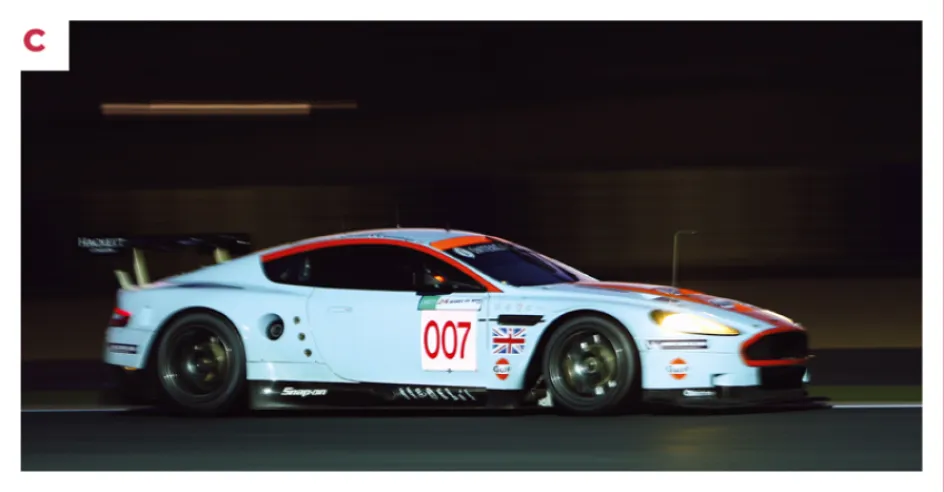
C. In 2008, the second official DBR9 entered in the race was driven by German driver Heinz-Harald Frentzen, Italian Andrea Piccini and Austrian Karl Wendlinger. It finished 16th, five laps behind its faster twin.
© IXO Collections SAS - Tous droits réservés.
For 2007, however, Aston Martin opted for a different approach: the official team competed at Le Mans with the numbers 007 and 009, two cars that had been significantly improved in terms of both performance and driving comfort to comply with the new ACO regulations. Together with the four cars from the private teams BMS, Larbre and Modena, success was finally achieved: the DBR9 009, driven by David Brabham, Darren Turner and Rickard Rydell, took victory in its class. The team fought fiercely with the Corvettes behind the leading group of LMP1 prototypes, a group that gradually shrunk during the race, allowing the DBR9 to climb to fifth place and taking a lap lead over the official Corvette No. 63, which in turn had a one-lap lead over the first Aston Martin of the Larbre team.
The Corvette and Maserati MC12 dominated the American Le Mans Series and FIA GT Championships; they also achieved victories in 2008, while Aston Martin once again dominated the GTI class at Le Mans. The success was once again thanks to the 009, driven by Turner and Brabham, assisted by third driver Antonio Garcia. Less impressive was the overall final classification, with only thirteenth place, and the lead over the first Corvette, still number 63, was less than a lap, but the satisfaction was great.
Recent articles