 English
 français
 Deutsch
 español
 italiano
 português















09/12/2025
Toyota GT-One - 1998
Toyota GT-one
The Toyota of the late 1990s, initially classified in GT1 and then ‘“redirected” to Prototypes, failed to win the 24 Hours of Le Mans due to technical problems and strategic mistakes. It finished second in 1999.
During the second half of the 1990s, Toyota pursued its dream of achieving an outright victory at Le Mans. Toyota took advantage of new regulations that favoured the creation of cars that were theoretically derived from street models but were in fact very similar to prototypes. In addition, the technical commission removed the requirement to produce at least 25 units to obtain homologation and in 1998 the green light was given for the first street model.
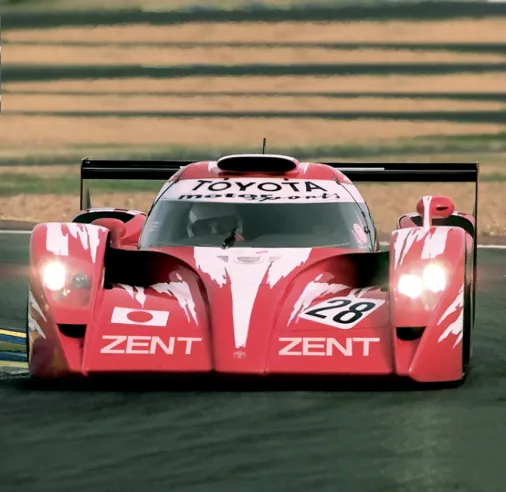
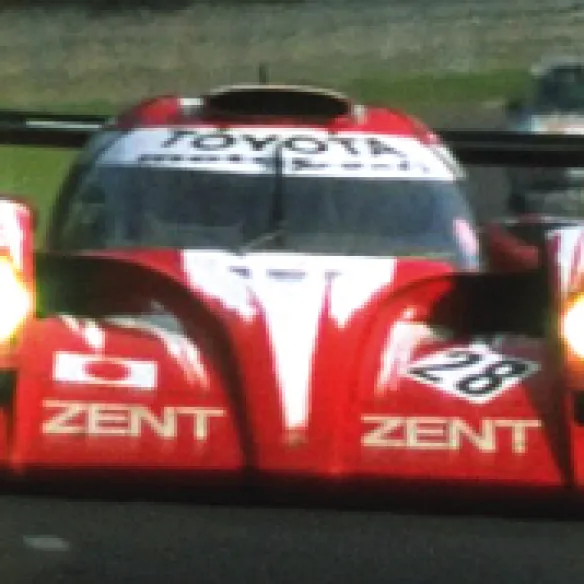
The Toyota GT-One was designed in 1997 to race exclusively at Le Mans, with its front section designed to make it faster on long straights.© IXO Collections SAS - Tous droits réservés.
The result was the GT-One (internally codenamed TS020), a closed-body car with an aluminium and carbon fibre chassis designed by André de Cortanze and developed in both Japan and Germany (although the chassis was manufactured in Italy by Dallara), where the European motorsport department of Toyota is based. The 1998 debut was encouraging at first, before turning into a catastrophe. During the pre-qualifying session at Le Mans in May, one of the participating cars, driven by Martin Brundle and Emmanuel Collard, achieved the second fastest time overall, while the other two finished fifth and tenth. But the situation changed during the race. During qualifying, Brundle and Collard were only beaten by Bernd Schneider's Mercedes CLK-LM, with the other two Toyotas finishing 7th and 8th.
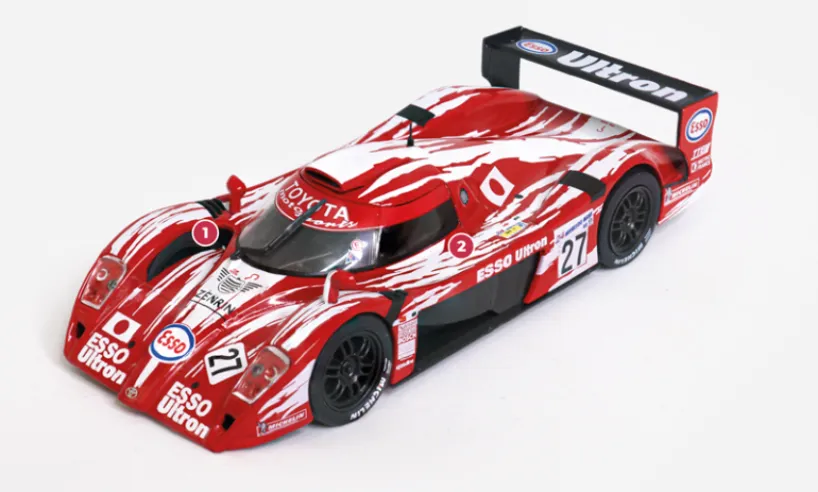
1. The wheel arch apertures serve to reduce air pressure in the wings.
2. The body is made of carbon fibre with an aluminium honeycomb structure.© IXO Collections SAS - Tous droits réservés.
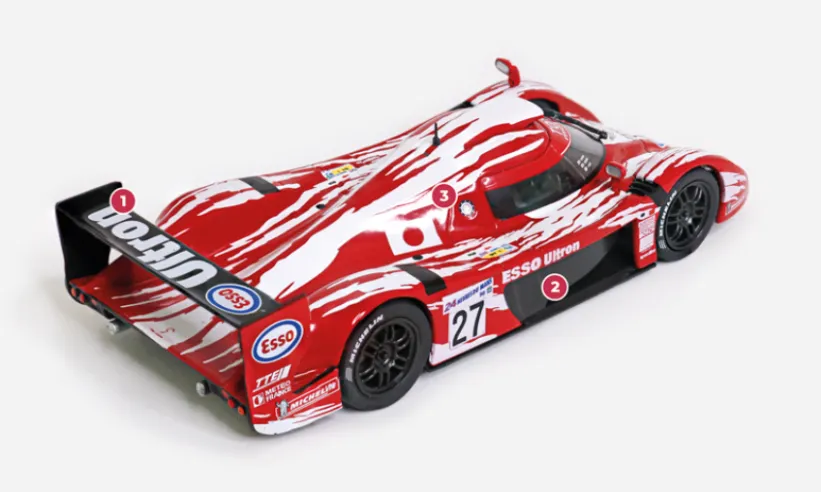
1. The monoplane rear spoiler has a simple shape and minimal incidence, favouring high speeds.
2. The large side apertures also help to optimise the escape of air accumulated in the muzzle.© IXO Collections SAS - Tous droits réservés.
The Japanese team's hopes of victory remained alive at the start of the race when technical problems forced the Mercedes and BMW V12s out of the race, leaving the Japanese team in the lead. But the GT One cars suffered a number of reliability issues and, despite spending long periods in the lead, they eventually had to give up victory to the Porsche 911 GT1-98, which was set to capitalise on the withdrawal of car no. 29 with Thierry Boutsen, Ralf Kelleners and Geoff Lees at the wheel, which had been forced to retire less than two hours before the finish due to a gearbox problem. When Brundle, Collard and Eric Hélary's car was forced out of the race on lap 191 after running off the track, the honour of defending Toyota fell to the third crew, consisting of Japanese drivers Ukyo Katayama, Toshio Suzuki and Keiichi Tsuchiya, who would only finish in ninth place.
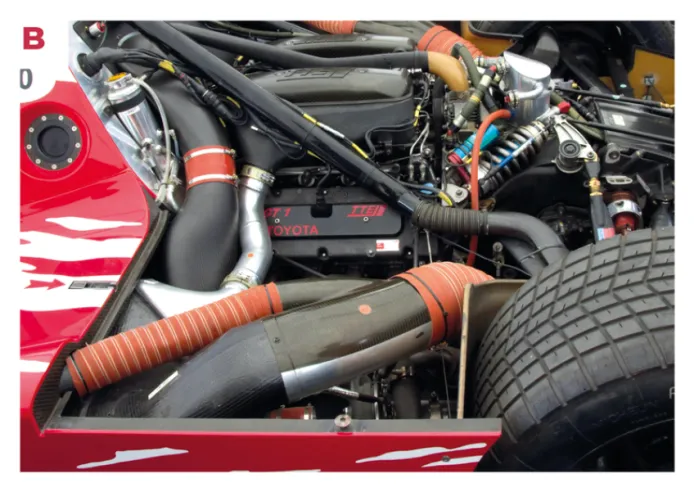
A. At the front, the asymmetrical placement of the large rear-view mirrors is striking, compensating for the limited visibility through the windscreen.© IXO Collections SAS - Tous droits réservés.
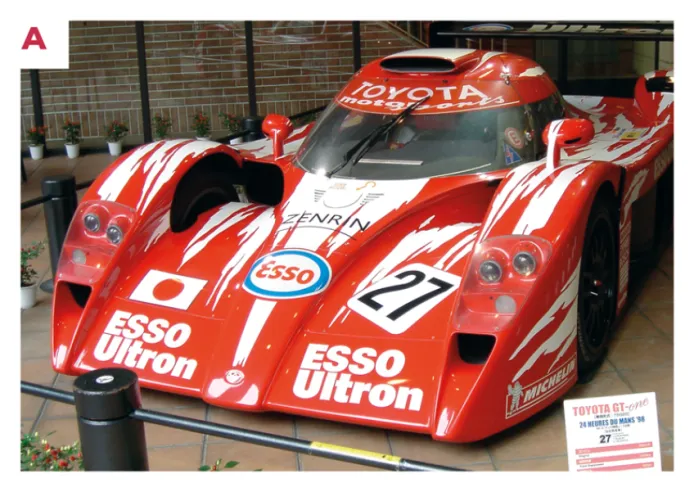
B. The twin-turbo 600 hp V8 engine (which also has a semi-structural function) is not derived from the TS010's V10, but from the 10-year-old Group C car engine, which has been revised and lightened.© IXO Collections SAS - Tous droits réservés.
In 1999, the FIA issued more specific rules with the aim of eliminating ambiguities in the GT1 category by excluding cars that, like the Porsche 911 GT1, were in fact prototypes. The ACO, organiser of the 24 Hours of Le Mans, brought them back in by creating the LM-GTP category. Toyota took part in this edition, where it came close to victory despite the presence of numerous manufacturers (including BMW, Mercedes, Audi, Nissan and Courage). The GT-Ones were the fastest in practice, but their tyres wore out quickly and they suffered numerous punctures. This problem, which was the cause of one of the Toyotas being forced to retire (the third withdrew following a collision), proved fatal for car no. 3 in the hands of Katayama, Tsuchiya and Suzuki, who, due to a strategic decision by the team, decided not to change their tyres, a decision that would cost them the few seconds they had gained on the BMW V12 LMR and condemn them to remain in second place.
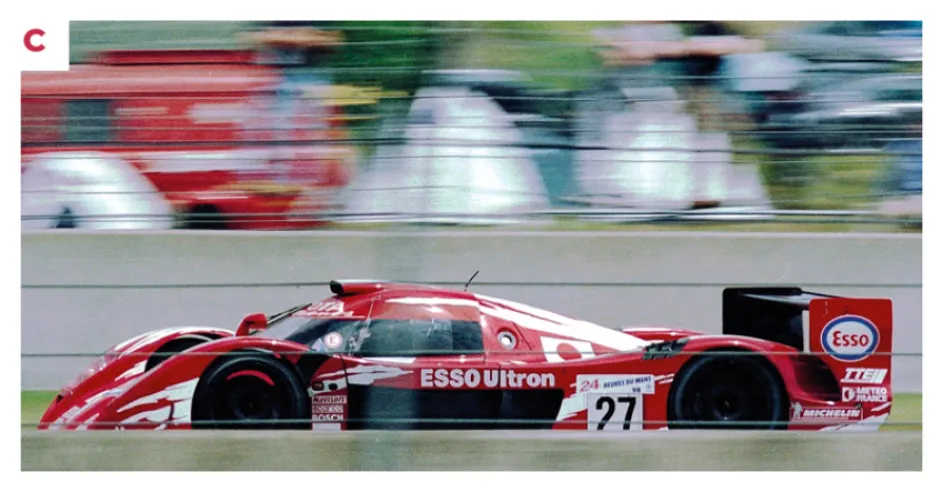
C. The GT-One driven by Katayama, Tsuchiya and Suzuki finished ninth overall in 1998. It was the only one of the three cars entered by the team to finish the race.© IXO Collections SAS - Tous droits réservés.
Recent articles