 English
 français
 Deutsch
 español
 italiano
 português













17/02/2026
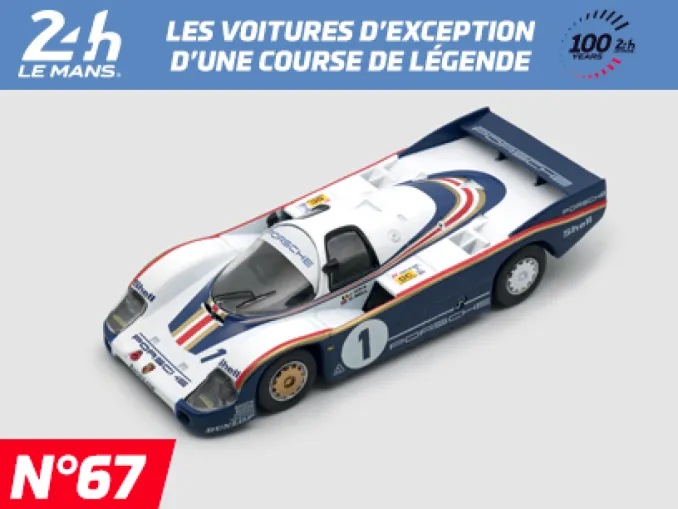
1968 PORSCHE 907
PORSCHE 907
During the early 1980s, the FIA sought to revitalise a championship dominated by Porsche.
It amended the regulations and introduced Group C as a new premier category, imposing fuel consumption limits for the first time while allowing greater design freedom. Making perfect use of the new regulations, the Porsche 956 prolonged the brand's supremacy.
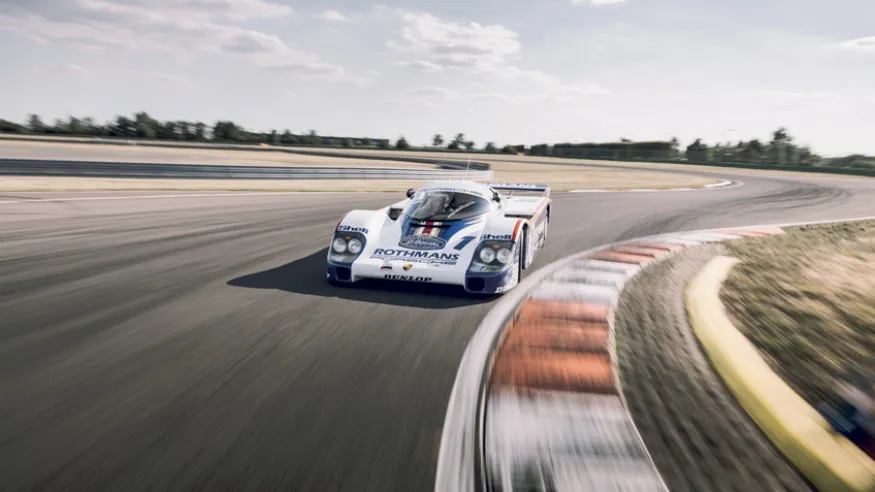
The 956 driven by Jacky Ickx and Derek Bell (chassis number 002), winner of the 1982 Le Mans 24 Hours, is now part of the Porsche Museum in Stuttgart. © IXO Collections SAS - Tous droits réservés.
Though the 956 was developed in record time, its most significant innovation was the adoption of an aluminium monocoque, an unprecedented feature in Porsche's history, offering both lightness and torsional rigidity. Underneath the sleek bodywork, designed to optimise aerodynamic efficiency with a large rear extractor and a mobile spoiler, was a 2,650 cc flat-six engine supercharged by two KKK turbochargers. Developing 620 bhp, this engine ensured high efficiency and very fuel-efficient performance, both of which are essential for racing in Group C. Power transmission involved a 5-speed manual gearbox, while independent suspension contributed to stability and precision when taking corners.
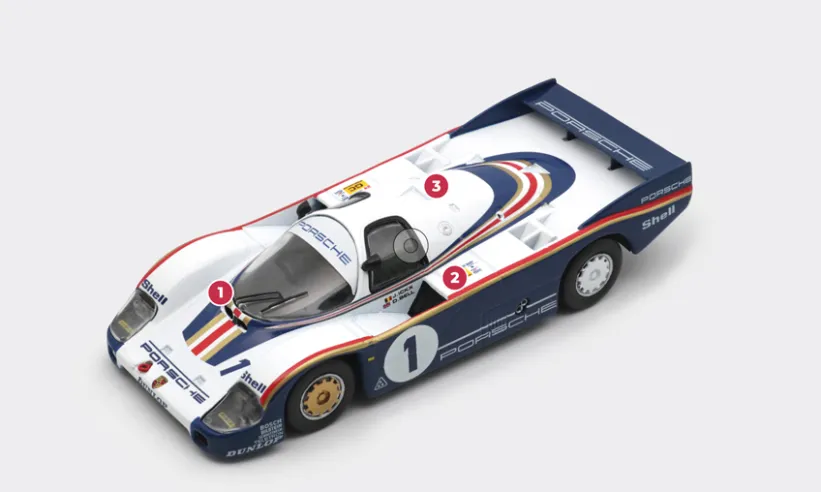
1. The main innovation of the 956 is its aluminium monocoque. At the front, the suspension is still directly attached to the main load-bearing structure, while at the rear it is anchored to a subframe.
2. Airflow to the engine compartment and turbo heat exchanger is provided entirely by the large openings on either side of the driver's compartment, but otherwise the bodywork is ‘sealed’.
3. The 2.65-litre boxer engine with two turbochargers and liquid-cooled cylinder heads comes from the previous 936 models. The initial power output of 620 hp will increase over the years to 640 hp with the arrival of Bosch electronic fuel injection.© IXO Collections SAS - Tous droits réservés.
The Porsche 956 made its debut in 1982 during the 6 Hours of Silverstone, the second event of the World Endurance Championship. Driven by experts Jacky Ickx and Derek Bell, it immediately showed its potential by finishing second behind the Lancia LC1, one of the prototypes from the ‘old’ Group 6 which were still allowed to compete in the championship, even if they only counted towards the Drivers’ classification. The 956 proved to be the best car in Group C and marked the start of a successful era for Porsche.
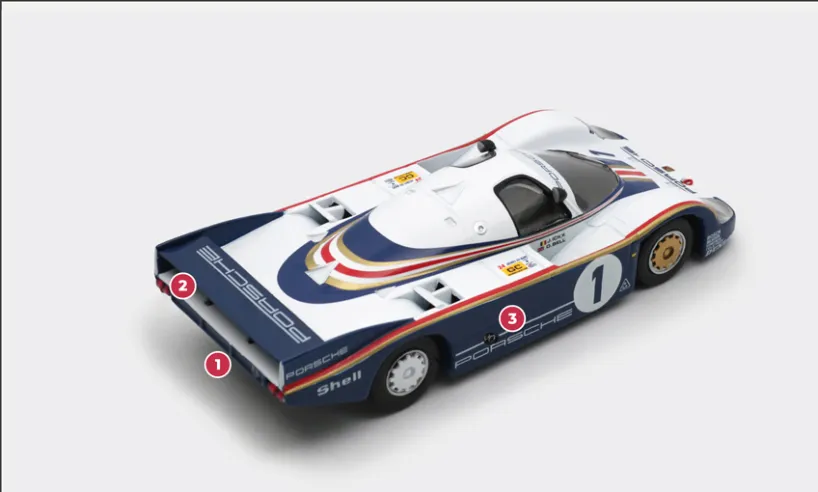
1. The 956 has a flat underbody, as required by regulations, and a barely visible extractor. But its aerodynamics are so carefully designed that it generates three times more downforce than the 917.
2. The specific bodywork adopted for races such as Le Mans is of the LH (‘long tail’) type. It features a lower, less sloped spoiler for improved top speed and fuel economy.
3. To avoid interfering with the aerodynamics of the rear and to avoid unnecessarily long tubing, the exhaust outlets are located at the sides.© IXO Collections SAS - Tous droits réservés.
Its definitive triumph came at the 24 Hours of Le Mans, the most prestigious race of the season. Porsche entered three official 956s, entrusted to a team of top drivers who monopolised the podium: car no. 1, driven by Jacky Ickx and Derek Bell, dominated the race and finished first, setting a new distance record (4,899 km covered in 24 hours). Behind them, Jochen Mass and Vern Schuppan finished second, with Al Holbert, Hurley Haywood and Jürgen Barth completing the top three.
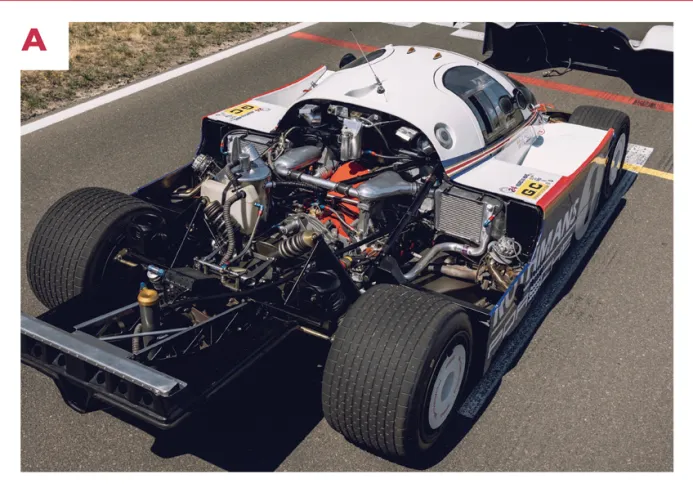
A. The 956 featured a new 5-speed gearbox coupled to the engine, to which the rear suspension mountings were attached. The whole assembly was supported by an auxiliary tubular chassis bolted to the body.© IXO Collections SAS - Tous droits réservés.
The 956 proved to be both fast and reliable. Its remarkable fuel efficiency was a decisive factor in its victory, allowing the No. 1 car to take the lead in the first hour of the race and maintaining a pace that was simply too fast for its rivals to match. Refuelling management, essential with a fuel limit of 2,600 litres for the entire race, was perfect. Its competitors, including Rondeau, Ford and Lancia, were helpless against the technical and strategic superiority of the 956.
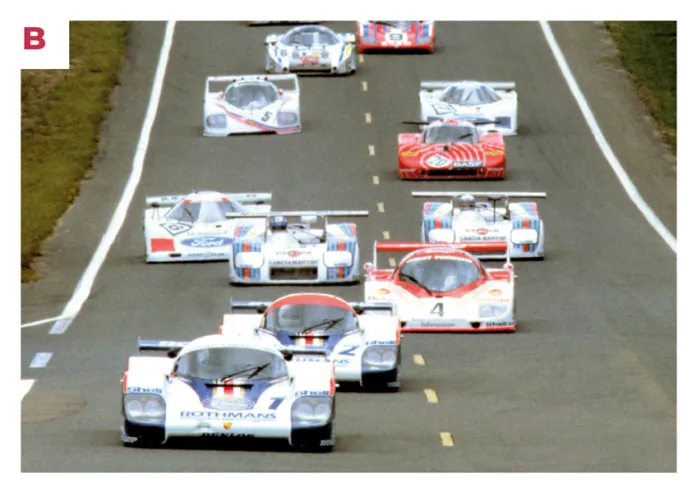
B. This image is characteristic of the 1982 Le Mans 24 Hours, where Porsche achieved a historic triplet victory.© IXO Collections SAS - Tous droits réservés.
But Porsche's victory at Le Mans proved to be just a warning. Over the following months, the 956 continued to dominate, winning at Spa, Mount Fuji and Brands Hatch to obtain the Drivers' title with Jacky Ickx and the Manufacturers' title. The success of the 1982 season marked the beginning of an extraordinary career for the 956 and its successor, the 962, which in the years that followed would emerge as benchmark models, recording glorious achievements in the history of endurance racing in Europe and America.
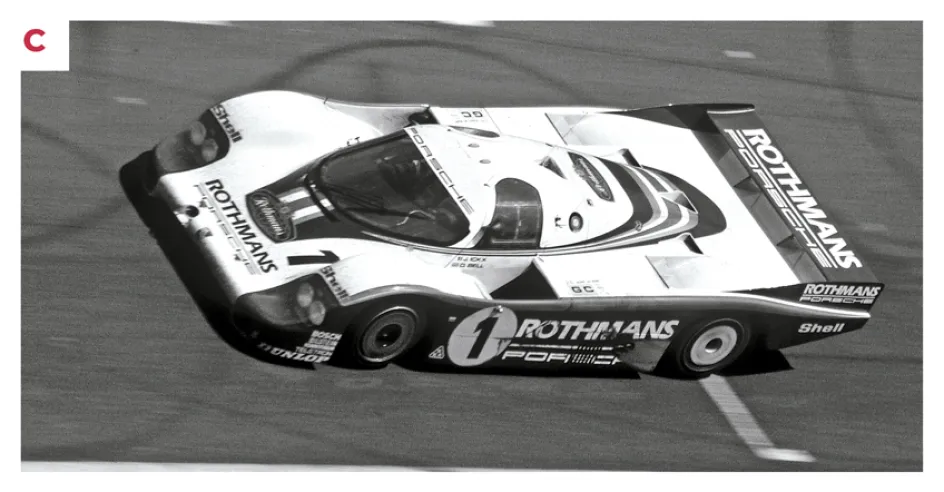
C. For Jacky Ickx and Derek Bell, who had already won at Le Mans in 1981 with a 936, the 1982 victory was their third, including the 1975 win with a Mirage GR8.© IXO Collections SAS - Tous droits réservés.
Recent articles