 English
 français
 Deutsch
 español
 italiano
 português














19/04/2026
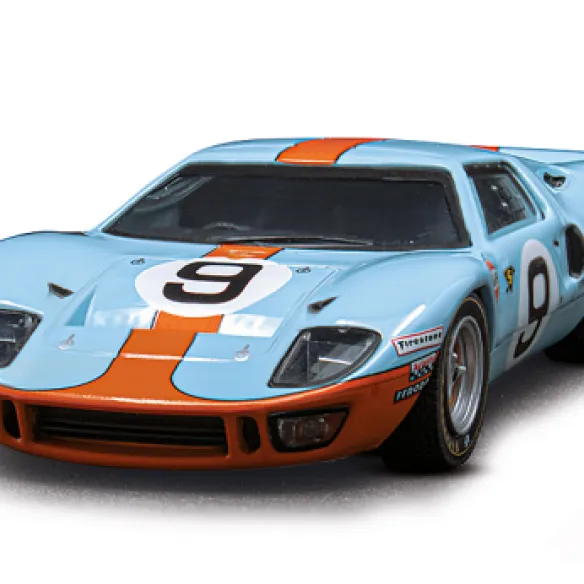
Ford GT40 Mk IV - 1967
Ford GT40 Mk IV
While Carroll Shelby was developing the GT40 Mk II that would prevent Ferrari from winning at Le Mans in 1966, Ford engineers started working on a lighter structure. Its development, at the cost of legendary driver Ken Miles' life, resulted in a potentially unbeatable car that triumphed at Le Mans in 1967 before being ruled out of competition due to changes in the regulations.
Renamed ‘Project J’ in reference to Appendix J of the FIA regulations, the redesign of the Ford GT40 began in autumn 1965. It was based on an idea suggested by driver and designer Eric Broadley to replace the steel chassis with an aluminium structure to reduce weight. By using a honeycomb-type material from the aeronautics industry, it was possible to create a body that was just as sturdy but 200 kg lighter, housing the suspension, brakes and mechanics of the Mk II, as well as an automatic gearbox, a feature that was quickly dropped.
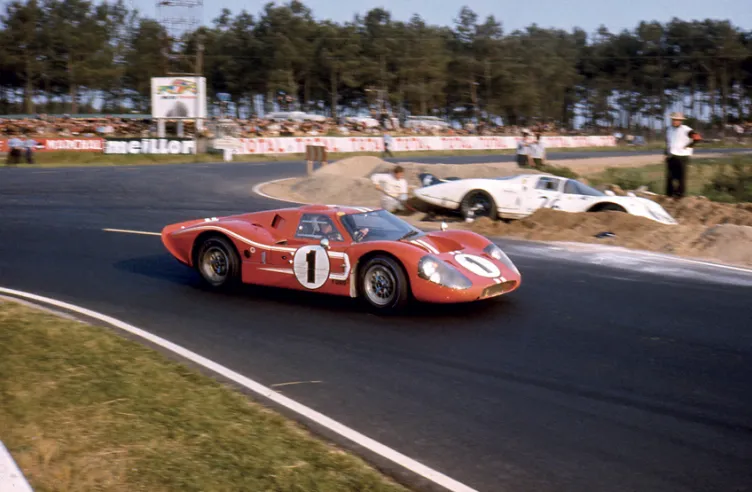
The Mk IV chassis number J5, winner of the Le Mans 24 Hours in 1967, was the first of four cars built specifically for this race. Almost like a premonition, it was given the number 1.© IXO Collections SAS - Tous droits réservés.
Following Bruce McLaren and Chris Amon's controversial victory at Le Mans in 1966 (ahead of Ken Miles and Denny Hulme), Miles, whose contribution to the development of the Mk II had been fundamental, was put in charge of testing the car on the track. Unfortunately, this testing ended in a terrible accident at Riverside, which cost him his life.
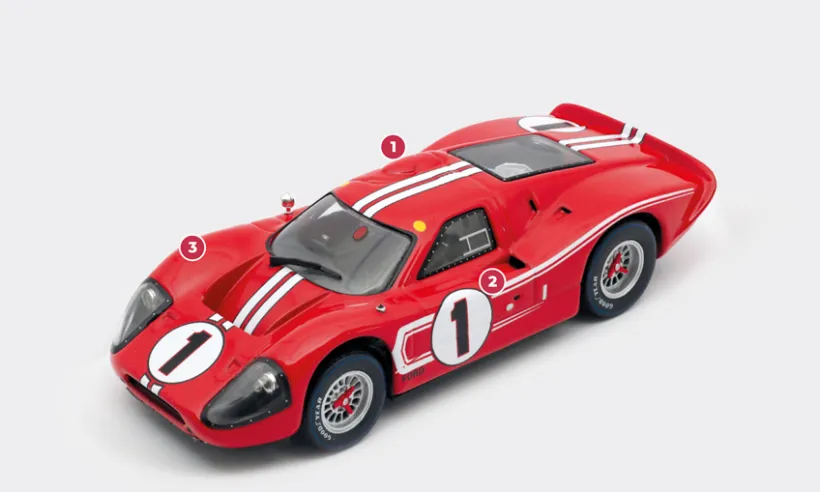
1. The winning car is distinguished by the ‘Gurney hump’, a raised section on the roof that allows the 1.93 m tall American driver to sit comfortably behind the wheel. Following the race, the three other Mk IVs were converted into ‘replicas’ of the J5 and maintained this feature.
2. Instead of the protruding air intakes of the Ford GT40 Mk II, the air is fed to the radiators through air intakes of the NACA type.
3. The new aluminium body has a honeycomb structure sandwiched between two sheets of aluminium. It is manufactured for Ford by Brunswick Aerospace.
© IXO Collections SAS - Tous droits réservés.
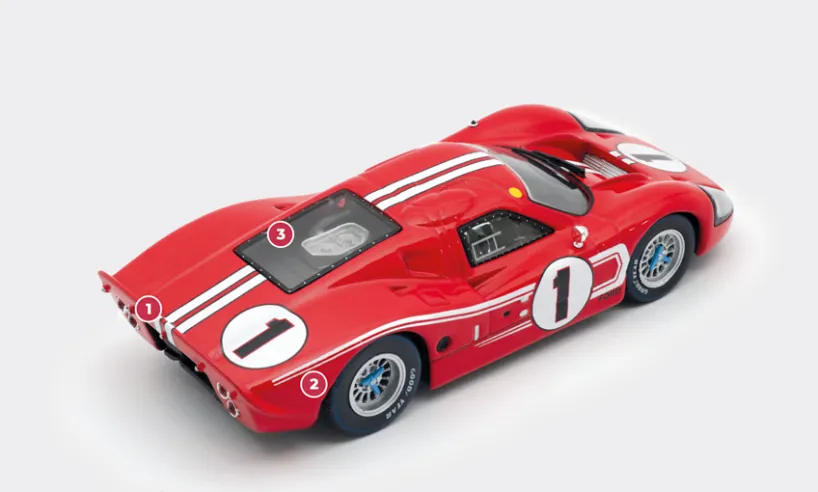
1. The rear profile of the Mk IV, very different from that of the other GT40s with its straight, quadrangular shape, features more sinuous lines and supports a more pronounced spoiler, providing greater aerodynamic downforce, which was an advantage at Le Mans.
2. The Mk IV is almost 30 cm longer than other GT40s, mainly due to its more streamlined shape, making it more aerodynamically efficient.
3. The 7-litre V8 engine, upgraded here to 530 bhp, was initially connected to an automatic gearbox, which was replaced during development by a 4-speed manual gearbox.
© IXO Collections SAS - Tous droits réservés.
With a redesigned rear end and renamed GT40 Mk IV (often abbreviated to Mk IV), the car made its official debut at the 12 Hours of Sebring in April 1967, where it scored its first victory with Bruce McLaren and Mario Andretti, followed shortly afterwards by an encouraging 5th fastest time at the Le Mans qualifying tests. Two months later, the four newly built Mk IVs with chassis numbers J5 to J8 lined up on the starting grid at the Sarthe circuit. But they were part of a strong team of ten Ford GT40s: the J5 and J6 entrusted to Shelby American Inc. were driven by Dan Gurney/A. J. Foyt and Bruce McLaren/Mark Donohue, while the other two belonged to partner team Holman & Moody with Mario Andretti/Lucien Bianchi and Lloyd Ruby/Denny Hulme. Apart from Ferrari with a fleet of eight prototypes (330, 365 and 412), the main rivals were the Chaparral 2Fs.
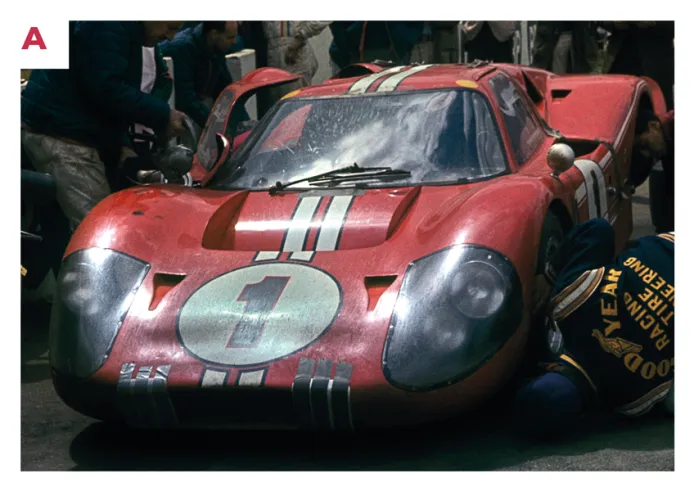
A. Of the four Mk IVs entered at Le Mans, two are red, one is blue and one is yellow. All feature a double central stripe and white stripes along the sides (or black on the last one).© IXO Collections SAS - Tous droits réservés.
During qualifying, McLaren took pole position ahead of the Chaparral driven by Mike Spence and Phil Hill, clocking a time more than four seconds faster than the fastest Ferrari. However, the Ferraris proved themselves reliable during the race and fought their way up the rankings, while the Chaparral and a number of GT40s were hindered by technical problems. The Mk IV driven by Hulme and Ruby was forced to retire due to a damaged sump, Andretti's car was involved in an accident, and the car driven by McLaren and Donohue lost its rear bonnet, causing a delay that it was able to partially recover from by finishing fourth. Only Gurney/Foyt's No. 1 car survived, repeating its 1966 success and winning with a four-lap lead over Lodovico Scarfiotti and Mike Parkes' Ferrari. In the aftermath of the race, new regulations for 1968 limited engine capacity to 5 litres and imposed a minimum production requirement of 50 units, which excluded the Mk IV and the 7-litre ‘big blocks’. For the next two editions of the 24 Hours of Le Mans, Ford won with the 4.9-litre Mk IV entrusted to private teams.
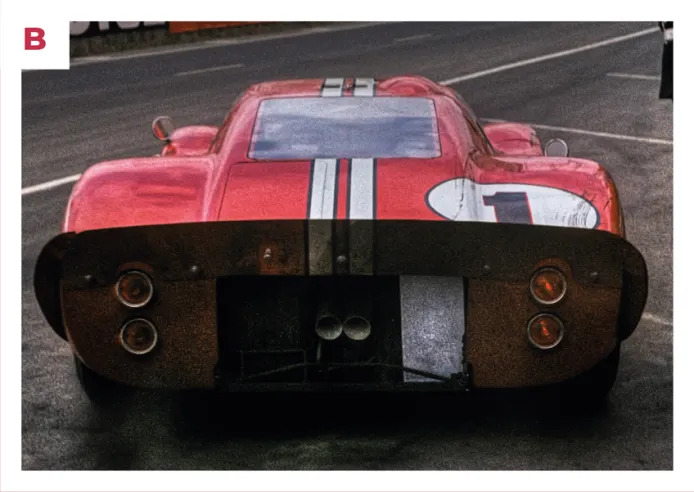
B. In order to finalise the bodywork design, Carroll Shelby and Ford's engineers conducted five days of testing in January 1967 to try out 25 different solutions.© IXO Collections SAS - Tous droits réservés.
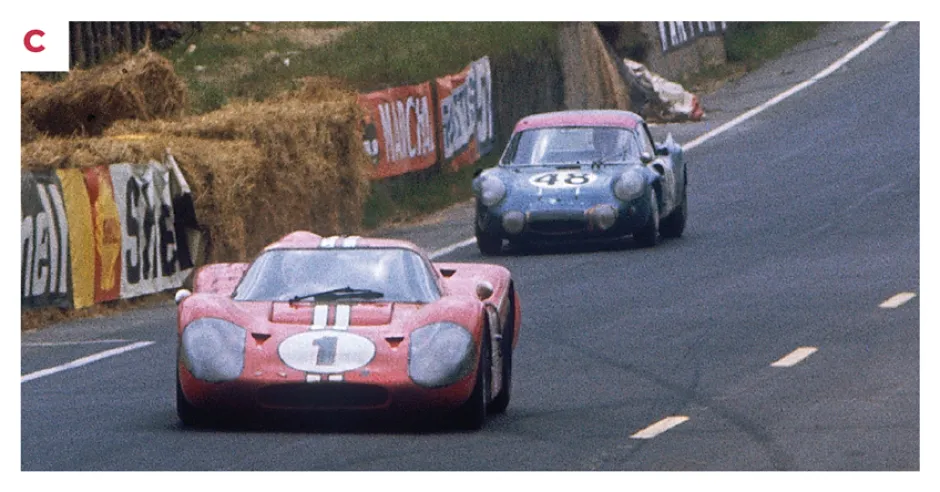
C. The Gurney/Foyt car, seen here being followed by an Alpine A210, was up against the Ferrari 330 P4s, which finished second and third.© IXO Collections SAS - Tous droits réservés.
Recent articles