 English
 français
 Deutsch
 español
 italiano
 português















20/04/2026
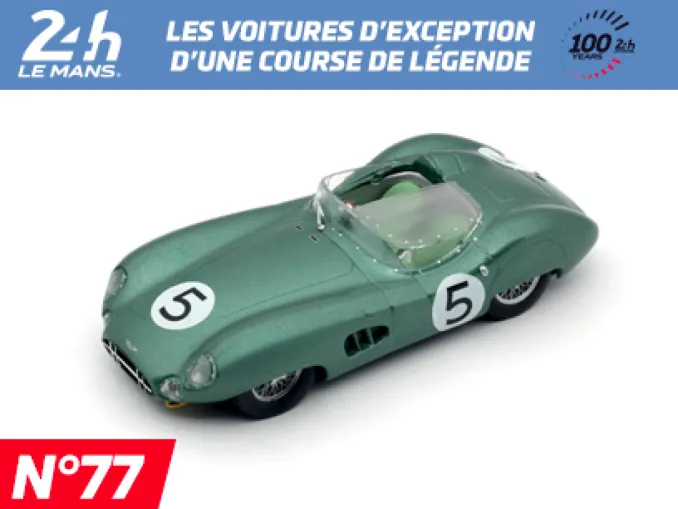
Aston Martin DBR1 - 1959
Aston Martin DBR1
Except for Mercedes' brief interruption in 1952, the 24 Hours of Le Mans in the 1950s seemed to be a contest solely between Ferrari and Jaguar. However, Aston Martin was also seeking glory in the French endurance race, ultimately achieving victory at the end of the decade thanks to an American driver.
Victory at Le Mans was the ultimate dream of the English industrialist David Brown. Just after the war, he bought and revitalised Aston Martin, before acquiring the prestigious Lagonda brand, with the aim to gain access to the 6-cylinder twin-cam engine which Walter Owen Bentley had designed during the war. This engine, rivalling the formidable Jaguar XK6, proved to be the decisive factor in the race for victory.
Its first 2.6-litre version, fitted to the DB2, ended up third at Le Mans in 1951. This was followed by the 3-litre version, which powered the DB2/4 and the DB3S, a roadster developed for racing. Both cars delivered numerous victories for the British firm, both class and overall, yet their conventional road-going base limited their potential against the more powerful and competitive Ferraris and Jaguars – true racing cars ‘disguised’ as Grand Tourers.
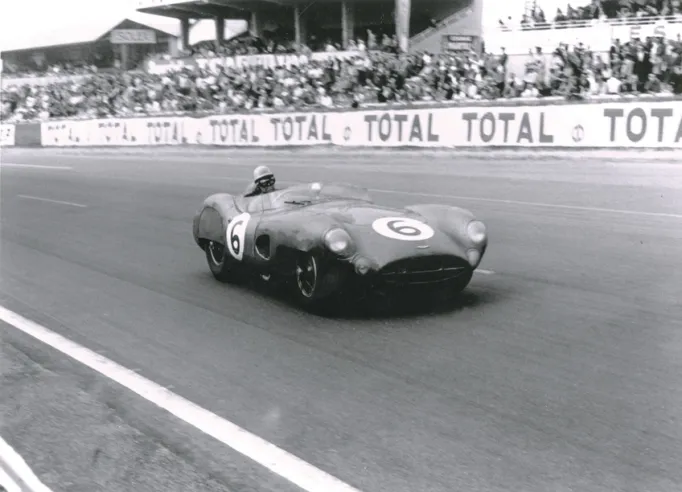
In 1959, the DBR1 took first and second place overall at Le Mans. Pictured here is the No. 6 car driven by Maurice Trintignant and Paul Frère, finishing less than a lap behind the winners, Shelby and Salvadori.© IXO Collections SAS - Tous droits réservés.
The DB3S achieved its best result in the French marathon in 1955 when, with Peter Collins and Paul Frère at the wheel, it finished second, between two Jaguar Type Ds; this result was repeated the following year by Collins, teamed up this time with Stirling Moss, who finished less than a lap behind the Jaguar of the Écosse team.
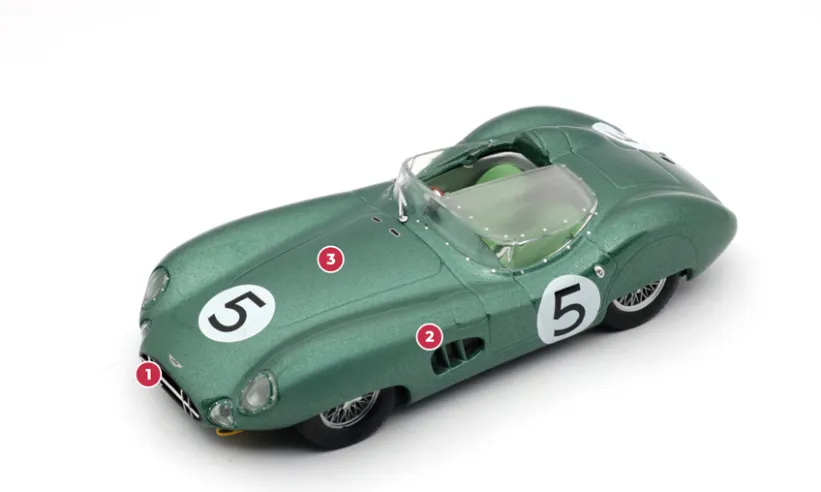
1. The tubular chassis designed by chief engineer Ted Cutting is more rigid and weighs 20 kg less than that of the DB3S.
2. Some models feature a chrome trim on the characteristic hot-air extractor, a design element that would also become a distinctive styling feature for its street cars.
3. The GC537 gearbox, manufactured by David Brown, is mounted transversely to reduce the overall length. Its fragility was one of the reasons behind the numerous withdrawals in the early years. © IXO Collections SAS - Tous droits réservés.
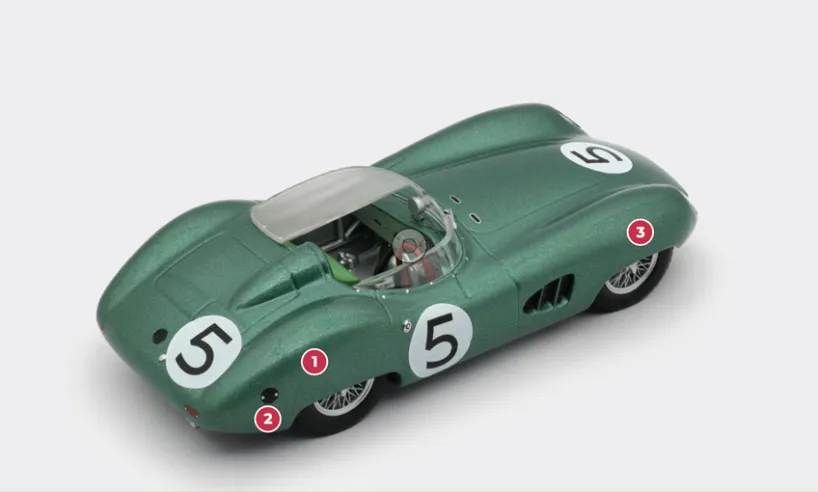
1. The aerodynamics of the bodywork have been designed to redirect airflow away from the wheels, similar to contemporary Jaguar Type D models. Partial fairing of the rear wheels is a key feature of this design.
2. The suspension system is predominantly taken from the DB3S, including the rear De Dion axle.
3. The brake discs, initially supplied by Lockheed, were subsequently replaced by Girling parts.
© IXO Collections SAS - Tous droits réservés.
Meanwhile, Aston Martin started working on the DBR1, a car that looked similar to the DB3 but featured a new tubular lattice chassis. First appearing at Le Mans in 1956 as the DBR1/1 (or DBR1/250) with a 2.5-litre 6-cylinder engine, it had to withdraw due to a gearbox problem. It was followed by the DBR1/2 or DBR1/300 with a 3-litre engine,which achieved its first victory in 1957 at Spa and in the 1000 km of the Nürburgring; this was followed by the 3.7-litre DBR2, designed for short races as a rival to the leaders within the class. At Le Mans, both models missed out on victory, once again due to gearbox issues causing frequent withdrawals.
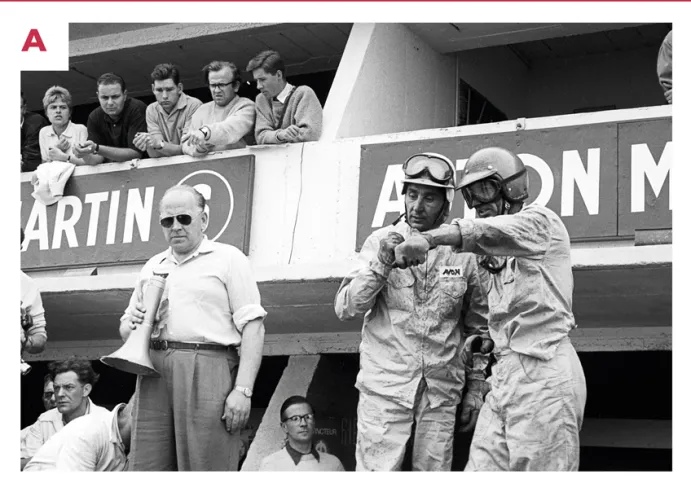
A. The British driver Roy Salvadori (centre) and the American Carroll Shelby (right) celebrate their victory at the 1959 24 Hours of Le Mans. © IXO Collections SAS - Tous droits réservés.
For 1958, the regulations limited the engine capacity of sports prototypes to 3 litres, thereby putting the DBR2, the Jaguar Type D and the Maserati 450 on the sidelines, but bringing the DBR1/300 back onto the scene; this year saw another string of withdrawals, even though Aston Martin secured an unexpected second place thanks to the ‘old ” DB3S from the private Whitehead team.
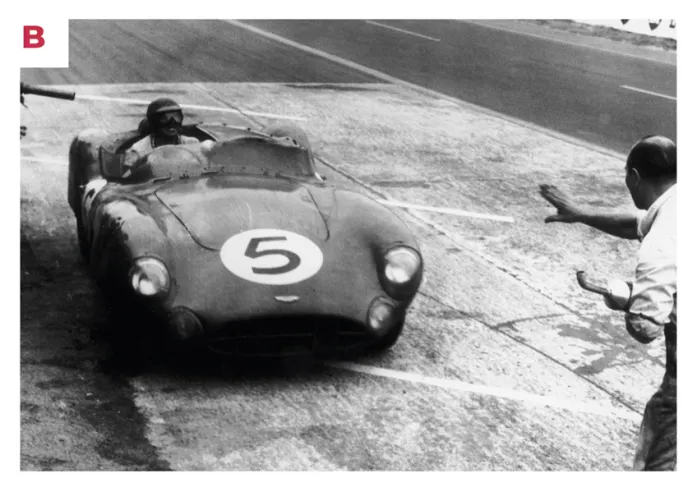
B. Shelby and Salvadori’s winning DBR1/300 No. 5 refuelling at Le Mans in 1959.© IXO Collections SAS - Tous droits réservés.
Finally, it was in 1959 that success finally arrived, when two of the four DBR1/300s that entered the race crossed the finish line, securing the top two positions thanks to the withdrawal by former winners Phil Hill and Olivier Gendebien, whose Ferrari 250 TR/59 had suffered an engine failure. The winning car was driven by Texan Carroll Shelby and British specialist Roy Salvadori, the two having already teamed up the previous year. Taking second place, was Maurice Trintignant and Paul Frère’s DBR1, finishing less than a lap behind. In 1960, Salvadori secured third place alongside Jim Clark, but in the 1961 race – which was the last for the DBR1/300 – all the cars were forced to retire.
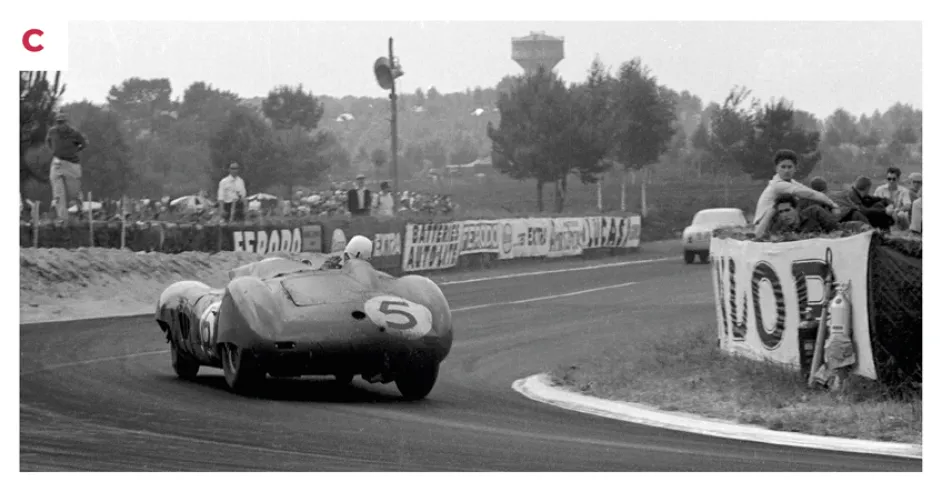
C. The DBR1s that finished first and second in 1959 (here, the No. 5 car of future winners Shelby and Salvadori) were also the only two cars in the Sport Class to finish the race. They were followed only by Grand Touring cars crossing the finish line. © IXO Collections SAS - Tous droits réservés.
Recent articles