 English
 français
 Deutsch
 español
 italiano
 português














23/01/2026
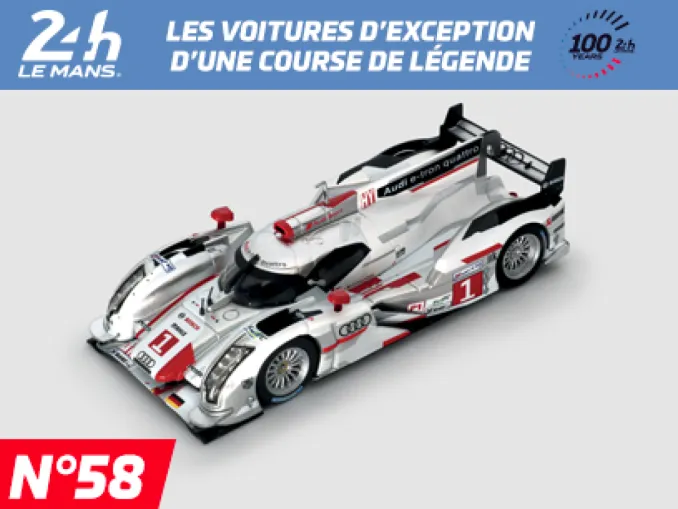
Audi R18 e-tron quattro – 2012
Audi R18 e-tron quattro
The undisputed queen of the 24 Hours of Le Mans, having won every edition apart from two since 2000, Audi introduced a new diesel-powered LMP1 car in 2011: the R18 TDI. Using this model as a basis, the following year saw the launch of the e-tron quattro hybrid version, winner of three more races, including the first two editions of the WEC, the new World Endurance Championship.
The R18 TDI was the direct successor to the R10 TDI and R15 TDI, continuing the success of the petrol-powered R8s, only losing out to its Peugeot rivals in the 2009 edition. The car was completely redesigned to comply with new regulations, which included a reduction in engine capacity. Audi replaced the 5.5-litre V10 turbo diesel with a 3.7-litre V6 mono turbo capable of delivering 550 hp. Looking ahead to the next regulatory change in 2012, allowing the introduction of hybrid technology, the brand opted for a more compact engine in order to free up the space needed for future electrical components and energy recovery devices.
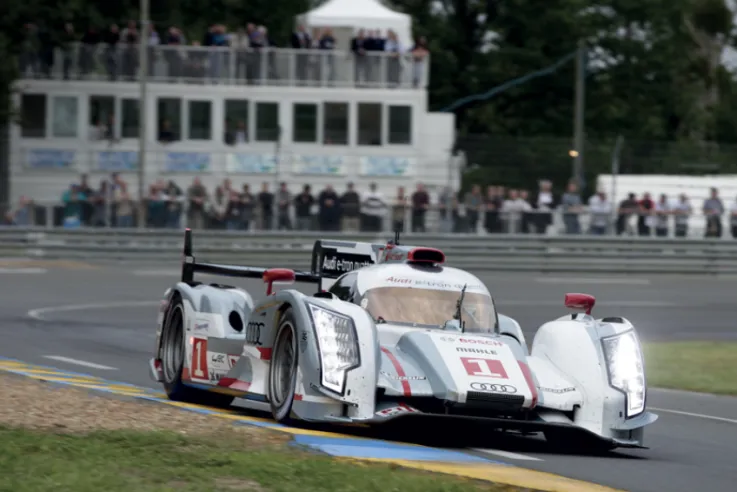
In 2012, Audi combined the efficiency of diesel with that of hybrid technology in the R18 e-tron quattro, dominating three consecutive editions of the Le Mans 24 Hours and the first of two WEC seasons.© IXO Collections SAS - Tous droits réservés.
The R18 TDI was a partial success. It won at Le Mans, even though the winning car driven by Marcel Fässler, André Lotterer and Benoît Tréluyer (who took pole position in qualifying) was the only one of the three cars entered by the official Joest/North America teams to finish the race. However, in its final ranking in the Le Mans International Cup (which was held on seven circuits that year, including the Circuit de la Sarthe), it was beaten by the Peugeot 908.
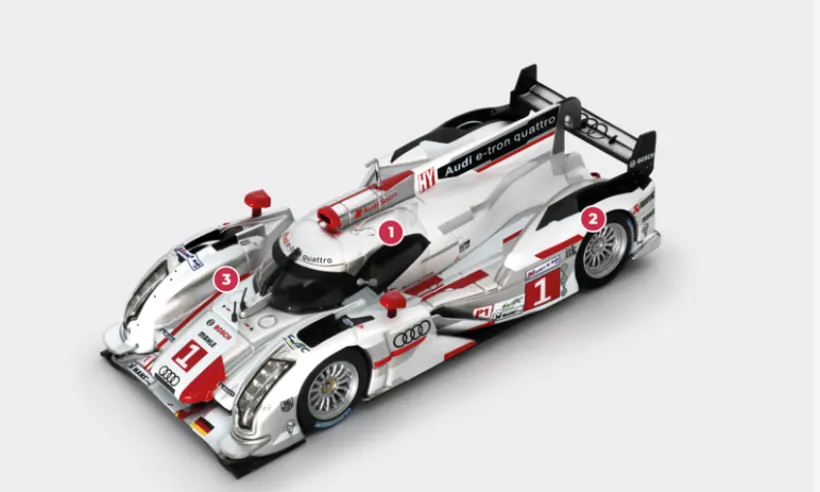
1. The energy recovered during braking is stored in an electric accumulator installed next to the driver and fitted with an additional cooling system.
2. The Audi e-tron quattro is derived from the 2011 R18 TDI, which was already designed to accommodate a hybrid system planned for subsequent seasons.
3. The e-tron quattro system combines the rear V6 TDI with an electric front axle that uses the energy recovered from braking during acceleration. The regulations stipulate that all-wheel drive may only be activated above 120 km/h.© IXO Collections SAS - Tous droits réservés.
In 2012, the Audi team proved the excellence of its interpretation of the regulations allowing hybrid technology. Taking a cautious approach, it entered not only the new R18 e-tron quattro but also a non-hybrid, diesel-powered car, the R18 Ultra. The e-tron was Audi's first prototype with all-wheel drive, a new feature authorised by ACO regulations that allowed hybrids to use an electric motor operating on the front axle.
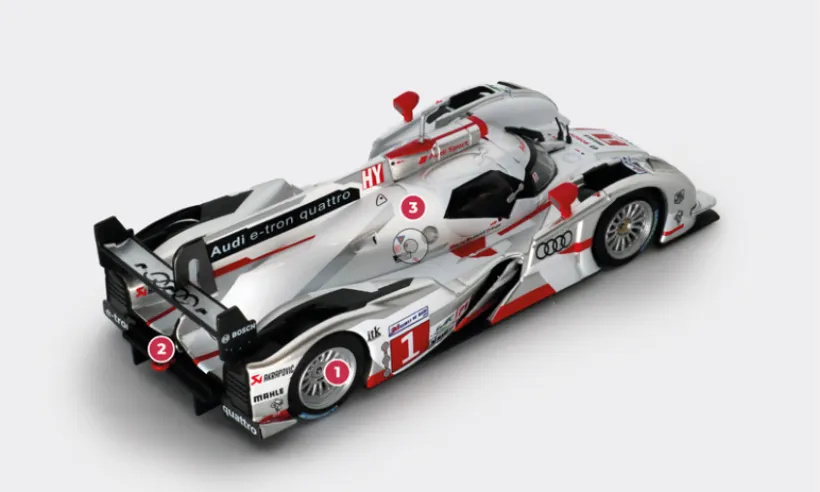
1. All wheels feature double-wishbone suspension, but the front springs are operated by a push-rod system with reaction arms, while the rear springs are operated by pull-rods.
2. To save weight and compensate for the added mass of the hybrid system, the 2012 R18 e-tron quattro is equipped with a gearbox whose housing is made of carbon fibre.
3. Compared to the previous V10 5.5 used in the R15, the V6 3.7 engine in the R18 is powered by a single variable turbine geometry installed between the cylinder banks, opened at 120°.© IXO Collections SAS - Tous droits réservés.
The Audi e-trons won the first WEC championship in the LMP1 class with five wins and three second places over eight races, almost double the points scored by their main rivals, the Toyota TS030 Hybrids powered by electrified V8 petrol engines and rear-wheel drive. Following these successes, team Audi Joest entered two R18 e-tron cars plus an R18 Ultra and a similar model under the Audi Sport North America banner in the 24 Hours of Le Mans. The race, which Audi led with relative ease due to the withdrawal of both Toyotas after slightly more than 130 laps, resulted in victory for the two e-trons, followed by the North America Ultra, while Joest finished fifth behind the Rebellion Racing Lola. The winning crew was once again the team of Fässler, Lotterer and Tréluyer, ahead of Allan McNish, Rinaldo ‘Dindo’ Capello and Tom Kristensen.
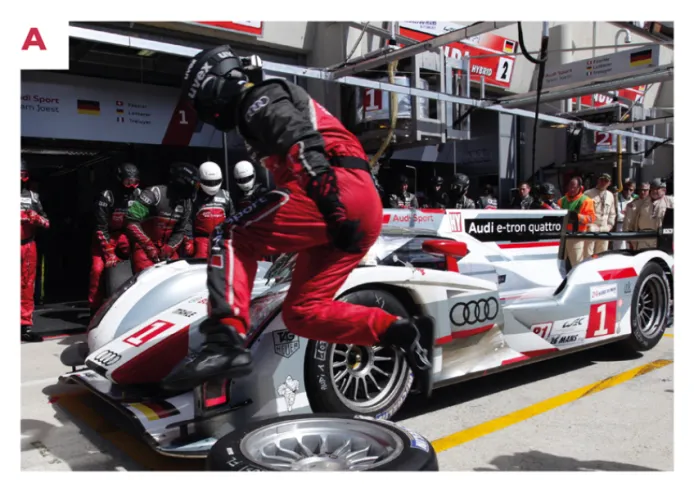
A. The R18 e-tron quattro, pictured here at Le Mans, made its debut in the second race of the 2012 WEC, the 6 Hours of Spa. At Sebring, it was still the R18 TDI from 2011 that competed.© IXO Collections SAS - Tous droits réservés.
Audi's dominance came to an end with the R18 e-tron quattro, failing to achieve a hat-trick: Although the same team won again at Le Mans in 2014 (with a 4-litre engine), it finished second in the WEC championship, while in 2013, victory at Le Mans and in the World Championship went to McNosh and Kristensen, partnered by Loïc Duval.
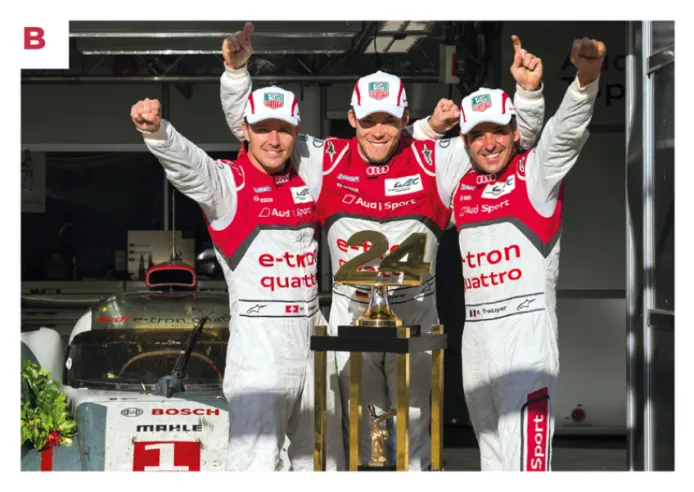
B. From left to right: André Lotterer, Marcel Fässler and Benoît Tréluyer, winners at Le Mans in 2011 with the R18 TDI and again in 2012 with the e-tron.© IXO Collections SAS - Tous droits réservés.
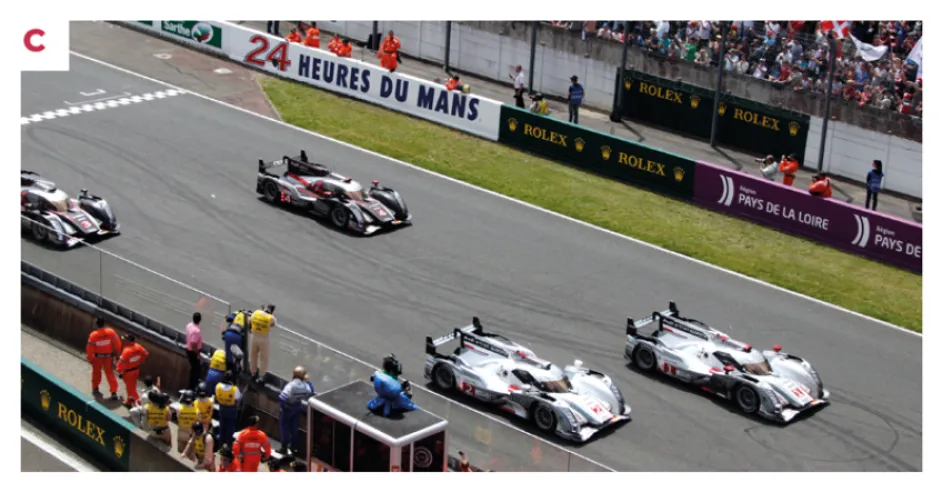
C. At the 2012 24 Hours of Le Mans, Joest and North America (official Audi teams) entered two R18 e-tron quattros and two R18 Ultras, taking the entire podium plus fifth place.© IXO Collections SAS - Tous droits réservés.
Recent articles