 English
 français
 Deutsch
 español
 italiano
 português

















17/02/2026
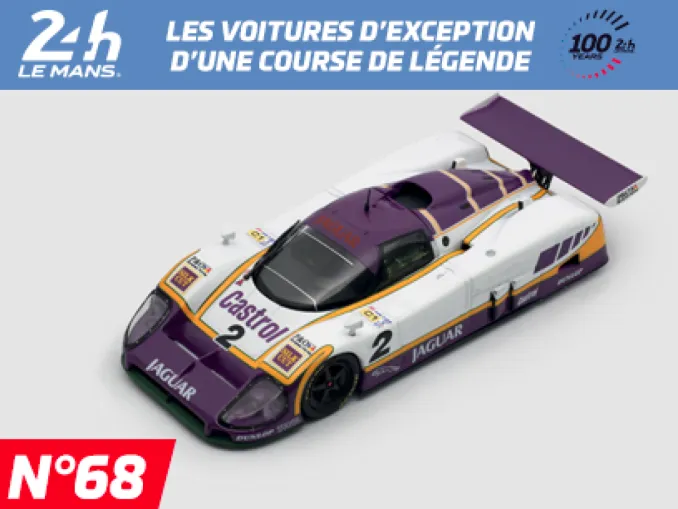
Jaguar XJR-9 – 1988
Jaguar XJR-9
The Jaguar XJR-9 LM was one of the most iconic cars from the history of endurance racing, coinciding with Jaguar's come-back to racing at top level, long after the victories of the Type D in the mid-1950s. This return to excellence was the result of a long development process.
Following a long absence during the 1980s, Jaguar returned to racing competition in the new FIA Group C category with highly promising, but not yet successful, models developed by the British company Tom Walkinshaw Racing. They formed the basis for the XJR-9 LM project, initiated in 1988. The project successfully achieved the right balance between power, advanced aerodynamics and reliability, all essential factors for competing effectively at the highest level.
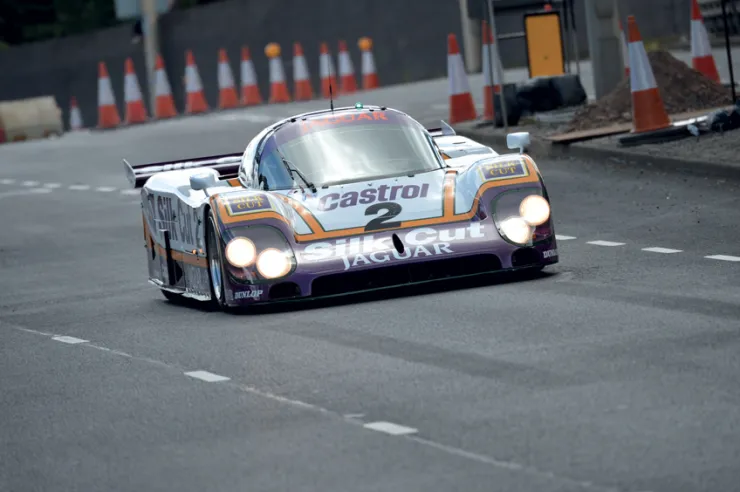
Before its triumph at the 24 Hours of Le Mans in 1988, the XJR-9 chassis no. 488 failed to achieve success at Jerez, Jarama, Monza and, during testing only, at Silverstone.© IXO Collections SAS - Tous droits réservés.
The XJR-9 project was the culmination of a development process that began in 1985 with the XJR-6, a car featuring a carbon fibre chassis and a sophisticated aerodynamic system that took full advantage of ground effect. Subsequently, the XJR-8 improved on these solutions and was fitted with a 7-litre V12 engine, identical to the one that would be used in the XJR-9. Jaguar used these models to build a solid technical foundation, culminating in 1988 with a car capable of competing with and beating the Porsche 962s that dominated its class. Equipped with an engine capable of initially delivering 720 bhp, later more than 750, and featuring a carbon fibre body, the XJR-9 LM was capable of reaching extreme speeds while maintaining agility and stability, thanks also to an optimised exterior body shape that generated maximum aerodynamic downforce.
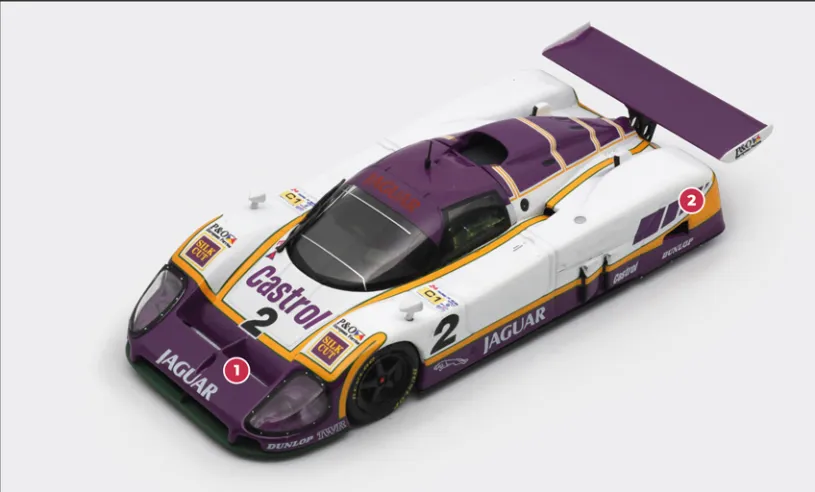
1. Of the XJR-9s entered in 1988 and 1989, six were built from scratch, while three others were converted from previous XJR-6 and XJR-8 chassis.
2. Enclosed rear wheels were a feature applied to almost the entire ‘XJR’ family. However, on the XJR-9, NACA-type air intakes were added at the height of each wheel.© IXO Collections SAS - Tous droits réservés.
In 1988, the XJR-9 made its debut in North America and Europe. It won the 24 Hours of Daytona, its only victory in the IMSA Camel GTP series (the equivalent of the FIA Group C), and the 2 Hours of Del Mar, which was the last race on the calendar. On the European continent, it dominated the World Sportscar Championship (WSC), winning six of the eleven races on the schedule and the title.
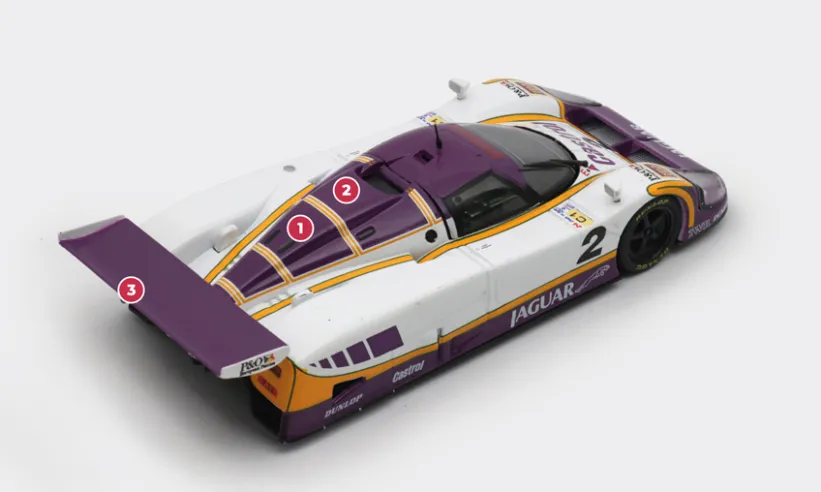
1. The naturally aspirated V12 engine derived from Jaguar's racing and sports cars, was upgraded to 7 litres and tested by TWR on the XJR-8 as an alternative to the previous 6-litre version. In 1988 at Le Mans, all five cars entering the race were equipped with this engine.
2. In addition to its covered rear wheels, the XJR-9 is distinguished by the pronounced ‘hump’ extending from the roof, formed by the air intake fairing.
3. The main modification to the ‘LM’ variant, used only at Le Mans, was the specific configuration of the rear wing, which was lower and less inclined in order to accelerate airflow on the long Hunaudières straight.© IXO Collections SAS - Tous droits réservés.
The Silk-Cut-sponsored TWR-Jaguar team fielded five cars with the suffix ‘LM’ at the 24 Hours of Le Mans. Despite mechanical problems that caused two withdrawals, one of the three survivors, driven by Jan Lammers, Andy Wallace and Johnny Dumfries, finished first overall, two minutes ahead of the second-placed Porsche. The other two Jaguars finished fourth and sixteenth, demonstrating the reliability of the TWR team's model. During the race, the Jaguars showed speed and great endurance, combining high performance with precise fuel management, an essential quality given the regulatory consumption limits.
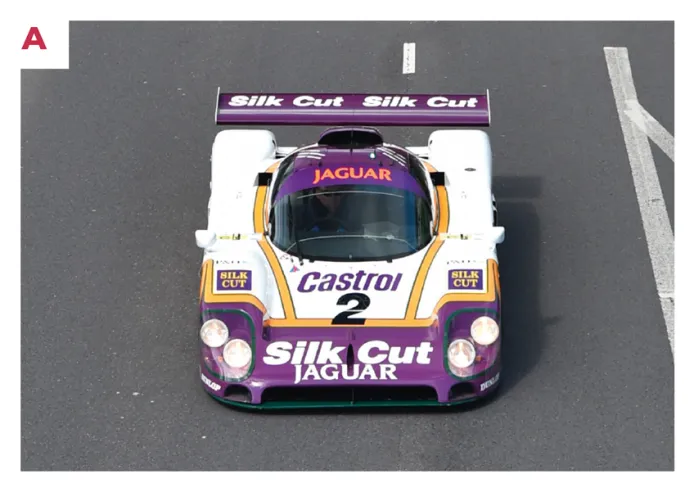
A. The XJR-9 No. 2, victorious at Le Mans in 1988, was immediately withdrawn from competition and added to Jaguar's Heritage Museum.© IXO Collections SAS - Tous droits réservés.
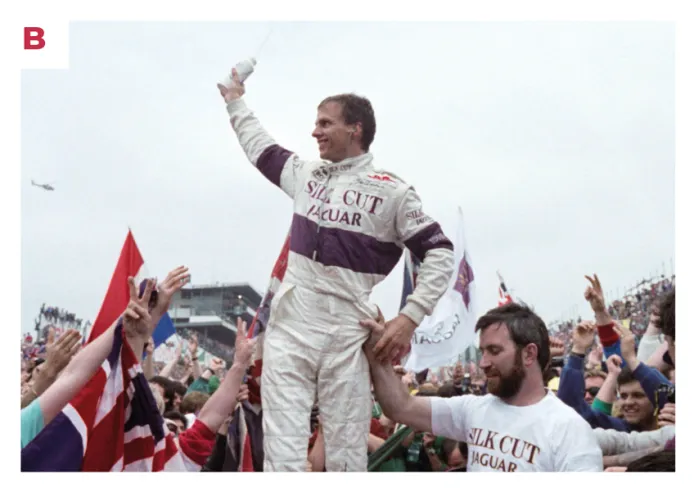
B. Dutch driver Jam Lammers celebrates victory at the finish line of the 1988 24 Hours of Le Mans, a success he achieved with Andy Wallace and Johnny Dumfries.© IXO Collections SAS - Tous droits réservés.
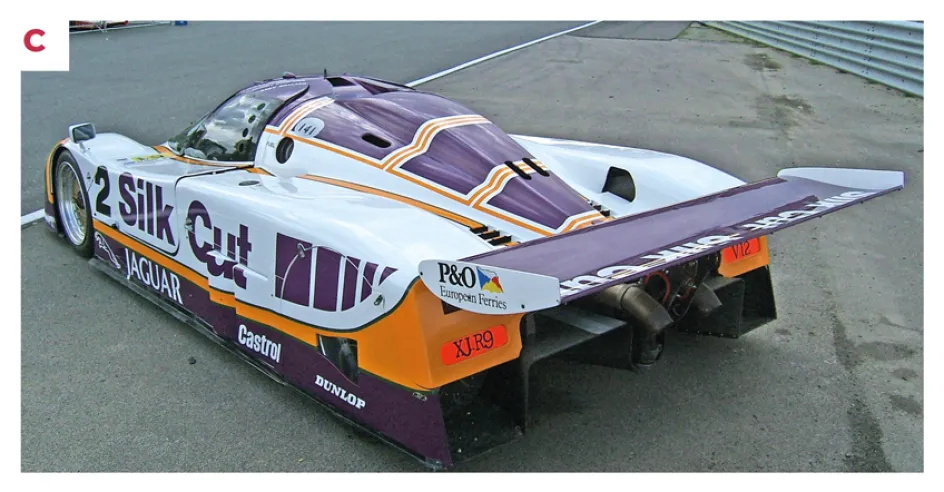
C. In 1988, the XJR-9 competed in the WSC and IMSA GT championships, replacing the XJR-8 and XJR-7 respectively, both developed for these two championships.© IXO Collections SAS - Tous droits réservés.
Recent articles