 English
 français
 Deutsch
 español
 italiano
 português
















18/12/2025
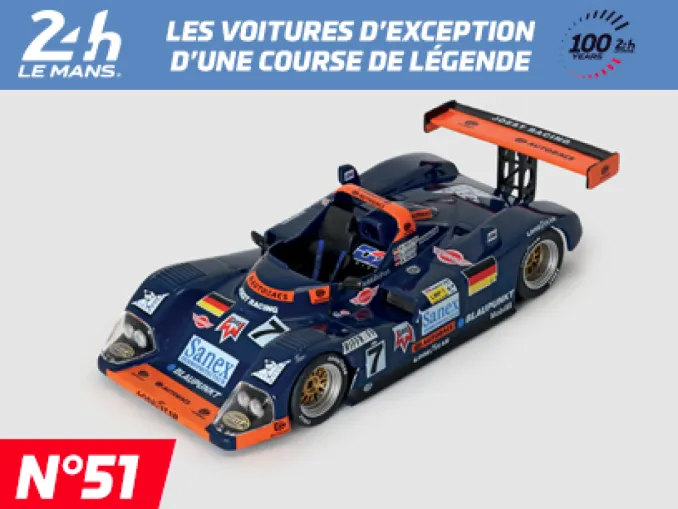
TWR Porsche WSC-95 - 1996
TWR Porsche WSC-95
Given the successes of Dauer and McLaren, Porsche decided to focus on the 911 GT1 for its return to the very top of the premier class in 1996. However, this dream was shattered when Porsche decided to abandon the prototype it had originally sought to acquire, thereby allowing its engine to be used twice in a row.
This prototype was named the TWR Porsche WSC-95. Two were built following a decision by the German company to participate in the 1995 IMSA World Sports Car Championship, but with fewer resources being allocated than usual. The company in Stuttgart preferred to focus its resources on developing the 911 GT1, aimed at competing in the GT1 category from 1996 onwards. Permissive regulations made this category as competitive as the prototypes, but the cars were ‘formally’ derived from series production models, offering a much more effective return on investment from a commercial perspective.
Tom Walkinshaw Racing was entrusted with building the prototypes. Due to budget constraints, two chassis from the victorious XJR-14 (which had since been recycled to build the Mazda MXR-01 in 1992) were used as a starting point. The cars were converted from coupés to barquettes in accordance with the LMP1 category specifications and fitted with the 956/962 ‘Mezger’ engine, just in time to take part in the Daytona tests before being prevented by an unexpected rule change imposing a reduction in power and an increase in weight that made them uncompetitive.
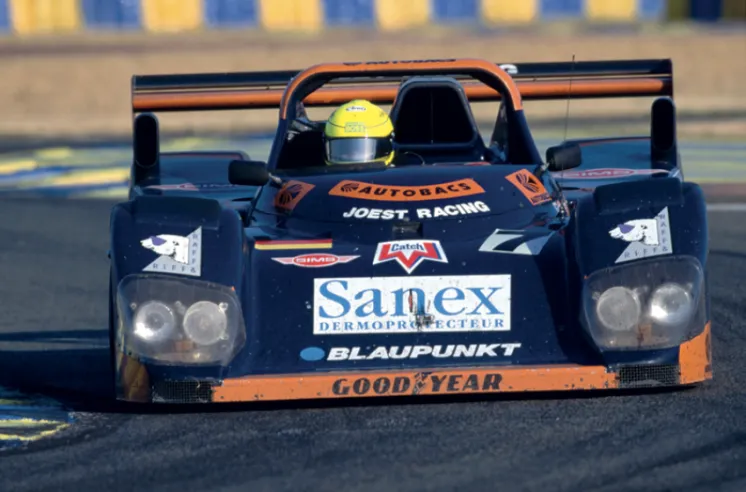
The No. 7 WSC-95 won at Le Mans in 1996 in that year with a team comprising Alexander Wurz, Davy Jones and Manuel Reuter.© IXO Collections SAS - Tous droits réservés.
These two cars also caught the attention of the team of Reinhold Joest, who was eager to compete at Le Mans, where he had been absent since 1993, the year he participated with the 962. So Joest managed to get Porsche to send the two prototypes, which had been adapted by TWR to the new LMP1 specs, to the Sarthe circuit for testing at the end of April 1996, where they clocked the fifth and tenth fastest times overall. During the June tests, the two cars were among the fastest, taking first and sixth positions on the grid, while in the race they demonstrated the success of their combination of chassis and engines, not exactly new but still valid. The 3-litre six-cylinder boxer engine is less powerful than the 3.2-litre engine fitted to the 911 GT1, but it is more reliable, fuel-efficient and lightweight, all qualities that put less strain on the suspension and tyres, enabling the WSC-95 to beat Porsche's GT1. It was not the N°8 car driven by Michele Alboreto, Pier Luigi Martini and Didier Theys, which started from pole position but retired after 300 laps with electrical problems, that won the race, but the other car, the N°7 driven by Davy Jones, Alexander Wurz and Manuel Reuter, which kept the two official Porsches and three McLaren F1s at bay. Not satisfied with this success, the following year Joest entered the winning car again. A comeback was awaited from the GT1s of Porsche, who had continued to develop the 911, and from McLaren and Nissan. But once again, reliability rewarded the WCS-95, which, with Michele Alboreto, Tom Kristensen and Stefan Johansson, took pole position and the final victory, ahead of two McLaren F1s. After this triumph, the WSC-95 once again won at Donington Park with Johansson and Martini.
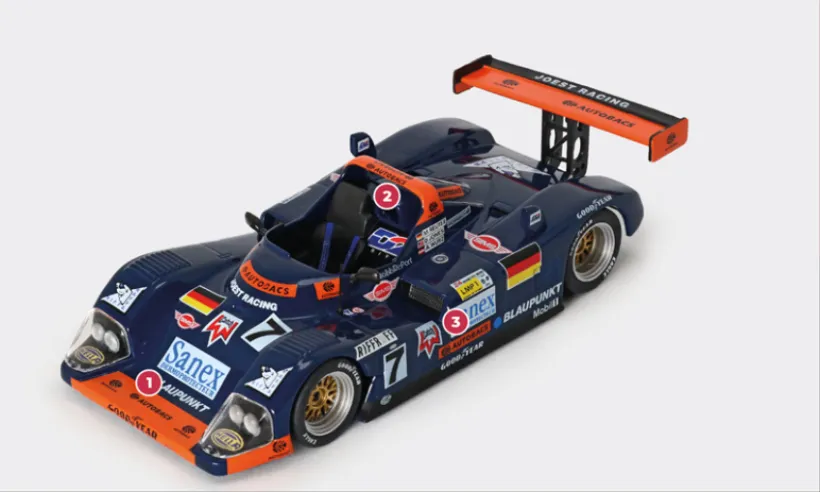
1. The new LMP1 regulations required that the TWR Porsche WSC-95 be equipped with simpler aerodynamic solutions, which is why the front wing attached to the Jaguar's wings was removed.
2. The transition from the closed cabin of the XJR-14 to an open cabin required structural modifications, but it offers greater comfort for the driver.
3. The large air intakes on the pontoons were created to better feed the twin-turbo engine, which requires more air than the original naturally aspirated Ford-Cosworth.© IXO Collections SAS - Tous droits réservés.
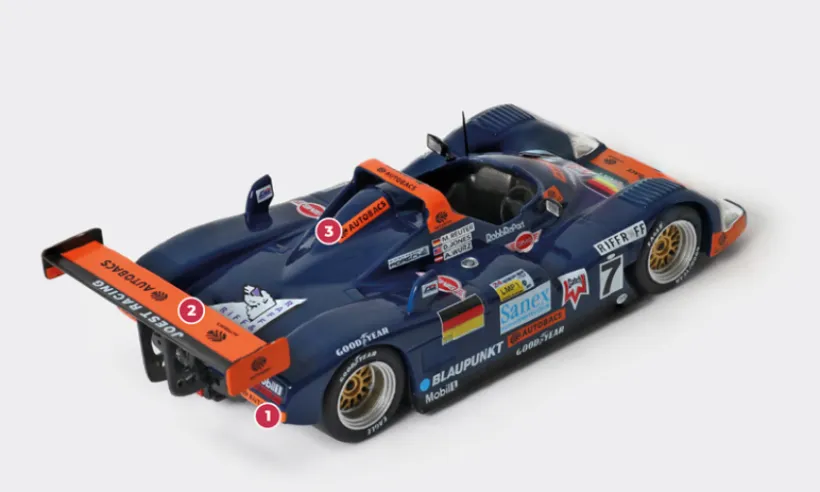
1. One of the most significant modifications made by TWR to the original Jaguar chassis was the removal of the aerodynamic ducts under the car, which were replaced by the regulatory flat bottom.
2. Compared to the Jaguar XJR-14 from which it is derived, the TWR Porsche WSC-95 features a monoplane rear wing instead of a biplane element.
3. The 3-litre Porsche boxer engine required some modifications to be fitted in place of the previous Cosworth V8.
© IXO Collections SAS - Tous droits réservés.
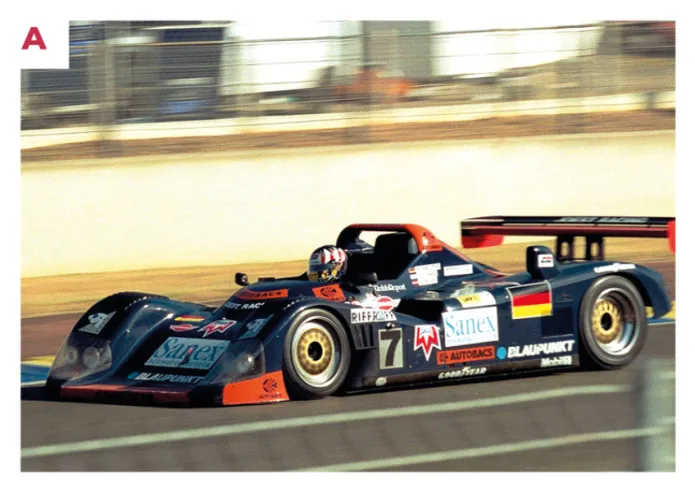
A. At the 1996 Le Mans 24 Hours, the future winner navigates the Dunlop curve, finishing just one lap ahead of the Porsche 911 GT1 driven by Stuck, Boutsen and Wollek.© IXO Collections SAS - Tous droits réservés.
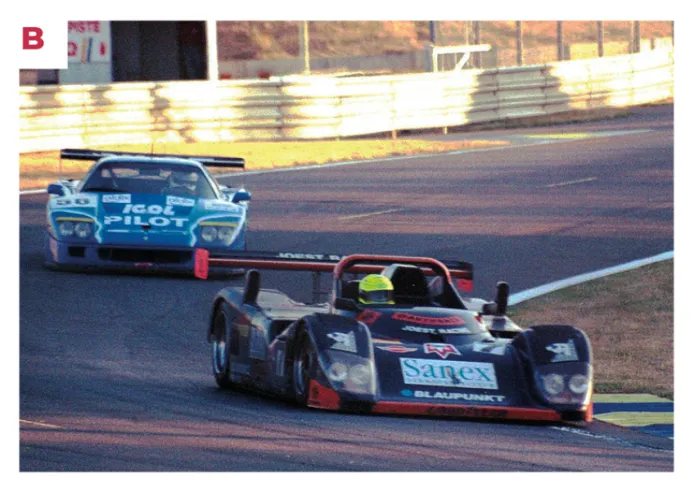
B. The same WSC-95 in a battle with a Ferrari F40 LM in 1996. The fuel consumption and reliability of the Porsche 3.0 engine would prove invaluable in the following year's race in 1997.© IXO Collections SAS - Tous droits réservés.
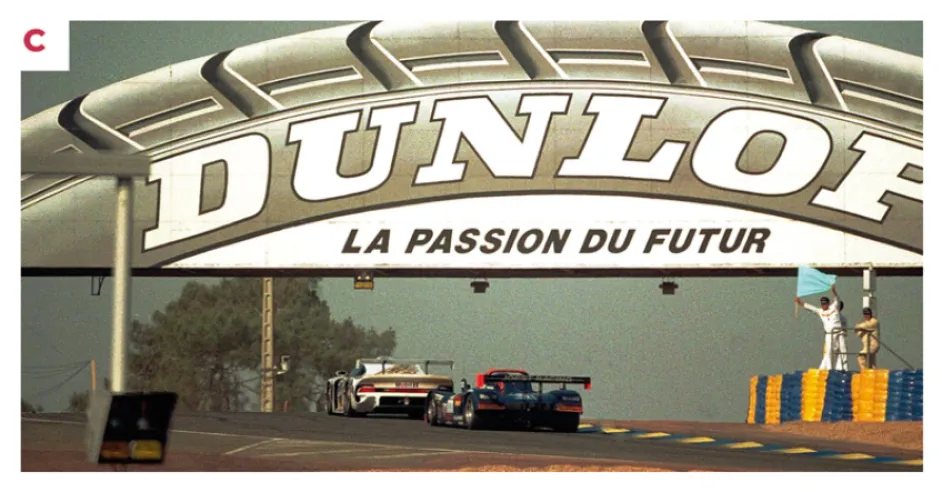
C. On the tail of the Porsche 911 GT1 driven by Karl Wendlinger, Yannick Dalmas and Scott Goodyear, which would finish third, is the TWR Porsche WCS-95.© IXO Collections SAS - Tous droits réservés.
Recent articles