 English
 français
 Deutsch
 español
 italiano
 português













24/11/2025
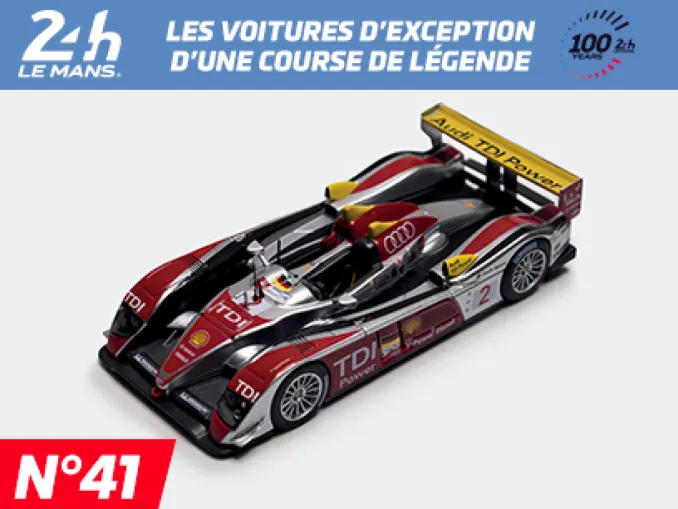
Audi R10 TDI – 2008
Audi R10 TDI
The ACO's decision to allow diesel engines from 2006 onwards was a wake-up call for Audi. The brand seized the opportunity to replace the award-winning R8 with a new diesel-powered LMP. The German brand continued their series of successes by winning the 24 Hours of Le Mans for three consecutive years and also the European and American Le Mans series in 2008.
When the ACO announced in 2003 that it intended to allow the use of diesel engines in LMP1 prototypes, Audi decided not to officially participate in the 24 Hours of Le Mans in order to help the Volkswagen Group, of which it was a part, secure victory for Bentley. The super-powerful R8s were taken over by private teams, which in the following two years continued the series of successes that had come to an end in 2003. In addition to diesel engines, in 2006 the ACO introduced new technical regulations that excluded the R8. For this reason, Audi decided to return to direct participation and developed the new R10 TDI, which was deployed in the La Sarthe marathon and in the American Le Mans Championship, an ideal scenario for promoting the modern diesel engines fitted to its street models.
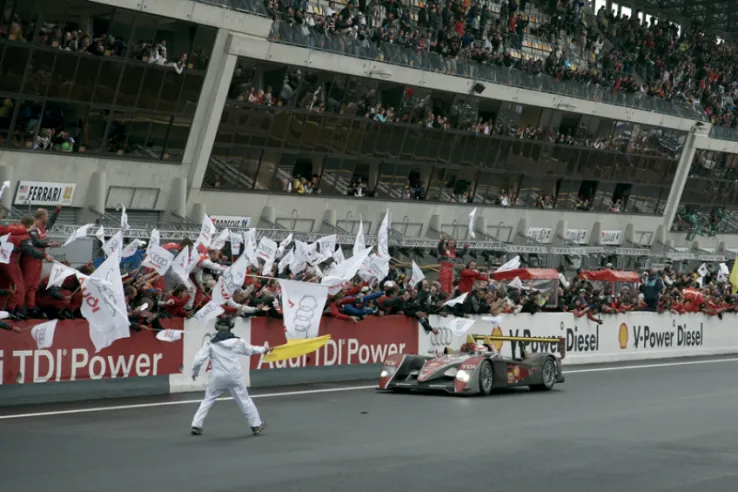
Since 2006, drivers Allan McNish, Tom Kristensen and Rinaldo Capello have been sharing the wheel of the R10, but they had to wait until 2008 to win the 24 Hours of Le Mans.© IXO Collections SAS - Tous droits réservés.
The R10 TDI (or R10 for short), developed in the utmost secrecy, was presented in December 2005 to everyone's surprise, catching Peugeot off guard, which had announced the arrival of its LMP1 Diesel at Le Mans for 2007. The German prototype first won the 12 Hours of Sebring, the first race of the American Le Mans series and ideal preparation for the 24 Hours of Le Mans, where the R10 triumphed, becoming the first diesel car to win in France. The new Audi replaced the R8 in the other races of the American Le Mans Series (ALMS), where it again achieved significant successes. The main threat to the German LMP1 in 2007 seemed to come from the Peugeot 908 HDi FAP, which, however, was no match for the RD10 TDI and ultimately finished ten laps behind the winner. Audi decided to also win the European Endurance Championship, also known as LMS or ELMS, in 2008, which it did as expected, as well as the American Le Mans Series (which it had already won in the previous two years).
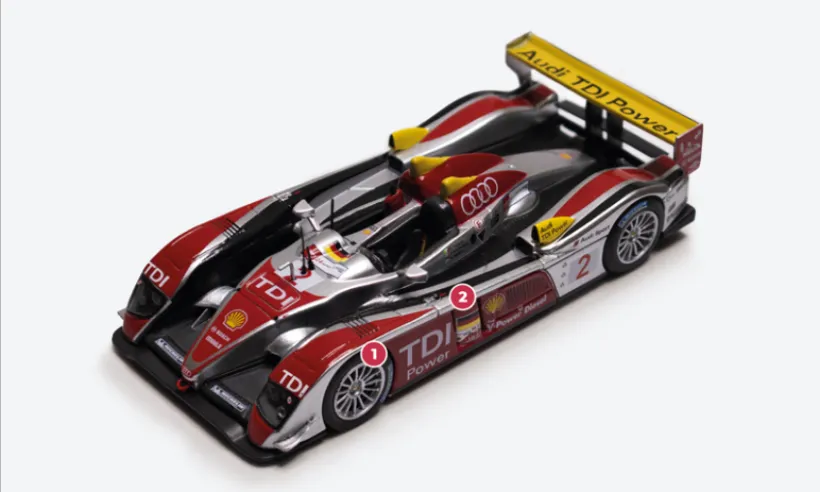
1. Compared to the R8, the R10 TDI offers a very different weight distribution and configuration. The wheelbase is 20 centimetres longer and the front wheels are wider.
2. The appearance of the R10 TDI remained virtually unchanged from 2006 to 2008, although in 2007 many internal components were redesigned and improved, starting with the particulate filter.© IXO Collections SAS - Tous droits réservés.
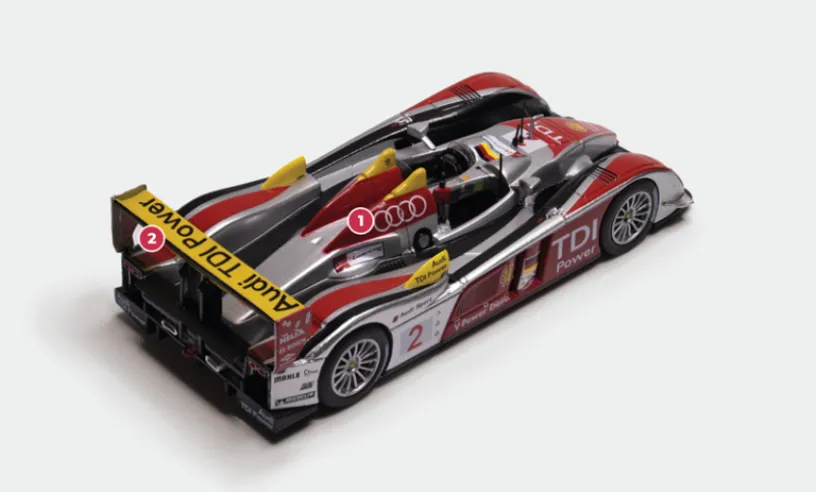
1. The V12 twin-turbo engine of the TDI, built entirely of aluminium like the previous V8 petrol engines, delivers nearly 650 hp.
2. Cars No. 2 and No. 1 were entered at Le Mans in 2008 by the Audi North America team, while No. 3 raced under the colours of Team Audi Joest. Despite this split, the cars were given identical liveries, with the exception of the spoiler and the tips of the two rear wings, which were yellow on car no. 2, red on car no. 1 and black on car no. 3.© IXO Collections SAS - Tous droits réservés.
During a triumphant year, the R10 made its mark at the 24 Hours of Le Mans, which proved more difficult than expected. Peugeot took the top three places on the starting grid with a flawless qualifying performance, while Audi took fourth, fifth and seventh place. The R10's problems were confirmed in the race, in which the French prototypes led for the first 12 hours. But the rain benefited the German cars. Peugeot reacted by adjusting the aerodynamic settings, though their cars lost ground until Allan McNish, Rinaldo Capello and Tom Kristensen took the lead in the R10 No. 2. Then towards the end, the 908 HDi FAP No. 7 of former leaders Nicolas Minassian, Marc Gené and Jacques Villeneuve became a threat again. But although it was faster, it failed to overtake the leading Audi again and eventually finished second, just behind the front-runner. Behind them, the two other Peugeots finished third and fifth, while the remaining Audis came fourth and sixth.
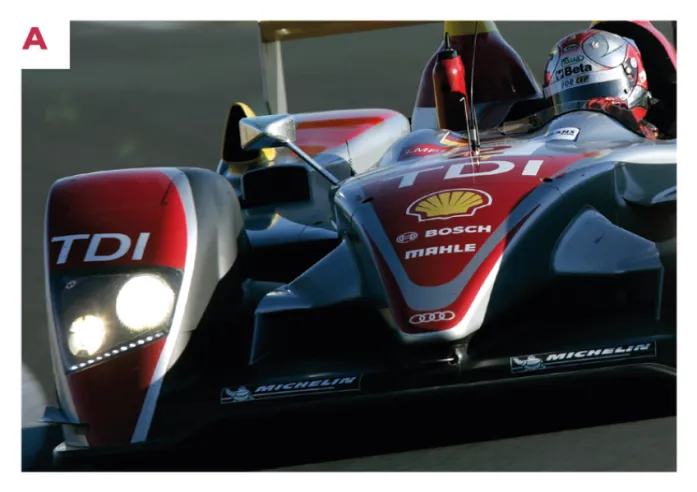
A. The upper arms of the front suspension, visible and protected by a carbon cover, are designed to improve aerodynamics, a solution adopted from the 2003 Bentley Speed 8.© IXO Collections SAS - Tous droits réservés.
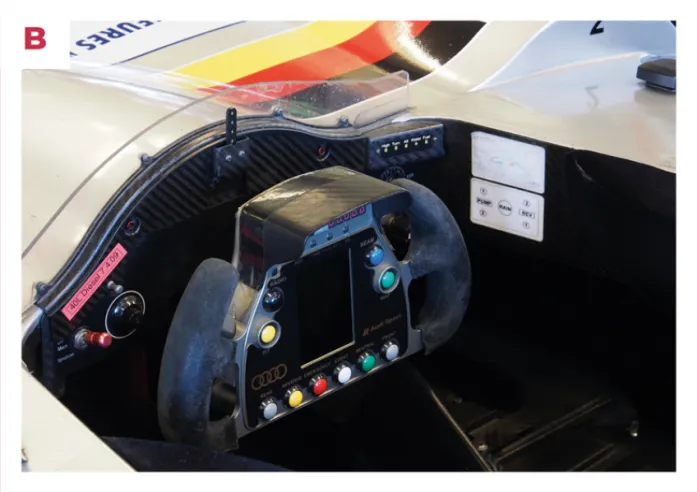
B. The driver's seat and steering wheel with digital instrumentation are similar to those in the R8. Thanks to the torque and flexibility of the engine, the X-Trac sequential gearbox only has 5 gears.© IXO Collections SAS - Tous droits réservés.
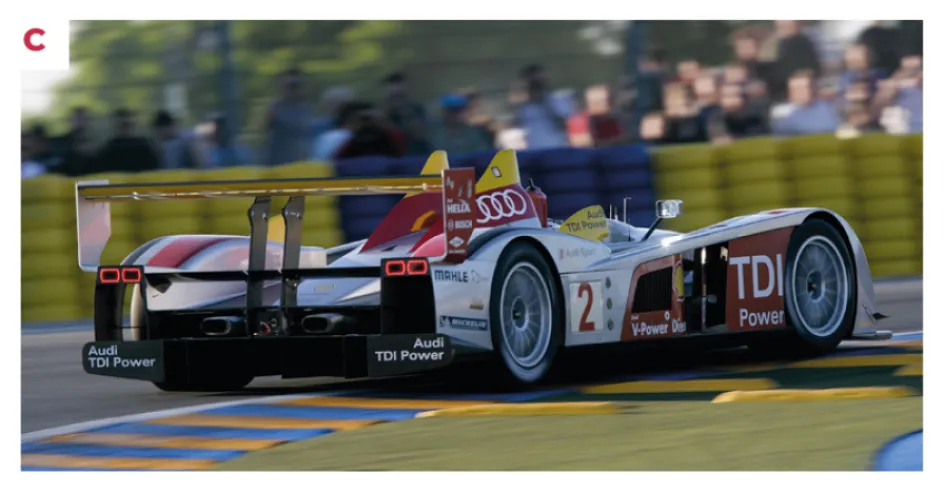
C. The chassis of the R10 TDI was developed and manufactured using Dallara's expertise. In 2007, the suspension geometry was slightly revised.© IXO Collections SAS - Tous droits réservés.
Recent articles